

 Log In


August 26, 2026
 Offline

Hello everyone. New to the forum. Looking for some help on identifying exactly what I have so I figured I would get the experts involved. I got the email version of the Cody letter that stated.
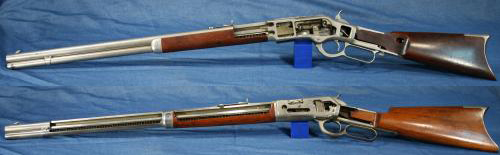
WINCHESTER MODEL 1876 – SERIAL NUMBER 39292
Serial number application date not available
Type: Rifle
Caliber: 40/60
Barrel Type: Round
Trigger: Plain
Received in warehouse on August 22, 1884
Shipped from warehouse on September 12, 1884, Order number 15328
The letter seems to indicate this left the factory as a standard 28″ barrel. The one I have has a 24″ barrel (measured with a wooden dowel inside the barrel). If this was cut down back in this time period they did an excellent job as there is no signs of it. Are there other measurements or other indicating factors. I have a ton of pictures. Thanks!
November 19, 2006
Offline

Sure – post the photos and you will receive some first class opinions and analysis. Please note that as a guest you can’t post a photo directly. However you can use an outside photo hosting site such imgur, photobucket, etc.
If the museum letter doesn’t state the 24 inch length, it’s very unlikely that it wasn’t shipped with the standard barrel length of 28 inches.
August 26, 2026
Offline
Thanks for the reply. Here are the pictures. Please let me know what you think.

April 30, 2023
Offline
Rockhands, that image hosting site is rife with pop-ups and questionable ads…can you try using imgur or google photos (share an “album”) or even email them to someone for posting?
August 26, 2026
Offline
My apologies. I am new to posting on forums. Here is a google album.
July 31, 2005
Offline
I added this serial number to the 1876 survey. It is smack dab in the middle of a bunch of round barrel .40-60 rifles. The .40-60 WCF was introduced in 1884 so Winchester was marketing it against the Marlin Model 1881 rifle in .40-60 Marlin (.40-65 WCF).
I call myself a collector as it sounds better than hoarder
November 19, 2006
Offline
I hope that someone with younger eyes than mine chimes in, but the front sight looks too close to the muzzle. That, combined with the museum letter, leads me to conclude the barrel has been shortened.
December 9, 2002
Offline
steve004 said
I hope that someone with younger eyes than mine chimes in, but the front sight looks too close to the muzzle. That, combined with the museum letter, leads me to conclude the barrel has been shortened.
Steve, I’m in agreement with you, as the front sight looks to have been shortened also to accommodate a shorter barrel! IMHO!
Tony
August 26, 2026
Offline
Thanks guys for the feedback. According to my research the sight location is supposed to be .75-.78 inches from the end of barrel to the center line of the sight. My measuring tape isn’t perfectly aligned but it is close. See pic.

March 31, 2009
Offline
Bill Hockett said
I added this serial number to the 1876 survey. It is smack dab in the middle of a bunch of round barrel .40-60 rifles. The .40-60 WCF was introduced in 1884 so Winchester was marketing it against the Marlin Model 1881 rifle in .40-60 Marlin (.40-65 WCF).
40-60 Marlin is probably what the Colt lightning used?

May 2, 2009
Offline
The front sight is normally .750″ to the front cut of the dovetail.
I don’t get any popup or ad’s from postimg but I use an AD blocker add on to my browser.
Bob
WACA Life Member---
NRA Life Member----
Cody Firearms member since 1991
Researching the Winchester 1873's
Email: [email protected]
April 30, 2023
Offline
1873man said
The front sight is normally .750″ to the front cut of the dovetail.
I don’t get any popup or ad’s from postimg but I use an AD blocker add on to my browser.
Bob
Use his second google photos link, it’s much better.

April 15, 2005
Offline
rockhands369 said
Thanks guys for the feedback. According to my research the sight location is supposed to be .75-.78 inches from the end of barrel to the center line of the sight. My measuring tape isn’t perfectly aligned but it is close. See pic.
https://photos.app.goo.gl/2uFK6NEZrUzpfsyW7
The correct measurement for all Winchester barrels with a milled dovetail cut in the barrel is .750″ from the muzzle face to the forward bottom edge of the milled cut. If you are measuring to the dead center of the dovetail, it will always be .9375″.
Bert
WACA Historian & Board of Director Member #6571L
November 19, 2006
Offline
Chuck said
Bill Hockett said
I added this serial number to the 1876 survey. It is smack dab in the middle of a bunch of round barrel .40-60 rifles. The .40-60 WCF was introduced in 1884 so Winchester was marketing it against the Marlin Model 1881 rifle in .40-60 Marlin (.40-65 WCF).
40-60 Marlin is probably what the Colt lightning used?
Yes. I have a .40-60-260 Colt Express rifle and it is the same round as the .40-60 Marlin and the .40-65 Winchester. And by the way, it is the same round as the .40-70 Bullard. The .40-60 WCF wasn’t used in many other rifles from different manufacturers. The Whitney-Kennedy is one example I can think of.
March 31, 2009
Offline
All the Colt Lightnings chamber a Winchester cartridge. But may be called something else. My 45-85 uses the (45-70) Win 45-85 no WCF. The Win 45-85 WCF is the same length as the Win 45-90.

May 23, 2009
Offline
Chuck said
Bill Hockett said
I added this serial number to the 1876 survey. It is smack dab in the middle of a bunch of round barrel .40-60 rifles. The .40-60 WCF was introduced in 1884 so Winchester was marketing it against the Marlin Model 1881 rifle in .40-60 Marlin (.40-65 WCF).
40-60 Marlin is probably what the Colt lightning used?
The .40-60 Colt & .40-60 Marlin are the same dimensionally as the .40-65 Winchester (Introduced by WRACo 1884). They are not the same as the .40-60 Winchester (Introduced by WRACo 1887).
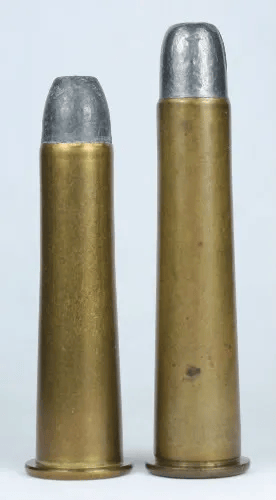 For the sake of comparison, here is a .40-60 WCF on the left next to a .40-60 Marlin.
Sincerely,
Maverick
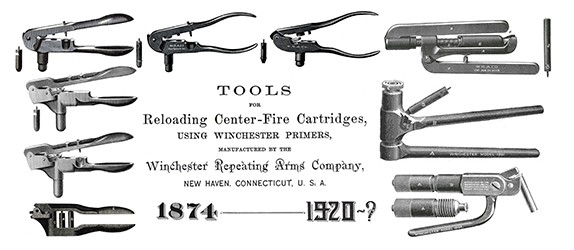
WACA #8783 - Checkout my Reloading Tool Survey!
https://winchestercollector.org/forum/winchester-research-surveys/winchester-reloading-tool-survey/
November 19, 2006
Offline
Chuck said
All the Colt Lightnings chamber a Winchester cartridge. But may be called something else. My 45-85 uses the (45-70) Win 45-85 no WCF. The Win 45-85 WCF is the same length as the Win 45-90.
This general topic has fascinated me since I bought Flayderman’s book as a teenager. It’s taking a long to understand it given the different cartridge designations (and sometimes the same designations.
Chuck’s comment that the Colt Lightnings chambering a Winchester cartridge reminds me of the Whitney-Kennedy (the large caliber versions) also chambered Winchester cartridges, but all from the Model 1876 chamberings. So of course, the .40-60 in the Whitney-Kennedy was the .40-60 WCF.
The .45 calibers get more interesting. One are of confusion, some .45-90 WCF cartridges came with an 85 grain powder load and were headstamped .45-85 WCF.
The Bullard rifle was chambered in both the .45-70 and the .45-85. These rifles used the same cartridge (dimensionally) but the difference between the two rifles was how the barrel was stamped and probably the rate of twist (given the .45 Govt. used a 405 grain bullet and the .45-85 used a 285 grain bullet).
The above reminds me of discussions we have had of the .50-100-450, .50-105, 50-110 chamberings in the Winchester ’86. These rifles would all fire the same cartridge but rate of twist differed, matched to different bullet weights. How these rifles were stamped as to the chambering has sometimes added to confusion.
On the topic of the .50 Model 1886, here’s a question I can’t resolve. If I recall correctly, there are 15 .50 caliber smoothbores listed in the factory ledger. Most are listed as .50 Express smoothbore. There is one .50-100-450 smoothbore listed. Now, that can’t have a different rate of twist or have been made up for a specific grain cartridge. H could it have been different in any way? What could have prompted them to make up this rifle?
On this topic, I would be fascinated to know the story behind every ’86 smoothbore that was ordered. Who ordered it and what they used it for? Sadly, I’ll wager not one story has survived.
November 19, 2006
Offline
My above post – talking about M1886’s and smoothbores – brought memories back from 40+ years ago – of a rifle I’d love to have back. The rifle was both improbable and a mystery. What didn’t help was that it was a later production M1886 and was beyond the letterable range. It an extralightweight, takedown, half magazine, pistol grip semi-deluxe, SGB with the Lyman no. 21 and surely that was special order and original as there was no rear sight seat. It was in .45-70 and was a smoothbore. It was in very very high condition. The downside of course was no letter to verify it and it was not marked smoothbore in any way. A .451 jacketed .45 acp bullet would not fit into the muzzle – so it definitely had not been bored out to a smoothbore. The only possibility would be a liner had been installed.
But who would have ordered a .45-70 smoothbore with the Long Lyman receiver sight and no provision for a rear sight? I can’t recall the front sight very well but I believe it was standard. And even if the rifle hadn’t been ordered this way, who would have taken a high condition M1886 and have it relined to a smoothbore? It was quite the oddity but the lack of a museum letter impacted the value dramatically. I traded it off, but like many, I wish I had it back. And of course, they mystery was never solved.
November 19, 2006
Offline
Chuck said
All the Colt Lightnings chamber a Winchester cartridge. But may be called something else. My 45-85 uses the (45-70) Win 45-85 no WCF. The Win 45-85 WCF is the same length as the Win 45-90.
Just to add to the mix, I recall there were five M1886’s made in .45-85.
March 31, 2009
Offline
steve004 said
Chuck said
All the Colt Lightnings chamber a Winchester cartridge. But may be called something else. My 45-85 uses the (45-70) Win 45-85 no WCF. The Win 45-85 WCF is the same length as the Win 45-90.
Just to add to the mix, I recall there were five M1886’s made in .45-85.
But I bet they were actually 45-85 WCF which are the same length as the 45-90 WCF. WRACO brass that just says 45-85 (missing the WCF) are the same length as a 45-70. That is the length Colt, Marlin and Ballard used. These cartridges are listed in the Winchester catalogs as 2.1″.


1 Guest(s)
