

 Log In


August 1, 2026
 Offline

Hello, this is my first post, and I’m hopeful it’ll be a good one. I’ve been doing a fair amount of reading here, and it truly is a trove of knowledgeable folks!
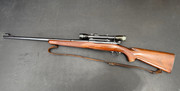
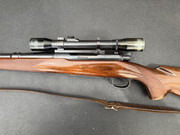
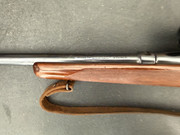
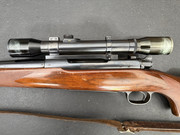
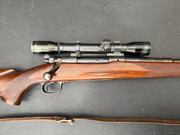
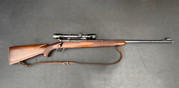
Recently, my father passed away and I inherited all of his guns, including those of my grandfather’s. Part of that group is a gorgeous Model 70 in 270 WCF, serial #2047 (there’s also a 243 Featherweight that I got my first deer with and a beautiful Model 52 which shoots like a dream, but those are for another post). From my rudimentary research on the interwebs, I’ve determined it’s a first-year 1936 model in a very popular caliber. I took it to the range at my gun club the other day and it took me right back to when I was 12 going out with my grandfather on the first day of deer season. Anyways, I was hoping some folks on here could help with some questions. Would the scope have been original? Does it look like he modified it in any way? I know my grandfather (32 at the time) would have bought it new at Dunham’s Department Store, but I don’t know how it would have looked then.
Any help would be greatly appreciated. Hopefully, these pictures are helpful.
August 25, 2009
Offline
Aaron
Ill comment on a couple of things i see until our experts roll along
First and foremost (In my opinion), Do NOT do a thing to this rifle except wipe it down gently and shoot it at every opportunity including take it out and hunt it. You only get a couple of chances to own something that was your grandfathers. He obviously shot the rifle a fair amount. Truly a wonderful heirloom.
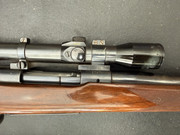
That being said the rear bridge has been drilled and tapped for the scope install. Many of them were and some of us feel that it was a shortcoming of Winchester to not do it on all of the early model 70s.
Maybe the finish has been touched up a bit. this would be normal for a rifle that was hunted here in the Northwest.
All in all a very nice piece. Please enjoy and respect it for what it is.
Doug
August 1, 2026
Offline
DEEREHART said
Aaron
Ill comment on a couple of things i see until our experts roll along
First and foremost (In my opinion), Do NOT do a thing to this rifle except wipe it down gently and shoot it at every opportunity including take it out and hunt it. You only get a couple of chances to own something that was your grandfathers. He obviously shot the rifle a fair amount. Truly a wonderful heirloom.
That being said the rear bridge has been drilled and tapped for the scope install. Many of them were and some of us feel that it was a shortcoming of Winchester to not do it on all of the early model 70s.
Maybe the finish has been touched up a bit. this would be normal for a rifle that was hunted here in the Northwest.
All in all a very nice piece. Please enjoy and respect it for what it is.
Doug
Thank you, Doug. That’s certainly my plan, keep it clean and shoot it when I can. Appreciate the insight.

January 20, 2023
Offline
Second Doug’s sage advice. A grand inheritance with priceless provenance. It will make every hunt a success whether you see game or not.
- Bill
WACA # 65205; life member, NRA; member, TGCA; member, TSRA; amateur preservationist
"I have seen wicked men and fools, a great many of both, and I believe they both get paid in the end, but the fools first." -- David Balfour, narrator and protagonist of the novel, Kidnapped, by Robert Louis Stevenson.

November 5, 2014
Offline

Hi Aaron-
Congrats on a very nice Model 70. That’s one to be proud of and hang onto for Generations.
To answer your question. Model 70s did not have factory drilled holes on the bridge until 1946. So the (probably just one) hole in the bridge for the rear of the Redfield JR mount was added. The other holes, two atop the front receiver ring and two on the left side rear for a receiver sight, were factory. Your rifle was originally a G7003C (Standard rifle, 270 WCF, Winchester 22G Sporting type rear sight). So the only other “alteration” is that the rear sight was removed from the barrel to allow clearance for the scope’s objective bell. As best I can tell, everything else, including wood and metal finishes, is original and correct.
The scope is a 4X Unertl Hawk and it’s in period Redfield rings. Those scopes date to about the late (post-WWII) 1940s or 50s. Your Grandfather certainly knew quality, as that scope was about the best available at the time.
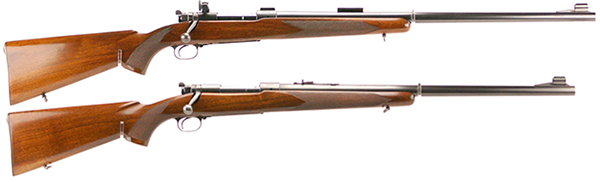
For comparison, the one pictured below is also a 1936 vintage Model 70 Standard rifle (s/n 1099). It’s a 30 GOV’T’06 but otherwise looks like yours. It has the type of rear sight that was removed from yours.
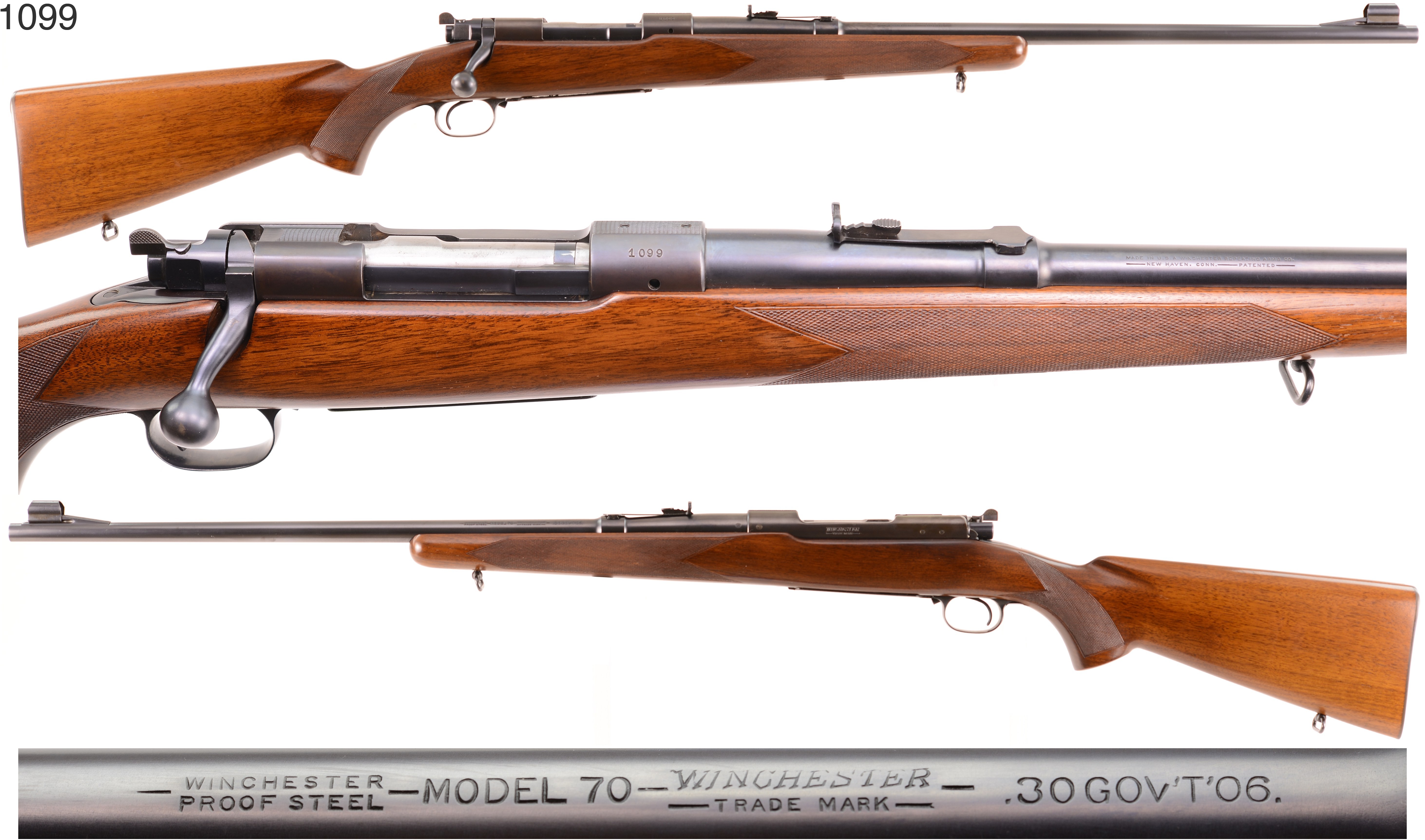
Hope this helps,
Lou
WACA 9519; Studying Pre-64 Model 70 Winchesters

August 8, 2024
Offline
Very nice rifle! As mentioned the rear receiver top has been drilled for the scope mount, and the 22G rear sight was removed to clear the scope. Chambered in a great caliber! I would be very proud to hunt with that rifle! I am the odd ball that used the 150 grain .270 bullet on all my hunting trips ( Jack O’Connor just rolled in his grave!).
August 1, 2026
Offline
Louis Luttrell said
Hi Aaron-
Congrats on a very nice Model 70. That’s one to be proud of and hang onto for Generations.
To answer your question. Model 70s did not have factory drilled holes on the bridge until 1946. So the (probably just one) hole in the bridge for the rear of the Redfield JR mount was added. The other holes, two atop the front receiver ring and two on the left side rear for a receiver sight, were factory. Your rifle was originally a G7003C (Standard rifle, 270 WCF, Winchester 22G Sporting type rear sight). So the only other “alteration” is that the rear sight was removed from the barrel to allow clearance for the scope’s objective bell. As best I can tell, everything else, including wood and metal finishes, is original and correct.
The scope is a 4X Unertl Hawk and it’s in period Redfield rings. Those scopes date to about the late (post-WWII) 1940s or 50s. Your Grandfather certainly knew quality, as that scope was about the best available at the time.
For comparison, the one pictured below is also a 1936 vintage Model 70 Standard rifle (s/n 1099). It’s a 30 GOV’T’06 but otherwise looks like yours. It has the type of rear sight that was removed from yours.Hope this helps,
Lou
Thank you, Lou! That’s extremely helpful and I really appreciate the kind words about my grandfather.
August 1, 2026
Offline
Louis Luttrell said
Hi Aaron-
Congrats on a very nice Model 70. That’s one to be proud of and hang onto for Generations.
To answer your question. Model 70s did not have factory drilled holes on the bridge until 1946. So the (probably just one) hole in the bridge for the rear of the Redfield JR mount was added. The other holes, two atop the front receiver ring and two on the left side rear for a receiver sight, were factory. Your rifle was originally a G7003C (Standard rifle, 270 WCF, Winchester 22G Sporting type rear sight). So the only other “alteration” is that the rear sight was removed from the barrel to allow clearance for the scope’s objective bell. As best I can tell, everything else, including wood and metal finishes, is original and correct.
The scope is a 4X Unertl Hawk and it’s in period Redfield rings. Those scopes date to about the late (post-WWII) 1940s or 50s. Your Grandfather certainly knew quality, as that scope was about the best available at the time.
For comparison, the one pictured below is also a 1936 vintage Model 70 Standard rifle (s/n 1099). It’s a 30 GOV’T’06 but otherwise looks like yours. It has the type of rear sight that was removed from yours.Hope this helps,
Lou
Hi, I have a follow-up question, if that’s allowed. If not, I can start a new thread.
I’m planning on getting back into deer hunting with a friend of mine whose future son-in-law is an avid hunter. Being in Western Oregon, the obvious place to start would be hunting blacktails on public lands between here and the coast. I’m thinking about either buying a new hunting rifle or using the Model 70. If I use it, I would probably buy a new scope (Leupold 3.5-10x likely).
My question: what bases/rings do I need to get for this? I figured out how to remove the old scope and rings by rotating the front ring. I also confirmed that there is a single screw drilled into the rear for mounting the Redfield base. Thanks in advance.
November 5, 2014
Offline
Hi Aaron-
My first recommendation is to use the existing Redfield JR (one-piece) scope base. The pre-war M70 action has a stripper clip slot on the bridge and the top has the depressed wavy line roll marking. Bases made for those receivers have the right hole spacing and the underside of the rear portion of the base is sculpted to fill the gap. If you were going to replace the base you’d need to find one that’s specifically made for the Model 70 receiver “below 60,500”. You already have one and you know it fits the existing hole, so why buy another?
Pretty much anybody’s “traditional” style split rings will work on that base. Redfield, Leupold, Burris, etc. You just need the ones with the rotary dovetail front ring and the rear ring that locks into the two windage adjustment screws on the base. You can even get 30mm rings in the right style if you’re going with a larger tube diameter scope. If you’re going with a 40mm or larger objective, you’ll need at least medium height rings. If you’re using a 1-inch tube Leupold 3.5 x 10 scope then getting the rings is easy. They don’t need to be “vintage”.
Two things to be aware of… First is that the “NRA style” (low comb) stock on the Model 70 was not designed for scope use. They were made for iron sights and there’s too much drop in the comb for many shooters’ comfort unless the scope can be mounted low to the receiver. A 40mm (or larger) diameter objective might be uncomfortable or difficult to shoot accurately. Quick fix is to get a lace-on leather cheek rest that will move your face up higher.
The second issue is that the pre-war “flag type” safety might be difficult to operate underneath the ocular bell of the scope, especially if it’s cold outside and you’re wearing gloves. Back in the day there was an aftermarket Tilden safety that used the pre-war bolt sleeve but operated over on the right side like a later M70 safety. So there is a “fix” that doesn’t involve permanently altering the gun if your scope of choice gets in the way of the safety. Tilden safeties are usually easy to find on eBay, but unless you’re comfortable working on guns you might want to get a gunsmith to swap safeties for you. Too many little plungers and springs to go flying if you’re not expecting it, and it’s not uncommon for a little bit of stoning (in just the right place) of the notch on the firing pin/striker that the vertical shaft of the safety rotates into is needed to get it to work.
Good Luck-
Lou
WACA 9519; Studying Pre-64 Model 70 Winchesters
August 1, 2026
Offline
Super helpful! Thanks again, Lou!
August 1, 2026
Offline
Good heads-up on the safety, too. I just compared the safety on this Model 70 with my 1955 243 Featherweight, and it’s obvious how that “flag” safety on the pre-war could be a potential issue with a scope. There’s enough clearance from the Unertl on it now, but it is more difficult to operate than the later model.
August 25, 2009
Offline
Hey Aaron
What is the condition of the existing scope?
Is it clear or hazy? I agree a new Leupold would likely be more clear but if it is still working why mess with it.
Westside Blacktails are rarely killed at long range. At least in my experience.
Just my thought…
Doug
August 1, 2026
Offline
It’s actually pretty clear, Doug. Only real signs of wear are where these leather lens caps sat on the scope for decades. I just thought I might need more magnification someday. Maybe not for blacktails, but in the future.

April 15, 2005
Offline
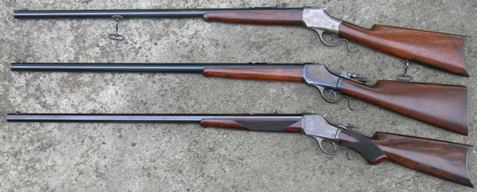
90% of all Blacktail deer are shot at <75 yds. I hunted them with my dad from Nehalem to Astoria during the late 1960s through the late 1970s and can remember only one time shooting one @ > 100-yds. My rifle was a Model 54 30-06 with a Lyman Alaskan 2.5X post-reticle scope.
Bert
WACA Historian & Board of Director Member #6571L
January 20, 2023
Offline
Bert H. said
90% of all Blacktail deer are shot at <75 yds. My rifle was a Model 54 30-06 with a Lyman Alaskan 2.5X post-reticle scope.
Bert
One November some years ago, my wife and I drove out the Sunset Highway from Portland to the coast and stayed for a week at the old Wheeler Inn. Using Wheeler as a base, we explored up and down the coast highway as far North as Astoria. On the drive to Wheeler we learned the season had opened for Shiras moose as well as the little Blacktail deer. Maybe Roosevelt Elk as well. Cars and trucks parked all along the roads.
Being a collector of the works of the late Francis Sell of Riverton, Oregon, I knew from his photographs the coastal forests were dense. But I was not prepared for such a Prehistoric wilderness of close-growing, gigantic trees. The double canopy rainforest kept out what little Sunlight filtered through the overcast, making it dark at midday. Standing on the edge of the roads, i couldn’t see fifty feet into the treeline, much less yards.
I’m certain there are clearings that offer longer opportunities but, if anything, I think 4X is too much for hunting a lot of that terrain. If I were going to hunt those hills, a 2.5 to 3 fixed power optic would the most I would consider, based on my experience in much less dense-wooded Southeast Texas. However, if I could recommend any scope for your rifle, it would be a favorite, very bright Leupold of mine: The current version of the line once called the VariX III – with the brightest and hardest coatings on all of its component lenses — specifically the 1.75X – 6X variable, which has a 1″ tube and a 32mm objective lens.
That scope can be mounted as low as your current safety will allow, although as Lou says, I would myself have my gunsmith locate and install a Tilden safety [keeping the original part safe] so I could mount the scope in low rings rather than medium. My 1950 Super Grade needs low rings and scope bells that do not resemble syrup buckets. I think yours does too.
You’ve got all the rifle you need but it may be a bit overscoped, not underscoped, for the hunting you have in mind.
Thanks very much for sharing your wonderful inheritance with us.
PS. I’ve attached a photo of the 1.75 – 6, even though is currently doing duty on a #1 Hornet. 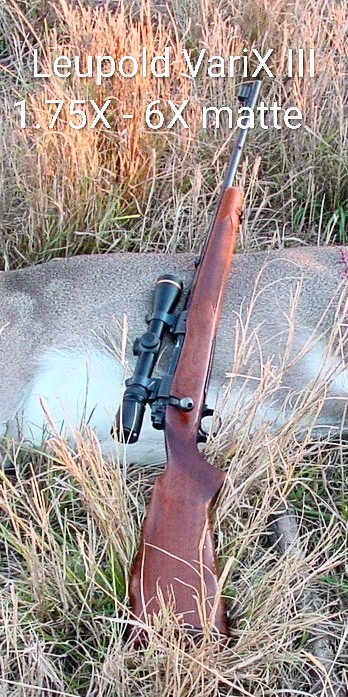
- Bill
WACA # 65205; life member, NRA; member, TGCA; member, TSRA; amateur preservationist
"I have seen wicked men and fools, a great many of both, and I believe they both get paid in the end, but the fools first." -- David Balfour, narrator and protagonist of the novel, Kidnapped, by Robert Louis Stevenson.
April 15, 2005
Offline
Zebulon said
Bert H. said
90% of all Blacktail deer are shot at <75 yds. My rifle was a Model 54 30-06 with a Lyman Alaskan 2.5X post-reticle scope.
Bert
One November some years ago, my wife and I drove out the Sunset Highway from Portland to the coast and stayed for a week at the old Wheeler Inn. Using Wheeler as a base, we explored up and down the coast highway as far North as Astoria. On the drive to Wheeler we learned the season had opened for Shiras moose as well as the little Blacktail deer. Maybe Roosevelt Elk as well. Cars and trucks parked all along the roads.
Being a collector of the works of the late Francis Sell of Riverton, Oregon, I knew from his photographs the coastal forests were dense. But I was not prepared for such a Prehistoric wilderness of close-growing, gigantic trees. The double canopy rainforest kept out what little Sunlight filtered through the overcast, making it dark at midday. Standing on the edge of the roads, i couldn’t see fifty feet into the treeline, much less yards.
I’m certain there are clearings that offer longer opportunities but, if anything, I think 4X is too much for hunting a lot of that terrain. If I were going to hunt those hills, a 2.5 to 3 fixed power optic would the most I would consider, based on my experience in much less dense-wooded Southeast Texas. However, if I could recommend any scope for your rifle, it would be a favorite, very bright Leupold of mine: The current version of the line once called the VariX III – with the brightest and hardest coatings on all of its component lenses — specifically the 1.75X – 6X variable, which has a 1″ tube and a 32mm objective lens.
That scope can be mounted as low as your current safety will allow, although as Lou says, I would myself have my gunsmith locate and install a Tilden safety [keeping the original part safe] so I could mount the scope in low rings rather than medium. My 1950 Super Grade needs low rings and scope bells that do not resemble syrup buckets. I think yours does too.
You’ve got all the rifle you need but it may be a bit overscoped, not underscoped, for the hunting you have in mind.
Thanks very much for sharing your wonderful inheritance with us.
PS. I’ve attached a photo of the 1.75 – 6, even though is currently doing duty on a #1 Hornet.
I have a very nice Leupold M8-4X mounted on my other 30-06 (a 1966 Remington Model 742 Woodsmaster 150th Anniversary).
Bert
WACA Historian & Board of Director Member #6571L
August 1, 2026
Offline
Thank you, Zebulon! I really appreciate the advice, and especially you sharing your story.
January 20, 2023
Offline
Bert H. said
Zebulon said
Bert H. said
90% of all Blacktail deer are shot at <75 yds. My rifle was a Model 54 30-06 with a Lyman Alaskan 2.5X post-reticle scope.
Bert
One November some years ago, my wife and I drove out the Sunset Highway from Portland to the coast and stayed for a week at the old Wheeler Inn. Using Wheeler as a base, we explored up and down the coast highway as far North as Astoria. On the drive to Wheeler we learned the season had opened for Shiras moose as well as the little Blacktail deer. Maybe Roosevelt Elk as well. Cars and trucks parked all along the roads.
Being a collector of the works of the late Francis Sell of Riverton, Oregon, I knew from his photographs the coastal forests were dense. But I was not prepared for such a Prehistoric wilderness of close-growing, gigantic trees. The double canopy rainforest kept out what little Sunlight filtered through the overcast, making it dark at midday. Standing on the edge of the roads, i couldn’t see fifty feet into the treeline, much less yards.
I’m certain there are clearings that offer longer opportunities but, if anything, I think 4X is too much for hunting a lot of that terrain. If I were going to hunt those hills, a 2.5 to 3 fixed power optic would the most I would consider, based on my experience in much less dense-wooded Southeast Texas. However, if I could recommend any scope for your rifle, it would be a favorite, very bright Leupold of mine: The current version of the line once called the VariX III – with the brightest and hardest coatings on all of its component lenses — specifically the 1.75X – 6X variable, which has a 1″ tube and a 32mm objective lens.
That scope can be mounted as low as your current safety will allow, although as Lou says, I would myself have my gunsmith locate and install a Tilden safety [keeping the original part safe] so I could mount the scope in low rings rather than medium. My 1950 Super Grade needs low rings and scope bells that do not resemble syrup buckets. I think yours does too.
You’ve got all the rifle you need but it may be a bit overscoped, not underscoped, for the hunting you have in mind.
Thanks very much for sharing your wonderful inheritance with us.
PS. I’ve attached a photo of the 1.75 – 6, even though is currently doing duty on a #1 Hornet.
I have a very nice Leupold M8-4X mounted on my other 30-06 (a 1966 Remington Model 742 Woodsmaster 150th Anniversary).
Bert
I think the M8 4X is very hard to beat and has an advantage over many of the newer scopes. I have one on a 1951 Savage 99R .300 and that long tube and long eye relief is mighty helpful for mounting on a rifle with the mount bases far apart. And Leupold scopes generally and the fixed power ones in particular, don’t leak. As much as I like to see vintage optics on an old rifle, when it’s 15F and icy, the old Weavers turn opaque. At least my K4 did.
In the mid-Fifties, our half-Comanche neighbor had just come back from a successful Central Texas deer hunt and was showing several neighborhood men his new Remington 740 Woodsmaster, the basic ADL grade 30/06. This was a man born to a family so large and poor that when the Depression hit West Texas, there was not enough food. He was only 16 when his father gave him a pony and the only guns they owned, a Winchester 32/20 and a Colt SAA 38/40, and with tears in his eyes sent his son off to seek his fortune.
The Comanche are many things but not stupid. After serving in the Pacific during WWII with an M1 Garand, our half breed neighbor developed a powerful affection for the 30/06 and gas operated rifles. If he wasn’t the first in town to buy the new Remington, he was close behind.
- Bill
WACA # 65205; life member, NRA; member, TGCA; member, TSRA; amateur preservationist
"I have seen wicked men and fools, a great many of both, and I believe they both get paid in the end, but the fools first." -- David Balfour, narrator and protagonist of the novel, Kidnapped, by Robert Louis Stevenson.

August 27, 2014
Offline
I’ve chased PA and NY bucks for the last 45 years with a 270 topped with a 4x Leupold. Never needed or wanted anything else
“If you can’t convince them, confuse them”
President Harry S. Truman
January 20, 2023
Offline
Tedk said
I’ve chased PA and NY bucks for the last 45 years with a 270 topped with a 4x Leupold. Never needed or wanted anything else
I think most of us could do that, although I found a low power optic to be useful when I was able to still hunt on forested land. On the few occasions I was able to jump a deer out of its bed, at close range, the lower the better.
When stand hunting overlooking a wide mesquite flat at last shooting light, when a buck stepped out of the treeline, the ones I observed were disinclined to wait for you to put binoculars away after counting points. On some Texas leases, you are required to count points and inside spreads because the lease terms forbade shooting a buck outside certain limits. A variable scope of 6 to 8 power or so can be very useful.to avoid a mistake. And a surprising number of young male Whietails are hard to distinguish from does at last shooting light during doe season.
I think there’s room for variables, for me the low to mid range.
Few of us rely on one rifle for game and varmints..But I know a dedicated coyote hunter who likes a .270 topped with a really big variable, using the high end most of time but occasionally cranking it way down when a coyote surprises him at close range, sees his mistake, and puts the hammer down.
- Bill
WACA # 65205; life member, NRA; member, TGCA; member, TSRA; amateur preservationist
"I have seen wicked men and fools, a great many of both, and I believe they both get paid in the end, but the fools first." -- David Balfour, narrator and protagonist of the novel, Kidnapped, by Robert Louis Stevenson.


1 Guest(s)
