

 Log In


July 7, 2026
 Offline

MidwestCrisis said
Georg. In your neck of the woods 25-35 wcf is known as 6.5X52R. I’ve read it’s still popular in Europe, RIA calls it desirable in their auction descriptions.
Ahaaaa.. Thanks for the info. Yes, I have heard of that caliber. it was, just like the 5.6x52R (22 Savage HP) quite popular in combis and drillings.
However, it is harder to find 6.5X52R ammo than 5.6X52R
November 19, 2006
Offline
Henry Mero said
Again Mike , some of them were just plain “junk” and some were very well manufactured . You couldn’t sell Me on a Canadian Centennial as a shooter, but a Crazy Horse or any of the 9422,s are great guns.
Interesting. I really had no idea that some of the commemorative rifles shot better than others. I’ve never owned a commemorative of any model.

January 20, 2023
Offline
I think most would agree the overall quality of the Winchester Model 94, run-of-the-mine or commemorative, reached its nadir in 1964 and then, from about 1968 steadily improved until, by the mid-Seventies, it was quite respectable and a serious competitor of the Marlin 336. Any manufactured after 1980 until the end of New Haven production were very nice indeed.
I am talking about the quality of materials, mechanical functionality, accuracy, fit and cosmetic finish. Traditionalists will never accept the “angle eject” feature, a rebounding hammer, and other “anomalies” but the guns are commonly acknowledged to be well made and superior to those of the worst of the post-64 years.
- Bill
WACA # 65205; life member, NRA; member, TGCA; member, TSRA; amateur preservationist
"I have seen wicked men and fools, a great many of both, and I believe they both get paid in the end, but the fools first." -- David Balfour, narrator and protagonist of the novel, Kidnapped, by Robert Louis Stevenson.
January 8, 2025
Offline
It might seem that I was discounting my post 64 94. I didn’t mean to. It’s a very nice rifle made in the mid 70s. It’s also from Illinois so I’m pretty sure it didn’t have a box of shells through it when I bought it 50 years later. I see these rifles gaining a little price these days Used to be a 5-600$. Now I’m seeing more. If I had a friend that wanted a lever gun, I would recommend a used post 64 94 over the new Henry or Rossi
January 20, 2023
Offline
Concur. Actually, the “1964” gun was so bad cosmetically that it put resale prices of ALL used Model 94s in the toilet for a while. In 2000 I bought a like new “longwood” 1951 Model 94 for $299 off a local consignment rack. I didn”t need it but couldn’t pass it up. The only reason I later sold it was the factory did not tap the left receiver wall for an aperture sight. As far as I could see, it had never been fired beyond factory proof!
1975 – 1980 were good years for the Model 94.
- Bill
WACA # 65205; life member, NRA; member, TGCA; member, TSRA; amateur preservationist
"I have seen wicked men and fools, a great many of both, and I believe they both get paid in the end, but the fools first." -- David Balfour, narrator and protagonist of the novel, Kidnapped, by Robert Louis Stevenson.
November 19, 2006
Offline
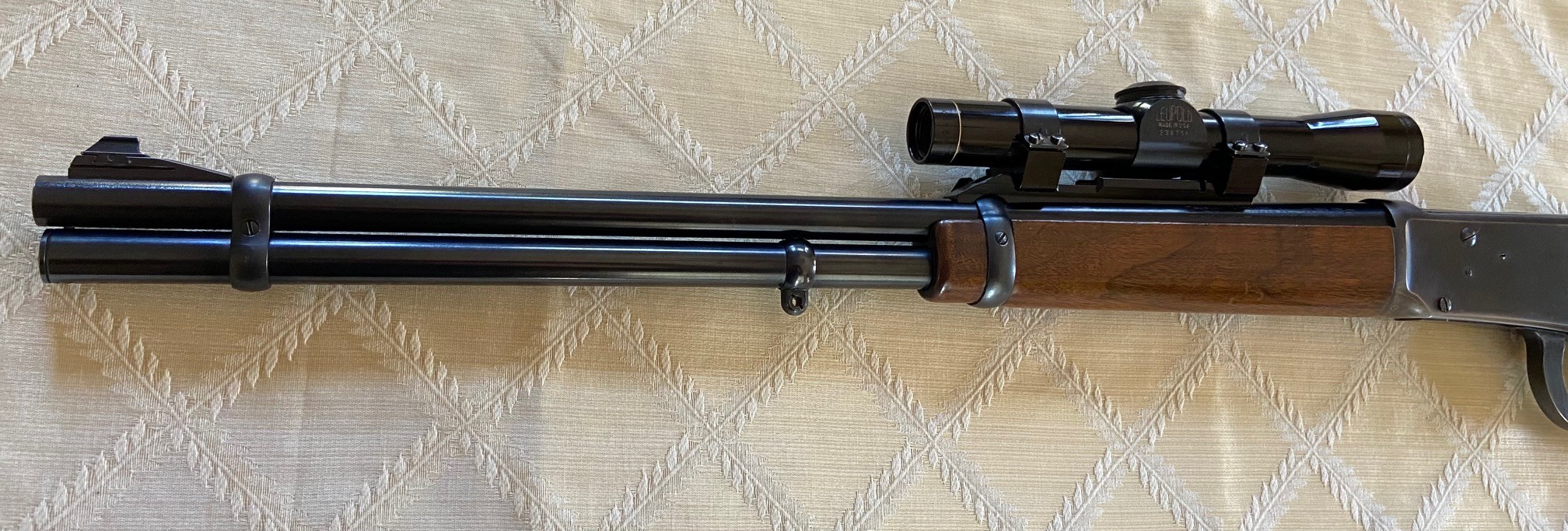
I know I’m cutting against the grain here (as well as doing a poor job with posting photos) but here is a .32 Special carbine I purcha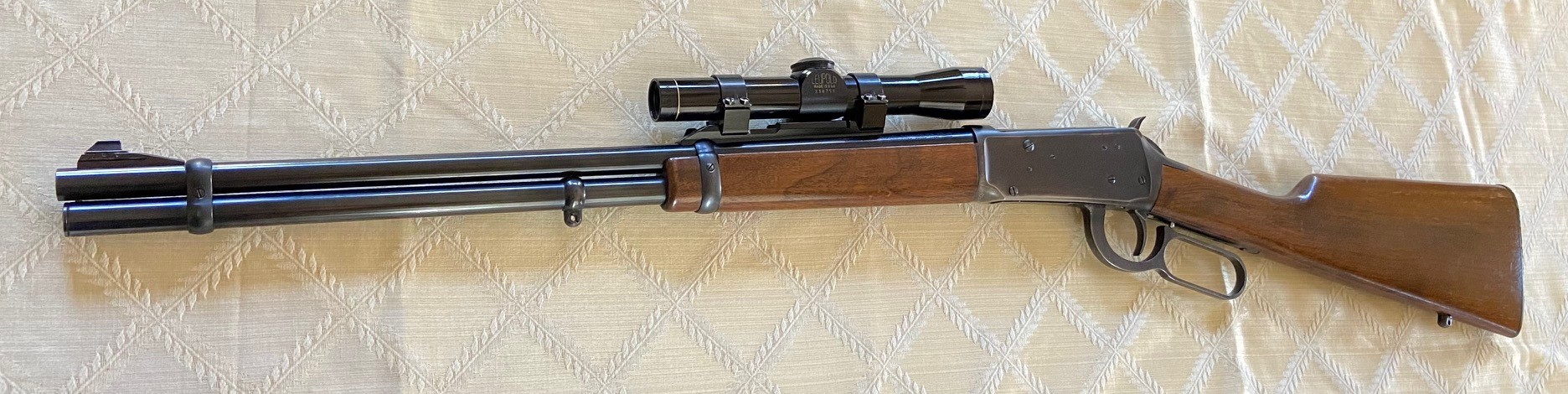 sed about 45 years ago. It was made in 1964. I’ve liked it ever since I bought it. I’ve killed many deer with it. It functions perfectively and there’s no aspect about the finishing or fitting that I can complain about.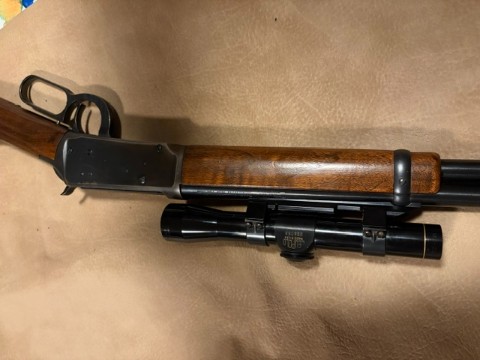
January 20, 2023
Offline
I like the IER setup. Are you sure it was made in 64? The finish on the receiver doesn’t look like black chrome.
- Bill
WACA # 65205; life member, NRA; member, TGCA; member, TSRA; amateur preservationist
"I have seen wicked men and fools, a great many of both, and I believe they both get paid in the end, but the fools first." -- David Balfour, narrator and protagonist of the novel, Kidnapped, by Robert Louis Stevenson.
November 19, 2006
Offline
Zebulon said
I like the IER setup. Are you sure it was made in 64? The finish on the receiver doesn’t look like black chrome.
Bill –
The scope is a Leupold long eye relief scope. It is very fast with sight acquisition. One of the things I like about it is the shooter can simultaneously see through the scope while seeing around the scope. This of course helps with sight acquisition and maintaining it (e.g. a running animal).
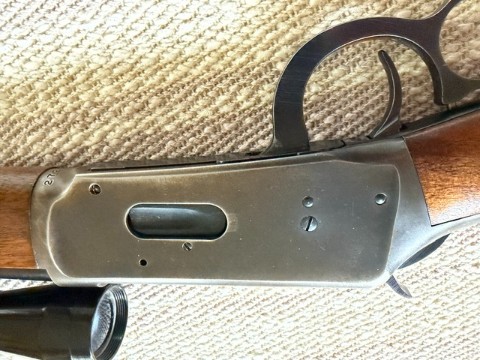
I’m going to cut against the grain again and note that I have had post-64 ’94 carbines made in the 1970’s (e.g. .44 magnum carbines) – and the receiver finish was miserable compared to this one. My carbine is in the low 2,700,000 range.
Bert provides some nice details in this thread:
https://winchestercollector.org/forum/winchester-rifles/late-1963-vs-1964-quality-of-winchester-94s/
January 20, 2023
Offline
I would never question your judgement; you’ve got the gun in your hands.
I do wonder whether there were Model 94 carbines serialized n the low 2.7m range that were assembled with machined rather than sintered metal receivers. Your receiver doesn’t appear to have been black chromed – I don’t think it’s late enough — but neither does it exhibit the flaking and mottling of Dulite on sintered steel.
My understanding of the sintered metal process is it is fully capable of making very precise parts but (1) the initial equipment. investment is huge; (2) the cost of creating a die is great, to the point you need to be making.enormous quantities of a part to justify the cost of the die; (3) the assembly technique of fitting sintered parts is different. You have a bin of the same part before you. You take one and try it. If it is oversized or undersized, you don’t fettle it but put it back and try another until one fits. This can be done much faster and by less experienced people than by a skilled fitter with stones and abrasive papers. With excellent results, with practice.
But there is a learning curve. It strikes me that quality of production in 1964 was more likely variable rather than consistently bad.
I have a late production Colt Trooper Mark III that is absolutely a credit to its maker. The lockwork is sintered and was assembled as above. I have also a 1955 Colt Three Fifty Seven, the Mark III’s antecedent made the traditional way. The trigger stroke is different between the two – the later gun has coil springs and doesn’t stack — but both are of very high quality. I have owned earlier Mark III revolvers that were crude by comparison.
So, like Schrodinger’s cat, perhaps the early post 63 Model 94 can exhibit more than one state, inside its box.
- Bill
WACA # 65205; life member, NRA; member, TGCA; member, TSRA; amateur preservationist
"I have seen wicked men and fools, a great many of both, and I believe they both get paid in the end, but the fools first." -- David Balfour, narrator and protagonist of the novel, Kidnapped, by Robert Louis Stevenson.
November 19, 2006
Offline
Zebulon said
I would never question your judgement; you’ve got the gun in your hands.
I do wonder whether there were Model 94 carbines serialized n the low 2.7m range that were assembled with machined rather than sintered metal receivers. Your receiver doesn’t appear to have been black chromed – I don’t think it’s late enough — but neither does it exhibit the flaking and mottling of Dulite on sintered steel.
My understanding of the sintered metal process is it is fully capable of making very precise parts but (1) the initial equipment. investment is huge; (2) the cost of creating a die is great, to the point you need to be making.enormous quantities of a part to justify the cost of the die; (3) the assembly technique of fitting sintered parts is different. You have a bin of the same part before you. You take one and try it. If it is oversized or undersized, you don’t fettle it but put it back and try another until one fits. This can be done much faster and by less experienced people than by a skilled fitter with stones and abrasive papers. With excellent results, with practice.
But there is a learning curve. It strikes me that quality of production in 1964 was more likely variable rather than consistently bad.
I have a late production Colt Trooper Mark III that is absolutely a credit to its maker. The lockwork is sintered and was assembled as above. I have also a 1955 Colt Three Fifty Seven, the Mark III’s antecedent made the traditional way. The trigger stroke is different between the two – the later gun has coil springs and doesn’t stack — but both are of very high quality. I have owned earlier Mark III revolvers that were crude by comparison.
So, like Schrodinger’s cat, perhaps the early post 63 Model 94 can exhibit more than one state, inside its box.
I don’t know if it will help but I just snapped two more photos of the receiver. I find that the wear is even and pleasant. 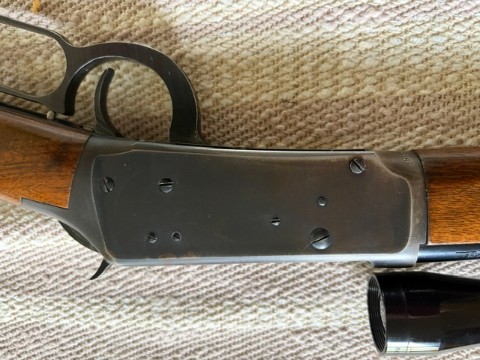
January 20, 2023
Offline
Steve, if I can find my Rennenburg text on the 94, maybe I can find images for comparison.
Whatever, your 94 is stocked with some handsome Walnut.
- Bill
WACA # 65205; life member, NRA; member, TGCA; member, TSRA; amateur preservationist
"I have seen wicked men and fools, a great many of both, and I believe they both get paid in the end, but the fools first." -- David Balfour, narrator and protagonist of the novel, Kidnapped, by Robert Louis Stevenson.
May 14, 2025
Offline
Zebulon said
Steve, if I can find my Rennenburg text on the 94, maybe I can find images for comparison.
Whatever, your 94 is stocked with some handsome Walnut.
I agree, the whole rifle looks amazing. Congrats!


1 Guest(s)
