

 Log In


January 20, 2023
 Offline


I may get hold of Redding to see if they have (or would make) a neck resizing die that would take the 38-55 neck exactly to .392. I have a spare T-7 turret with enough holes to include the FL sizer/decapper, expanding die, seating die, and a neck sizer, to speed a batch along.
At the moment, the Redding press is still in the box and my old Rockchucker is doing all the business, so it’s no big thing to unscrew the decapper stem and put the FL sizer back in the press.
My long ago classmate “Dynamite Dave” believed batch loading was too slow, but then I have never lifted the topstraps of, not one but two, Super Blackhawks.
- Bill
WACA # 65205; life member, NRA; member, TGCA; member, TSRA; amateur preservationist
"I have seen wicked men and fools, a great many of both, and I believe they both get paid in the end, but the fools first." -- David Balfour, narrator and protagonist of the novel, Kidnapped, by Robert Louis Stevenson.

March 31, 2009
Offline
Zebulon said
I may get hold of Redding to see if they have (or would make) a neck resizing die that would take the 38-55 neck exactly to .392. I have a spare T-7 turret with enough holes to include the FL sizer/decapper, expanding die, seating die, and a neck sizer, to speed a batch along.
At the moment, the Redding press is still in the box and my old Rockchucker is doing all the business, so it’s no big thing to unscrew the decapper stem and put the FL sizer back in the press.
My long ago classmate “Dynamite Dave” believed batch loading was too slow, but then I have never lifted the topstraps of, not one but two, Super Blackhawks.
Talk to Redding or Lee Precision and see if they could make you a bushing full length sizing die. This way you could size the neck where you want it and then use expander mandrels to open it back up to the desired neck tension. Rule of thumb is to use a bushing that is .004″ smaller than the neck diameter with a seated bullet. In the bolt guns we use a mandrel that is .002″ smaller than the bullet diameter. If you want to stop crimping, you would use a different combo.
January 20, 2023
Offline
Thanks, Chuck. After making up a dummy and using the FL sizer in the set to squeeze the neck down after seating, but not crimping, a bullet, it became obvious there was sufficient neck tension on the bullet that, for shooting in my 1885, there was no need to crimp, so I don’t plan to do so when I begin making up loads to shoot – hopefully some this evening.
I’m not familiar with the process you’re describing and I’m having a little trouble visualizing creating a particular neck tension with an expander madrel. I can visualize an FL sizing die with bushings that size the neck precisely. My notion of the expander die mandrel is to open up the neck – I can see where varying the mandrel diameter could sert the interior diameter of the case neck precisely – and flare the rim enough to allow seating a bullet without shaving it.
Here’s a hypothetical: We know we want to wind up with a bullet seated case neck no thicker than .392. The bullet is .378. We install a .373 bushing in the FL sizer and size the case. Ignoring springback, we should have a case with an inside neck diameter of .373, although not necessarily perfectly round.
Next we install a .376 mandrel in the expander and expand and flare the case. We get a flared rim that’s wide enough to let a bullet to set squarely but the neck is now round with an inside diameter of .376.
We seat the bullet but do not crimp it. Seating the bullet now increases the outside diameter of the neck to, allowing for brass thickness,
.378 + .020 = .398, necesssitating another trip within the sizer, to bump it down to at least .392, for a chamber neck/mouth of .394.
I think what you’re telling me is the combination of bushing and mandrel provide a precise and repeatable amount of neck tension on the bullet. Would not the subsequent, unmeasurable, trip back through the sizer to squeeze down the assembled cartridge’s outside neck diameter, alter the uniformity of the neck tension previously achieved?
- Bill
WACA # 65205; life member, NRA; member, TGCA; member, TSRA; amateur preservationist
"I have seen wicked men and fools, a great many of both, and I believe they both get paid in the end, but the fools first." -- David Balfour, narrator and protagonist of the novel, Kidnapped, by Robert Louis Stevenson.

November 7, 2015
Offline

Not true if you take the time to find the best neck tension where the bullets in the mag tube don’t move on recoil. Use a smaller diameter neck expander mandrel. I use modified pin gauges for calibers above about 33 cal. Under that the target guys can supply standard mandrels that come in .0005″ increments.-Chuck
That’s fine for target shooting, Chuck. What happens with a hunting rifle and the round makes a few trips thru the action and up the feed ramp on a slow hunting weekend? I don’t think Zeb will need a crimp for his SS but you are correct that neck tension is more important than a crimp for keeping a bullet where we seated it. I’ll always feel better with a moderate crimp for lever guns, tho. I’d be tempted to treat a single shot 38-55 as a BPCR and load a lead bullet with a wad over a case full of Holy Black. My 45-90 loads have nearly zero neck tension, I can pull the bullet with my fingers. This would necessitate Bert’s suggestion of opening up the chamber a bit.
Mike

March 20, 2010
Offline
Not necessarily disagree with anyone, or perceived expert reloader status, just making an observation for consideration/discussion; I was measuring some of my loaded 38-55 cartridges, using 0.380″ cast bullet with Starline Brass, and the neck diameter varies from 0.391-0.392 when compressing the cartridge neck in the sizing die as discussed above. Is there also a secondary effect in bullet alignment?? The loaded cartridge measures with a diameter at the base of the bullet at 0.395″, then below the bullet it is 0.390″. With the brass compressed against the bullet at and slightly below the neck, the brass below the bullet is restricted in diameter by 0.005″, forming a constriction in the case diameter upon the effect of stretching of the sized brass upon seating the bullet. Maybe a crimp wouldnt be needed for tubular magazine in this scenario?? Never tried it, but when you got something that works, at least for me, why tinker with it.
Not saying this may or does not apply to other cartridges, not claiming so, but with the 38-55 (1894) where cartridge/bullet diameters and chamber/bore diameter are concerned, it makes loading for it a bit different from other cartridges, IMHO. Regarding neck tension, under this process to attain 0.392″ chambering tolerances, I cant see where there would be a measurable difference or effect when it comes to neck tension.
CH
1892takedown @sbcglobal.net ......NRA Endowment Life Member.....WACA Member
"God is great.....beer is good.....and people are crazy"... Billy Currington
November 7, 2015
Offline
I think you’re working with a very similar set of bore and chamber dimensions as I, Chris. When loading the 38-55 and 45-70 I only size the brass enough to give me the desired neck tension. I find the bulge in the case at the base of the bullet unsightly and suspect it affects case capacity and may deform the bullet. Not really a consideration with smokeless powder but I suspect it also works the brass unnecessarily. My crimp for the 38-55 is moderate at best and the short trip inside the sizing die may indeed negate it. I just feel better when the mouth of the case digs into the bullet a little bit. I’ve never had a bullet push back in the case and quite honestly with my hunting loads it probably wouldn’t be a problem unless it went in so far it wouldn’t feed. It may be one of those “I’ve always done it this way” things but it seems I’m just following the conventional reloading wisdom that has served me well.
I’d like to figure out a way to get maximum performance from Zeb’s rifle but with the chamber, bore and component dimensions the math ain’t mathin’. In its original BP configuration and rifles I suspect this round had very little neck tension or tight chamber issues, especially when the chamber was cut for a paper patch bullet. The mystery is why the chamber appears to be too tight in the vintage Winchester and the more modern Browning rifles. I’ve tried soft 20-1 lead bullets sized .377 but my smokeless loads won’t bump them up to obturate to the .380 bore. I suspect Zeb’s rifle may perform best using a J-word bullet with a thin jacket and pure lead core but I applaud his desire to use a lead bullet.
Mike
January 20, 2023
Offline
Well, as they used to holler over at the other forum, “Quod Erat Demonstrandum.” Thus have I proved that buying a 38-55 will make you crazy.
I am, as I write, seaching for whereinhell I put my ancient powder dribbler and cord for my digital scale. Yes, we are about to assemble ammunition and will soon see what this rice-powered 1885 can do on paper.
If I can find my ##=/&_ stuff.
- Bill
WACA # 65205; life member, NRA; member, TGCA; member, TSRA; amateur preservationist
"I have seen wicked men and fools, a great many of both, and I believe they both get paid in the end, but the fools first." -- David Balfour, narrator and protagonist of the novel, Kidnapped, by Robert Louis Stevenson.
March 20, 2010
Offline
TXGunNut said
It may be one of those “I’ve always done it this way” things but it seems I’m just following the conventional reloading wisdom that has served me well.
Mike
That about sums it up nicely. If aint broke dont fix it.
What about trying a lead bullet with gas check??
I was measuring some bullets I cast from an original 1894 mould (cant remember which date) and they drop at 0.375″. Havent tried it but sure that wont work very well, maybe not even with BP, in a 0.380″ bore. It will probably chamber easily without extra steps but feel that it will rattle around down the bore.
Ive slugged and measured about 15-20 38-55 bores, from early in production (10,000 SN) on to past 1 MM serial, and they have all been at 0.3795″ to 0.380″.
1892takedown @sbcglobal.net ......NRA Endowment Life Member.....WACA Member
"God is great.....beer is good.....and people are crazy"... Billy Currington
January 20, 2023
Offline
A little coda to the evening’s work. I found my Pact digital scale and plugged it in. If it hasn’t been energized in a while (years) it doesn’t just “drift” before stabilizing, it goes full house Section 8 and is unusable for about an hour, then wears itself out and allows me to calibrate it.
While waiting, I found my trusty RCBS 5-0-5:balance scale, which I use to re-verify the sanity of the Pact, from time to time in the loading process
Well, the scale and the brass dish were found but the hanger and dish support have disappeared. By the time I went through all my gear for the third time and figured out those parts were gone, and tried unsuccessfully to fabricate replacements, I had to quit and get ready for an early appointment ttomorrow. Midway carries replacement parts for obscene prices ($29 but $40 with tax and shipping) but it’s cheaper than replacing the reliable little scale, which was actually made by Ohaus. I trust it to rat out the Pact, which is prone to treachery if our line current gets noisy.
I don’t weigh every charge if I’m making a sizeable batch and it becomes worthwhile to set the powder measure precisely, but even then I pull a test load for the scale every 10 pulls. When working up a ladder, I set the measure for the starting load, drop it into the scale dish and trickle the increments, a grain at a time until I get up to 85% of the published maximum for similar but not identical components (different brand of primer or different bullet of approximately same weight), then a half grain at a time. Chronographing as I go I rarely shoot maximum loads.
I could steal the chef’s Cuisinart kitchen scale that can read grams and convert to grains, just to double-check the Pact, but that would require stealth and luck, with severe penalties if discovered- eating McDonald’s made by the night shift, alone, for several days. I’ll wait on Midway instead.
- Bill
WACA # 65205; life member, NRA; member, TGCA; member, TSRA; amateur preservationist
"I have seen wicked men and fools, a great many of both, and I believe they both get paid in the end, but the fools first." -- David Balfour, narrator and protagonist of the novel, Kidnapped, by Robert Louis Stevenson.
March 31, 2009
Offline
TXGunNut said
That’s fine for target shooting, Chuck. What happens with a hunting rifle and the round makes a few trips thru the action and up the feed ramp on a slow hunting weekend? I don’t think Zeb will need a crimp for his SS but you are correct that neck tension is more important than a crimp for keeping a bullet where we seated it. I’ll always feel better with a moderate crimp for lever guns, tho. I’d be tempted to treat a single shot 38-55 as a BPCR and load a lead bullet with a wad over a case full of Holy Black. My 45-90 loads have nearly zero neck tension, I can pull the bullet with my fingers. This would necessitate Bert’s suggestion of opening up the chamber a bit.
Mike
Do what makes you feel the best. But I guarantee that the long bullets with enough tension on them won’t move if you go through the process.
November 7, 2015
Offline
1892takedown said
TXGunNut said
It may be one of those “I’ve always done it this way” things but it seems I’m just following the conventional reloading wisdom that has served me well.
Mike
That about sums it up nicely. If aint broke dont fix it.
What about trying a lead bullet with gas check??
I was measuring some bullets I cast from an original 1894 mould (cant remember which date) and they drop at 0.375″. Havent tried it but sure that wont work very well, maybe not even with BP, in a 0.380″ bore. It will probably chamber easily without extra steps but feel that it will rattle around down the bore.
Ive slugged and measured about 15-20 38-55 bores, from early in production (10,000 SN) on to past 1 MM serial, and they have all been at 0.3795″ to 0.380″.
All my old Winchesters measure .380, even a relatively recent LF commemorative measured .380 awhile back. I can only get three digits right of the decimal with instruments I trust. According to conventional wisdom my 38-55 loads do not require a gas check. I cast both plain based and GC bullets for the 38-55 and have gotten mixed results. My best two loads to date consist of the GC and the PB version of the same heavy for caliber design. I suspect that I’m still looking for the right bullet. With the price of checks I’m hoping it’s a PB bullet!
Mike
November 7, 2015
Offline
Bill-
I feel your pain on the powder scale front. It appears a faulty voltage adapter has addled my RCBS Chargemaster and RCBS no longer sells or supports this model. I have a perfectly good RCBS balance beam scale and a pair of Pact electronic scales that haven’t been used in awhile, one is the earliest model that was battery powered. I even have a Hornady digital scale that I’ve never used. Quite honestly the Chargemaster has me spoiled but I haven’t been able to convince myself to loosen the purse strings enough to order its replacement.
Mike
March 31, 2009
Offline
Zebulon said
Thanks, Chuck. After making up a dummy and using the FL sizer in the set to squeeze the neck down after seating, but not crimping, a bullet, it became obvious there was sufficient neck tension on the bullet that, for shooting in my 1885, there was no need to crimp, so I don’t plan to do so when I begin making up loads to shoot – hopefully some this evening.
I’m not familiar with the process you’re describing and I’m having a little trouble visualizing creating a particular neck tension with an expander madrel. I can visualize an FL sizing die with bushings that size the neck precisely. My notion of the expander die mandrel is to open up the neck – I can see where varying the mandrel diameter could sert the interior diameter of the case neck precisely – and flare the rim enough to allow seating a bullet without shaving it.
Here’s a hypothetical: We know we want to wind up with a bullet seated case neck no thicker than .392. The bullet is .378. We install a .373 bushing in the FL sizer and size the case. Ignoring springback, we should have a case with an inside neck diameter of .373, although not necessarily perfectly round.
Next we install a .376 mandrel in the expander and expand and flare the case. We get a flared rim that’s wide enough to let a bullet to set squarely but the neck is now round with an inside diameter of .376.
We seat the bullet but do not crimp it. Seating the bullet now increases the outside diameter of the neck to, allowing for brass thickness,
.378 + .020 = .398, necesssitating another trip within the sizer, to bump it down to at least .392, for a chamber neck/mouth of .394.
I think what you’re telling me is the combination of bushing and mandrel provide a precise and repeatable amount of neck tension on the bullet. Would not the subsequent, unmeasurable, trip back through the sizer to squeeze down the assembled cartridge’s outside neck diameter, alter the uniformity of the neck tension previously achieved?
Put a bullet in the case and then measure the OD of the case. Use a bushing that is .004″ smaller than this diameter. Others have found that moving the brass .004″ will reduce spring back. Then use an expander that is .002″ smaller in diameter of the bullet. Assuming you have annealed the case there will be little spring back and you should end up with .002″ of neck tension. But overall neck tension isn’t just how much you are squeezing the bullet but also how much of the bullet you are squeezing. On the heavy long bullets there is a lot of bullet length being squeezed. Coefficient of friction. If that is not enough tension use a smaller expander, like .001″ smaller than the bullet. This will cause the brass to hold onto the bullet much stronger. The store-bought bushings come in .001″ increments and the expanders .0005″ increments.
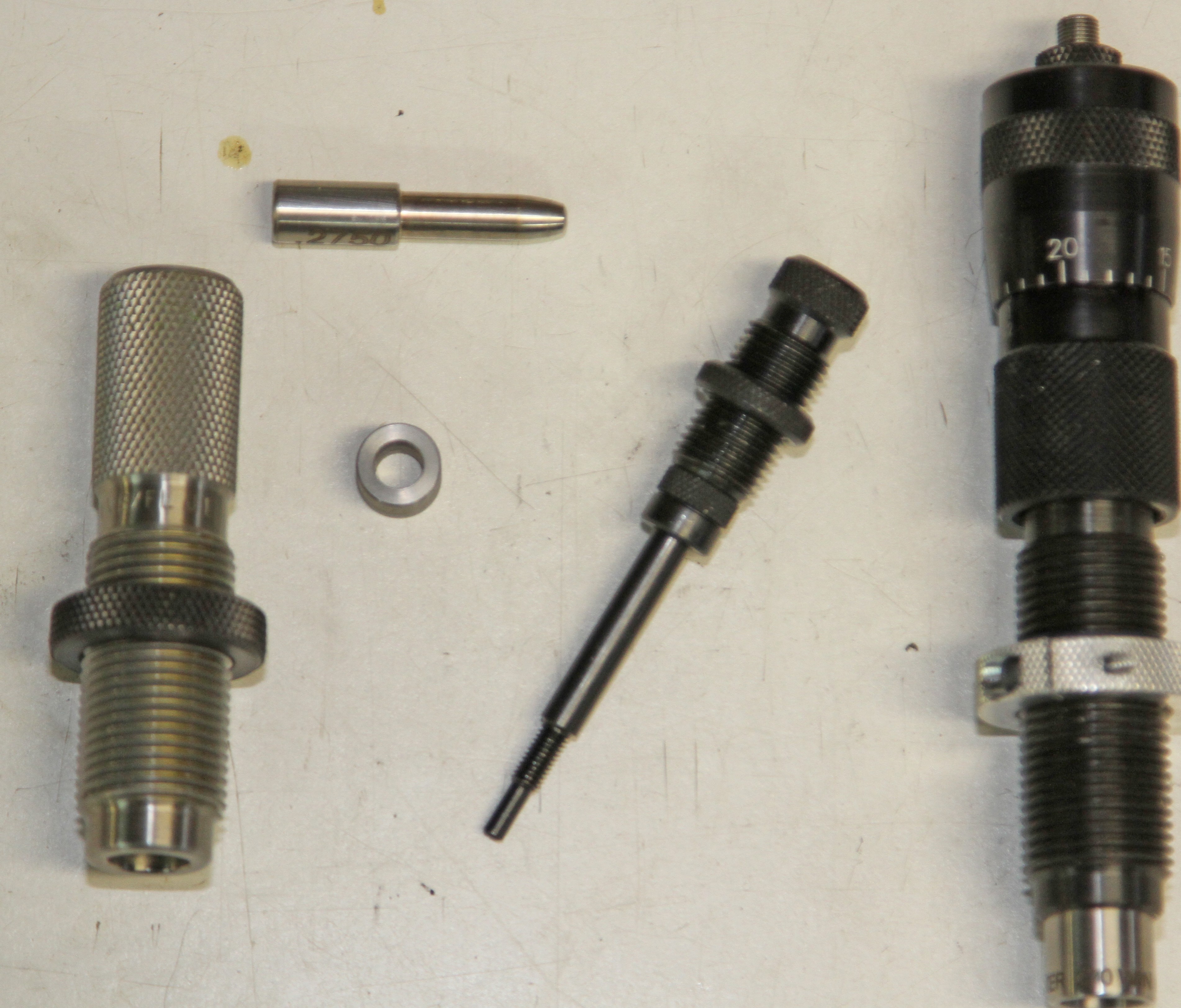
Unfortunately many suppliers don’t have bushings and expanders over about 33 Cal. But there are a few that go up to the 50 Cal. So I have made some of my own. The other thing the modern mandrels don’t do is bell the mouth. You have to do that yourself.
Here is a picture and on the left is a bushing die, expander and bushing. Unfortunately I don’t have a picture that shows inside the mandrel die to show how I use a pin gauge as an expander.
If the case mouth of the seated bullet is too large to chamber you need to remedy the problem before sizing. Straight wall cases might have to be inside neck reamed to thin the wall. I use a mini lathe to thin necks on the rimless cases.
None of what I do needs to be done if you are happy with what you are doing and don’t need more accuracy or can’t find what you need.
January 20, 2023
Offline
Chuck, That helps. Whether I do it or not, I want to be enlightened about the process. Right now, it’s difficult for me to work precisely in metal; I don’t have a lathe or a mill and it’s unlikely I’ll get either for lack of room. I had to pass Dad’s Southbend toolroom lathe for that reason. His Enco drill mill was never accurate enought suit him. We sold both when he died. (I’ve seen Enco mills that have been rebult by machinists that are as accurate as anything made but they had to do quite a bit. They also threw the motors away.) If anything, I might someday try as small parts combo machine. Not sure at this point what my time horizon looks like but Dad was still in his shop until he was 92 and got sick.
It’s been a while since I’ve used a good micrometer and setting the jaws is tricky. My T230 doesn’t have knife edges. As a result, I was gettting a significant amount of disagreement between my General dial caliper and the Starrett mic. The latter came in its case with a precise 1″ hardened steel calibration rod, so I was able to check both instruments for true, at least at that dimension. After that, here’s what I came up with for my two dummy cartridges, measuring the necks just below the rims, after seating the 245 grain cast lead bullets for an OACL of 2.500″ and running them back up into my FL sizer to reduce the neck diameters. I crimped the Starline but did not crimp the WW:
Starline, per General caliper .395
“” per Starrett T230 .3942
Winchester, per General .394
“” per Starrett .3948
Because both dummies are an easy sliding fit in the chamber, I have to assume this particular rifle has a wider chamber neck/mouth than I suspected. All to the good because I can use both brands of cases and I have enough of each to last longer than I probably will. I’m anxious to start working up some loads.
- Bill
WACA # 65205; life member, NRA; member, TGCA; member, TSRA; amateur preservationist
"I have seen wicked men and fools, a great many of both, and I believe they both get paid in the end, but the fools first." -- David Balfour, narrator and protagonist of the novel, Kidnapped, by Robert Louis Stevenson.


1 Guest(s)
