

 Log In


June 26, 2013
 Offline

steve004 said
This has been a fascinating thread to read – started in 2009! And as Tony points out, over 14000 views! I see I made a contribution in 2014, and now here I am, typing another post in 2026.
My question has to do with the hand-written card that was unearthed. The card states that 1303 were made specifically from .30-06 barrels. Yet some were from .30-03 and .30-40 barrels? What do we know about those?
I believe those with pinned front sights came from .30-40 barrels and those with dovetailed front sights came from .30-06 and .30-03 barrels. Not sure if there is a way to distinguish the .30-06 vs. those with .30-03 barrels though.
Don
November 19, 2006
Offline

As I’ve re-read this whole thread again, I was thinking about the time period where Winchester manufactured these carbines. In following the thoughts about Winchester’s financial position – and potential to take frugal measures – I’m reminded of what I read in Harold Williamson’s excellent Winchester book. In considering Pauleen’s comments regarding Winchester’s dedication to their employees, it makes even more sense to me that they used ’95 barrels on these barrels. Yes, there’s labor involved in converting 95 barrels to 94 carbine barrels, but in a way it was of no cost. That is, if you’re already paying your employees and orders are slow, this is a way of making use of that labor. And if the barrels were already sitting there unused – with every probability that the majority of them will go unused – this makes good sense to me.

April 15, 2005
Offline
steve004 said
This has been a fascinating thread to read – started in 2009! And as Tony points out, over 14000 views! I see I made a contribution in 2014, and now here I am, typing another post in 2026.
My question has to do with the hand-written card that was unearthed. The card states that 1303 were made specifically from .30-06 barrels. Yet some were from .30-03 and .30-40 barrels? What do we know about those?
There is no evidence that any of the 94/95 hybrids were assembled using 30-03 or 30-40 barrels.
Quite honestly, I do not believe that by October of 1928 that Winchester had on hand any 30-03 barrels. While it is not impossible, I also very much doubt Winchester used altered 30-40 (30 Army) barrels as they were still actively manufacturing Model 95s in that cartridge. Winchester did announce (in their catalogs) that the 30-06 cartridge chambering had been discontinued prior to 1928.
Bert
WACA Historian & Board of Director Member #6571L
April 15, 2005
Offline
deerhunter said
steve004 said
This has been a fascinating thread to read – started in 2009! And as Tony points out, over 14000 views! I see I made a contribution in 2014, and now here I am, typing another post in 2026.
My question has to do with the hand-written card that was unearthed. The card states that 1303 were made specifically from .30-06 barrels. Yet some were from .30-03 and .30-40 barrels? What do we know about those?
I believe those with pinned front sights came from .30-40 barrels and those with dovetailed front sights came from .30-06 and .30-03 barrels. Not sure if there is a way to distinguish the .30-06 vs. those with .30-03 barrels though.
Don
Don,
The under barrel markings would be the best possible source of information. While Winchester would (and did) remark the cartridge marking on the top (exposed) side of the barrel, I suspect that they may not have removed the cartridge marking on the bottom of the barrels. If you want to get brave, check to see what is marked on the barrels on your hybrids, and then please post some pictures of what you find.
Bert
WACA Historian & Board of Director Member #6571L
November 19, 2006
Offline
Bert H. said
steve004 said
This has been a fascinating thread to read – started in 2009! And as Tony points out, over 14000 views! I see I made a contribution in 2014, and now here I am, typing another post in 2026.
My question has to do with the hand-written card that was unearthed. The card states that 1303 were made specifically from .30-06 barrels. Yet some were from .30-03 and .30-40 barrels? What do we know about those?
There is no evidence that any of the 94/95 hybrids were assembled using 30-03 or 30-40 barrels.
Quite honestly, I do not believe that by October of 1928 that Winchester had on hand any 30-03 barrels. While it is not impossible, I also very much doubt Winchester used altered 30-40 (30 Army) barrels as they were still actively manufacturing Model 95s in that cartridge. Winchester did announce (in their catalogs) that the 30-06 cartridge chambering had been discontinued prior to 1928.
Bert
I thought somewhere I saw reference to some of the M94/95 utilizing ’95 musket barrels?
April 15, 2005
Offline
steve004 said
Bert H. said
steve004 said
This has been a fascinating thread to read – started in 2009! And as Tony points out, over 14000 views! I see I made a contribution in 2014, and now here I am, typing another post in 2026.
My question has to do with the hand-written card that was unearthed. The card states that 1303 were made specifically from .30-06 barrels. Yet some were from .30-03 and .30-40 barrels? What do we know about those?
There is no evidence that any of the 94/95 hybrids were assembled using 30-03 or 30-40 barrels.
Quite honestly, I do not believe that by October of 1928 that Winchester had on hand any 30-03 barrels. While it is not impossible, I also very much doubt Winchester used altered 30-40 (30 Army) barrels as they were still actively manufacturing Model 95s in that cartridge. Winchester did announce (in their catalogs) that the 30-06 cartridge chambering had been discontinued prior to 1928.
Bert
I thought somewhere I saw reference to some of the M94/95 utilizing ’95 musket barrels?
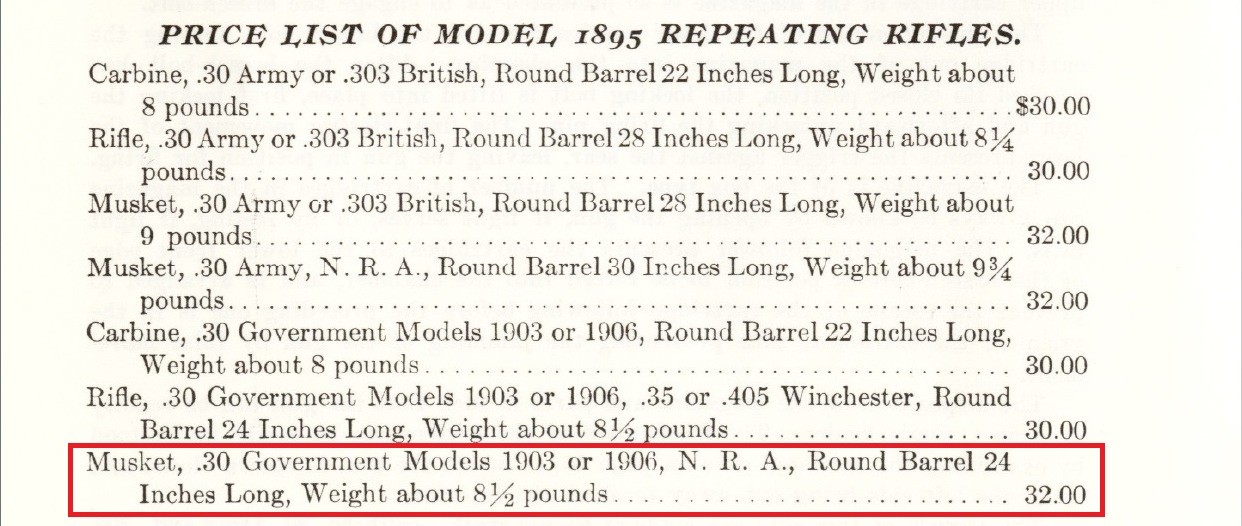
30-06 NRA Musket barrels
WACA Historian & Board of Director Member #6571L
April 15, 2005
Offline
This is a scanned copy of Winchester’s 1914 catalog.
Bert
WACA Historian & Board of Director Member #6571L

March 31, 2009
Offline
Bert H. said
There is no evidence that any of the 94/95 hybrids were assembled using 30-03 or 30-40 barrels.
Quite honestly, I do not believe that by October of 1928 that Winchester had on hand any 30-03 barrels. While it is not impossible, I also very much doubt Winchester used altered 30-40 (30 Army) barrels as they were still actively manufacturing Model 95s in that cartridge. Winchester did announce (in their catalogs) that the 30-06 cartridge chambering had been discontinued prior to 1928.
Bert
Was the 30-06 discontinued in the Model 95 or did you mean 30-03?
The Military rechambered the 30-03 barrels to 30-06. It is really hard to find a Military Springfield rifle in 30-03 because of this.
April 15, 2005
Offline
Chuck said
Bert H. said
There is no evidence that any of the 94/95 hybrids were assembled using 30-03 or 30-40 barrels.
Quite honestly, I do not believe that by October of 1928 that Winchester had on hand any 30-03 barrels. While it is not impossible, I also very much doubt Winchester used altered 30-40 (30 Army) barrels as they were still actively manufacturing Model 95s in that cartridge. Winchester did announce (in their catalogs) that the 30-06 cartridge chambering had been discontinued prior to 1928.
Bert
Was the 30-06 discontinued in the Model 95 or did you mean 30-03?
The Military rechambered the 30-03 barrels to 30-06. It is really hard to find a Military Springfield rifle in 30-03 because of this.
Chuck,
It was the 30-06 cartridge that Winchester discontinued for the Model 95 in the mid 1920s. It is my belief that the impetus behind doing that was the introduction of the Model 54 bolt-action rifles in that same cartridge.
Just as an FYI, it is not possible to “rechamber” a 30-03 barrel to 30-06 without first cutting the entire chamber off of the barrel. The 30-06 is simply a 30-03 cartridge with a slightly shorter neck.
It is perfectly safe to shoot 30-06 cartridges in any original 30-03 chambered rifle, but it is not possible to shoot a 30-03 cartridge in a 30-06 chambered barrel. The U.S. Army actually rebarreled the Springfield Model 1903 rifles versus rechambering them.
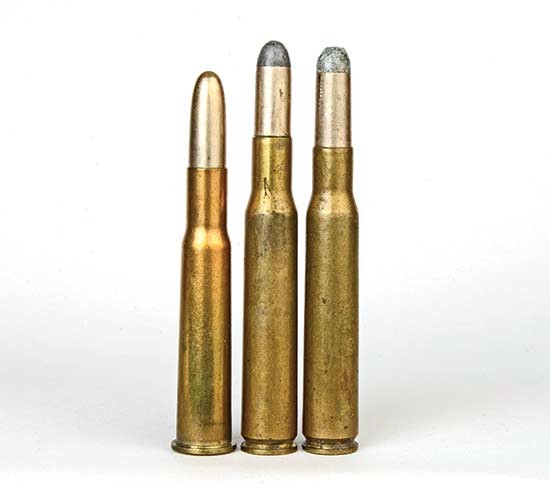
The attached picture shows in order the first three .30 caliber Military cartridges; 30-40 (30 US) on left, 30-03 Gov’t center, and 30-06 Gov’t right. Take note that the 30-06 has a slightly shorter neck than the 30-03.
Bert
WACA Historian & Board of Director Member #6571L
November 19, 2006
Offline
Thanks Bert! The picture keeps getting clearer.
March 31, 2009
Offline
Bert H. said
Just as an FYI, it is not possible to “rechamber” a 30-03 barrel to 30-06 without first cutting the entire chamber off of the barrel.
Bert
Not true.
“Military .30-03 barrels can safely and functionally be converted to .30-06 by unscrewing the barrel, setting it back (milling a small amount off the breech end), re-threading, and re-chambering. This requires a qualified gunsmith with a lathe and the proper reamer.”
This is what the Military did and that is why finding a 03 Springfield in 30-03 is rare.
November 19, 2006
Offline
Chuck said
Bert H. said
Just as an FYI, it is not possible to “rechamber” a 30-03 barrel to 30-06 without first cutting the entire chamber off of the barrel.
Bert
Not true.
“Military .30-03 barrels can safely and functionally be converted to .30-06 by unscrewing the barrel, setting it back (milling a small amount off the breech end), re-threading, and re-chambering. This requires a qualified gunsmith with a lathe and the proper reamer.”
Why would this be worth all the trouble when the .30-06 cartridge can be safely fired in the .30-06 chamber?
March 31, 2009
Offline
steve004 said
Chuck said
Bert H. said
Just as an FYI, it is not possible to “rechamber” a 30-03 barrel to 30-06 without first cutting the entire chamber off of the barrel.
Bert
Not true.
“Military .30-03 barrels can safely and functionally be converted to .30-06 by unscrewing the barrel, setting it back (milling a small amount off the breech end), re-threading, and re-chambering. This requires a qualified gunsmith with a lathe and the proper reamer.”
Why would this be worth all the trouble when the .30-06 cartridge can be safely fired in the .30-06 chamber?
I don’t know the answer to that. I’ll look at my 03 Springfield book and see what it may say. All I know is the Military wasn’t about to waste the barrels.
March 31, 2009
Offline
The Springfield 1903 Rifles by Brophy.
After a quick look through the 616 page book I found one paragraph on page 34. “The new cartridge had a neck that was .1″ shorter than the original one, and although it would fit into the chamber, it was not desirable.”
Page 38 states that the 03 barrels were 24.2″ and the barrels modified to 06 are 24″.
One other thing is that the 150 gr Military bullet is a spitzer, pointed, bullet.
November 19, 2006
Offline
Chuck said
The Springfield 1903 Rifles by Brophy.
After a quick look through the 616 page book I found one paragraph on page 34. “The new cartridge had a neck that was .1” shorter than the original one, and although it would fit into the chamber, it was not desirable.“
Page 38 states that the 03 barrels were 24.2″ and the barrels modified to 06 are 24″.
Interesting but pretty vague: “not desirable.”
March 31, 2009
Offline
steve004 said
Interesting but pretty vague: “not desirable.”
Well, there are more books on these rifles and maybe more info in this book but I don’t collect them.
November 19, 2006
Offline
When I think of the 94/95 Hybrids I am reminded of the Model 92 “Movie Guns.” Here, 20 inch octagon M1892 .44-40 barrels were used on carbines. A quick way to identify these (beyond the presence of an octagon barrel on a carbine) is an empty dovetail cut on the underside of the barrel immediately ahead of the forend. Presumably, these carbines were ordered for a movie company and whether they specified octagon barrels, or they wanted whatever Winchester could provide as cheaply as possible, is a mystery. Winchester may have had a surplus of 20 inch octagon barrels on hand and this was a handy way to use them up. Had these rifles been ordered specifically with 20 inch octagon and made up as such, I doubt the visible unused dovetail would be present. A fun puzzle, as this 94/95 Hybrid puzzle we’ve been discussing on this thread since 2009 has been 
December 9, 2002
Offline
I find it interesting going back again and re reading some of the points made when this post thread first started out and was slowly evolving. With a lot of great research, and a very good article by member Rick Hill in the Summer 2012 Collector, and then for Bert to stay on this and keep updating the research for us, really helps us all to understand more here.
The type l and ll with their 20 inch barrels, and the type lll and llll, with their M-95, 24 inch Musket barrels cut down to 21.75″. It makes me wonder how and why they came up with that number, for the length on the barrel, and not a more even, or rounded number. I guess it really doesn’t matter, just curious is all.
Years ago the barrel length on the type lll and llll, was said to be 21.50, and 22 inches long, in earlier beginning surveys. We can see how that can happen as the breach measurements can be subjective to assuming something, in many cases, I suspect.
With all the updated information, it really gives the collector some more information to go on.
Tony
November 19, 2006
Offline
I’m wondering about the customers who purchased these carbines – if they gave any thought to the variation from the standard carbine? The model 1894 and model 94 went through many variations – so it wasn’t all that unusual for a carbine to show up that wasn’t identical to earlier versions. I suppose that the variation that used the musket barrel, and had a magazine tube that didn’t reach to the end of the barrel, would logically have attracted the most notice. Maybe when they showed up a dealer’s stores, those dealers might have noticed? And is it possible they were discounted in some way?
April 15, 2005
Offline
Chuck said
Bert H. said
Just as an FYI, it is not possible to “rechamber” a 30-03 barrel to 30-06 without first cutting the entire chamber off of the barrel.
Bert
Not true.
“Military .30-03 barrels can safely and functionally be converted to .30-06 by unscrewing the barrel, setting it back (milling a small amount off the breech end), re-threading, and re-chambering. This requires a qualified gunsmith with a lathe and the proper reamer.”
This is what the Military did and that is why finding a 03 Springfield in 30-03 is rare.
Chuck,
The cost in both the time and labor to do the work necessary to convert a 30-03 barrel to 30-06 would be greater than simply installing a new barrel.
In addition to milling .2″ off of the breech end of the barrel, then rereaming the chamber to the correct dimension, that is not all that would have needed to be reworked.
The rear sight mounting holes would need to me moved further forward, the barrel fitments to the stock would also need reworking/moving. I simply do not believe that the Springfield Armory would have wasted all of the extra time needed to convert a 30-03 barrel versus simply putting a replacement barrel on the rifle.
Bert
WACA Historian & Board of Director Member #6571L


1 Guest(s)
