

 Log In


December 31, 2020
 Offline


I found the “Winchester “Trapper” / Baby Carbines – Practical Tool or Romantic Myth?” post from a few days ago really interesting. I understand that period photos of Trapper models seem to be rare.
Inspired by the above and being at house arrest due to the cold, I decided I would find at least one period photo of a trapper holding a Winchester Trapper. I searched (online) and looked at hundreds of period photos, trappers, hunters, gold prospectors, explorers, guides, log cabins, mining camp, logging camps, prison guards, etc., both in the US and Canada, but not luck.
Lever Winchesters are literally everywhere, but not the short ones, as far as I can tell.
Then I remember that I read that many 1892 Trappers were sent to the plantations in South America, so I started looking at period photos from South America, using Google translator for Portuguese and Spanish key words. Little luck there too, except for this one photo.
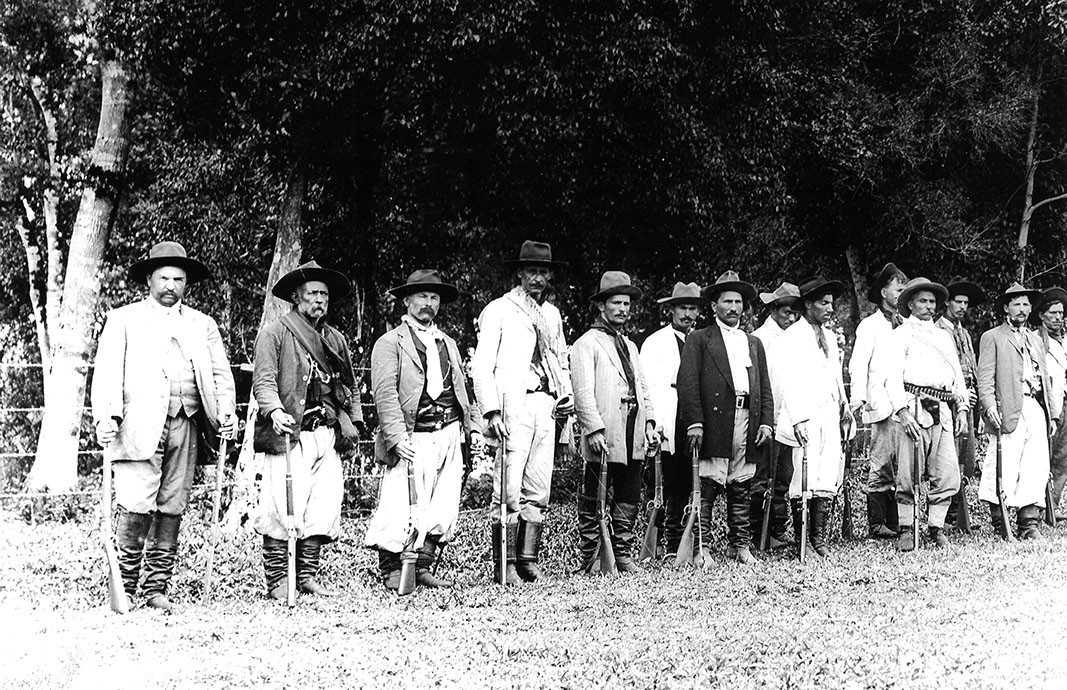
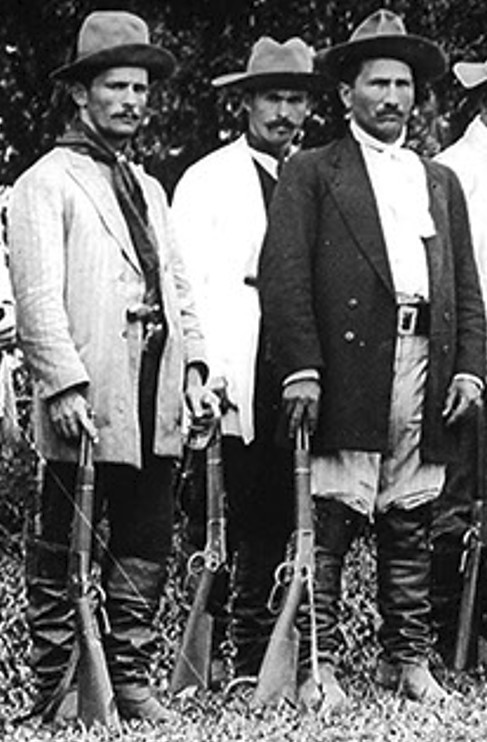
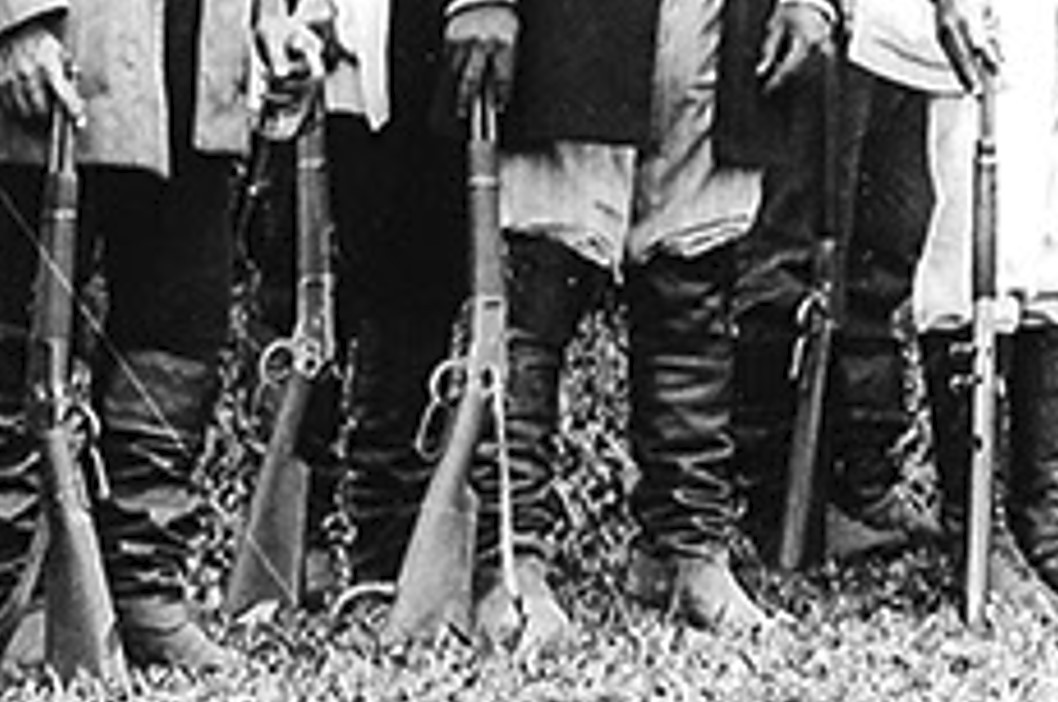
Photo taken in southern Brazil sometime between 1912 and 1916, during the Contestado war, several farmers seem to be armed with short Winchester model 1892. I think I see at least four or five short SRC.
Under the picture it reads: “Com armas de fogo, fazendeiros e soldados ajudaram a silenciar os redutos dos rebeldes – With firearms, farmers and soldiers helped to silence the rebel strongholds”.
From Wikipedia: The Contestado War (Portuguese: Guerra do Contestado), broadly speaking, was a guerrilla war for land between settlers and landowners, the latter supported by the Brazilian state’s police and military forces, that lasted from October 1912 to August 1916.
Perhaps it is a known photo to Winchester collectors, but I’ve never seen it before.
Here is the link: https://www.clicrbs.com.br/sites/swf/dc_mariazinha/guerra-do-contestado.html

January 20, 2023
Offline
I’ve often wondered why these short-barreled repeaters were so popular in South America. I’ve never owned an original but did have for a brief time one of the USRAC 16″ Model 94 “trappers” in 44 Magnum.
If I intended to be on foot in snowshoes and intended its use to be killing trapped animals and for self defense in the woods, one would make sense.
But I’d thought the Brazilian guards and paramilitary got around the cerrado on horseback, for the most part. Obviously they found the really truncated versions better for their purposes. I need to brush up my history.
- Bill
WACA # 65205; life member, NRA; member, TGCA; member, TSRA; amateur preservationist
"I have seen wicked men and fools, a great many of both, and I believe they both get paid in the end, but the fools first." -- David Balfour, narrator and protagonist of the novel, Kidnapped, by Robert Louis Stevenson.

August 27, 2014
Offline
Good stuff!
“If you can’t convince them, confuse them”
President Harry S. Truman
December 9, 2002
 Online
This is great work here as a very interesting thread Post.
This is by no means a knock on the Conquistadors, who carried these short rifles, but back in the day, they were shorter in stature, and like Zeb said, on horseback, for must of what we understand, so these short tools we’re a lot more convenient and easy to handle.
Anthony
September 19, 2014
Offline
Anthony, Good sleuthing. Tim
December 9, 2002
Online
Tim,
I’m just trying to hang with you, and a few others here, as the real, “Teachers”, in “Sleuthing”, as I’ve observed and continue to do so, in a very enjoyable and fun loving retirement! 
Anthony
January 20, 2023
Offline
Anthony said
This is great work here as a very interesting thread Post.
This is by no means a knock on the Conquistadors, who carried these short rifles, but back in the day, they were shorter in stature, and like Zeb said, on horseback, for must of what we understand, so these short tools we’re a lot more convenient and easy to handle.
Anthony
Anthony, Yes, that makes sense. I’ve had the pleasure of knowing many native Spaniards and some Portuguese over my lifetime and noticed they tend to be a small, if handsome [and in the case of many women, remarkably beautiful] people. Armored suits of metal on exhibit that were made long ago in Toledo and Seville would not fit today’s large American 10 year-old.
In Brazil, of course, most of the men in our subject photograph have Indio and possibly coastal African genes as well, tending to moderate bone structure and height.
But I doubt any of them are close to six feet, judging by the relative size of the carbines. And most seem to be wearing riding boots.
A very fine and useful photograph. Given the climate in Brazil and the probable absence of Ballistol and R.I.G. — this photo helps us understand why so many surviving “trappers” are only a few points better than tub toy grade.
Thanks to the OP for sharing.
- Bill
WACA # 65205; life member, NRA; member, TGCA; member, TSRA; amateur preservationist
"I have seen wicked men and fools, a great many of both, and I believe they both get paid in the end, but the fools first." -- David Balfour, narrator and protagonist of the novel, Kidnapped, by Robert Louis Stevenson.
December 9, 2002
Online
Zeb,
I’m in agreement with you as once again you’re tongue has a way of perfecting the English language.
In comparison, how about the many Schuetzen rifles, with the tightness, on the gap between the two spurs, that protrude beyond the butt of the rifle, as none in our world today, or at least not too many could even imagine shooting carefully, without harpooning themselves. 
Thanks to the poster for a great photograph and posting!
Anthony
December 31, 2020
Offline
Thank you for your comments.
After studying literally hundreds of B&W photos, the fact that I found at least one where the short barrel Winchester was unmistakably visible, plus the bonus that there were multiple carbines, I thought it was definitely worth posting.
Short carbines on slings have been used by the many cavalry units around the world, since the invention of the black powder.
I speculate that their adoption by mounted plantation farmers in Brazil had to do more with the weapon compact size and the saddle ring than the physical stature of the rider.
August 27, 2014
Offline
The Trapper’s look very cool
“If you can’t convince them, confuse them”
President Harry S. Truman
December 9, 2002
Online
Cowboy4 said
Thank you for your comments.
After studying literally hundreds of B&W photos, the fact that I found at least one where the short barrel Winchester was unmistakably visible, plus the bonus that there were multiple carbines, I thought it was definitely worth posting.
Short carbines on slings have been used by the many cavalry units around the world, since the invention of the black powder.
I speculate that their adoption by mounted plantation farmers in Brazil had to do more with the weapon compact size and the saddle ring than the physical stature of the rider.
Cowboy,
I’m in agreement with you, as the shorter barreled and more convenient rifles we’re such a great tool of resource for these guys in their adventures, as I was just making another reference point, and maybe didn’t explain myself completely, as you’re work here and postings are a great informative reference!
Tedk said
The Trapper’s look very cool
I agree Ted, as I also think so!
Anthony
July 2, 2023
Offline
Cowboy4 said
I found the “Winchester “Trapper” / Baby Carbines – Practical Tool or Romantic Myth?” post from a few days ago really interesting. I understand that period photos of Trapper models seem to be rare.
Inspired by the above and being at house arrest due to the cold, I decided I would find at least one period photo of a trapper holding a Winchester Trapper. I searched (online) and looked at hundreds of period photos, trappers, hunters, gold prospectors, explorers, guides, log cabins, mining camp, logging camps, prison guards, etc., both in the US and Canada, but not luck.
Lever Winchesters are literally everywhere, but not the short ones, as far as I can tell.
Then I remember that I read that many 1892 Trappers were sent to the plantations in South America, so I started looking at period photos from South America, using Google translator for Portuguese and Spanish key words. Little luck there too, except for this one photo.
Photo taken in southern Brazil sometime between 1912 and 1916, during the Contestado war, several farmers seem to be armed with short Winchester model 1892. I think I see at least four or five short SRC.
Under the picture it reads: “Com armas de fogo, fazendeiros e soldados ajudaram a silenciar os redutos dos rebeldes – With firearms, farmers and soldiers helped to silence the rebel strongholds”.
From Wikipedia: The Contestado War (Portuguese: Guerra do Contestado), broadly speaking, was a guerrilla war for land between settlers and landowners, the latter supported by the Brazilian state’s police and military forces, that lasted from October 1912 to August 1916.
Perhaps it is a known photo to Winchester collectors, but I’ve never seen it before.
Here is the link: https://www.clicrbs.com.br/sites/swf/dc_mariazinha/guerra-do-contestado.html
Hi,
Good find 👍
I’m happy to hear you liked my post.
Yes, finding old photographs that show guns consistent with Winchester SRC “Trappers”—that is, with shorter-than-average barrel lengths and shortened for-ends—is incredibly difficult.
I think the reason being is that…
The people who primarily used these “Trappers” were not like the traditional sportsman or hunting-enthusiast types who typically owned longer barrelled length deluxe or standard sporting rifles and posed for photos on hunting trips or safaris, proudly standing over a trophy in some “respectable” location.
These “Trappers” were used hard and used well, exactly as they were designed to be. They were carried by rough-and-tumble men who generally weren’t the gentleman sporting type. As mentioned in the post, these guns were thought of more as tools—a means to an end—much like the Australian “Stinger”-marked carbines used on cattle stations, in hunt cabins, or out in the rural bush where the going gets tough.
The guys who carried “Trappers” were probably too busy swatting blackflies and mosquitoes to worry about photographing their guns, cursing and swearing while trudging through swamps or dense brush, getting the rifle dirty, banged up, and nicked along the way.
December 21, 2006
Offline
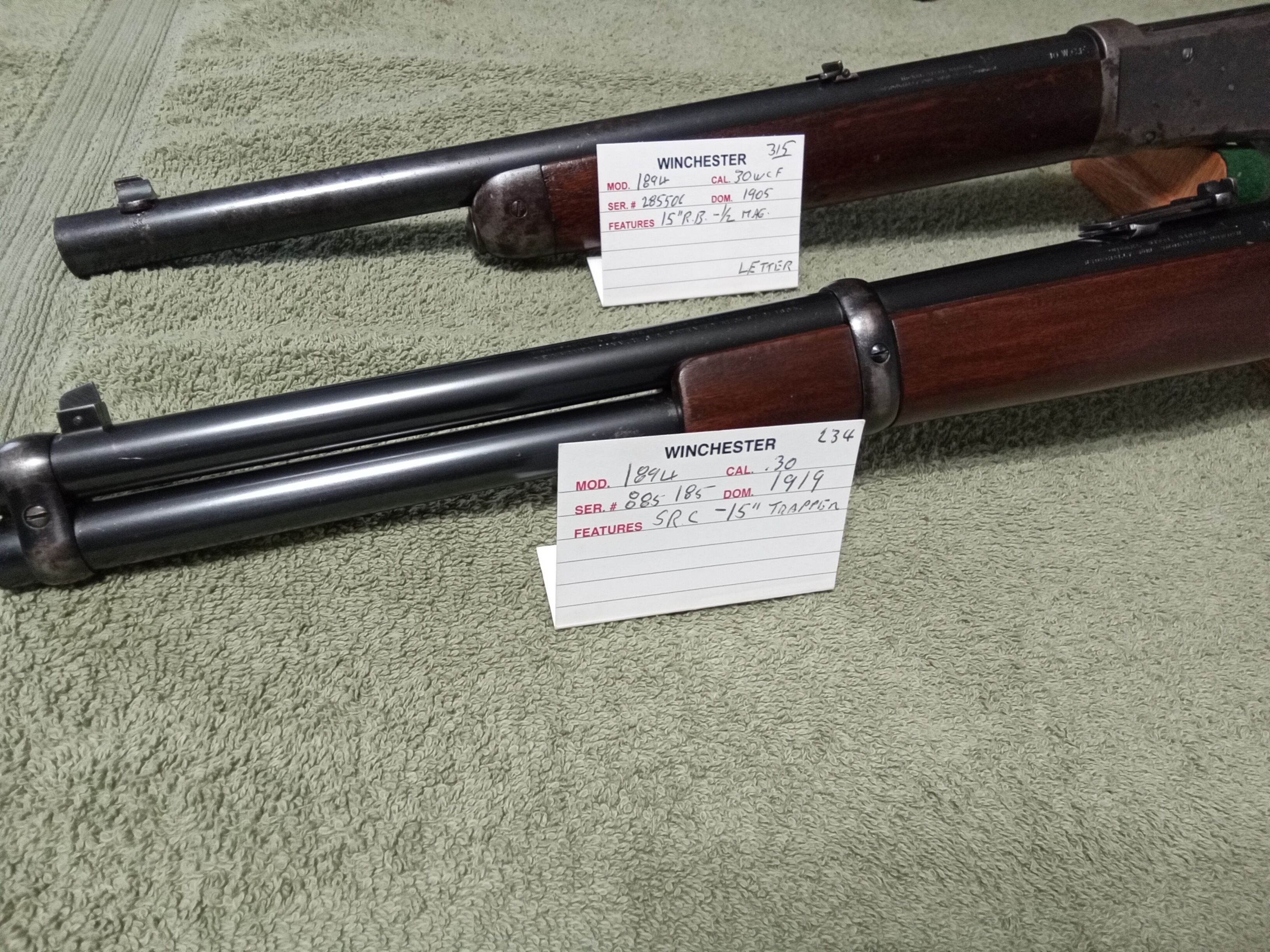
As most of You know I am very partial to the “trappers”. By comparison here is a 15″ “trapper” carbine and a 15″ short rifle , I just find the carbine more asthetically pleasing, (to My eye), in proportion etc. compared to the short rifle. Even though the short rifle is far more rare, (1 of 13), than the carbine, ,(1 of 272), letterable, I still prefer the looks of the carbine. I have the history and factory letter for the short rifle, see Winter 2025 W.A.C.A. magazine, but the carbine is to late to letter, but is 100% correct. In this case the rifle was carried and used in the rugged environment of northern Canada while the carbine spent most of it’s life in a gentleman’s gun room in Wisconsin.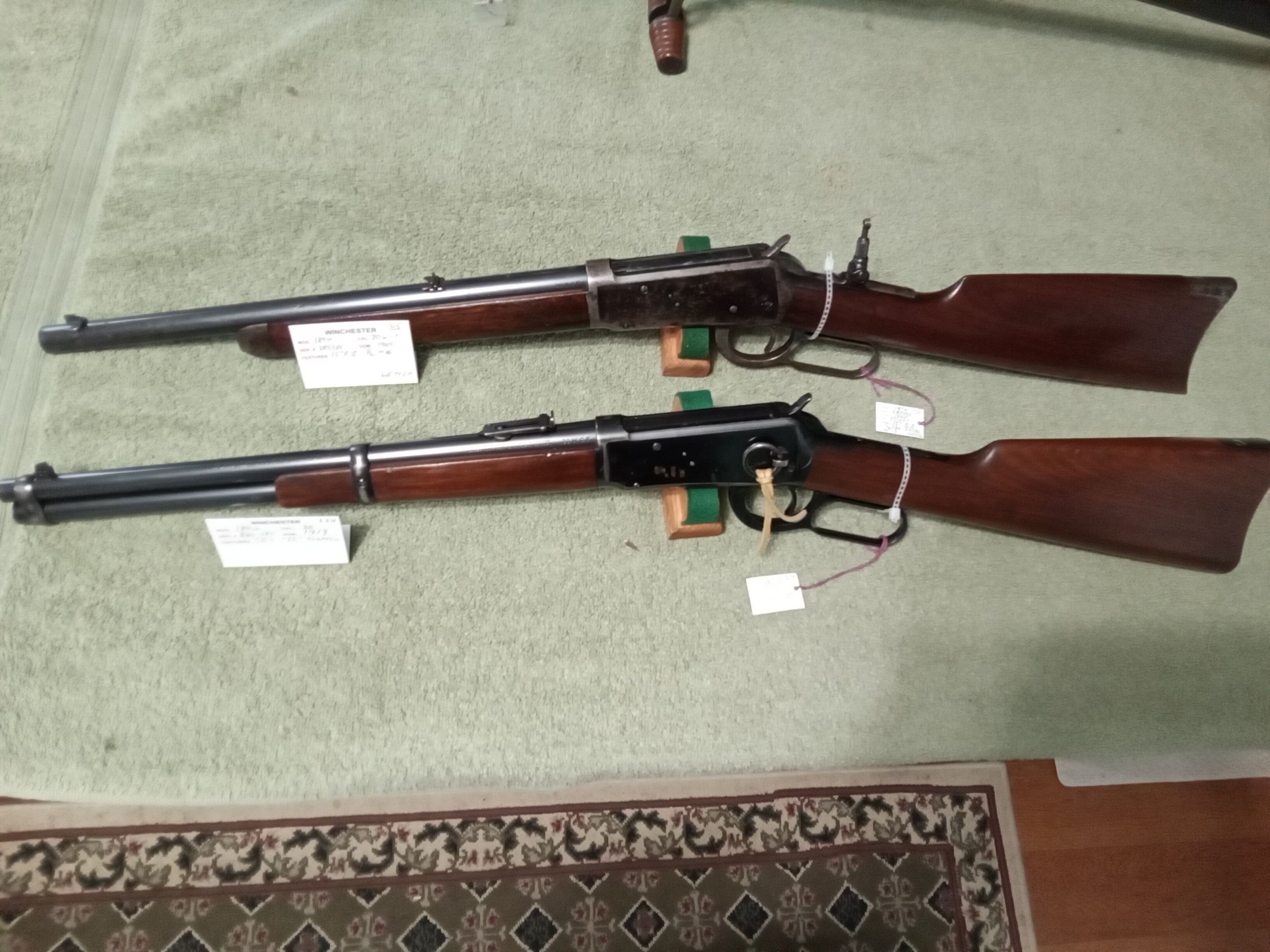
W.A.C.A. life member, Marlin Collectors Assn. charter and life member, C,S.S.A. member and general gun nut.
July 2, 2023
Offline
Henry Mero said
As most of You know I am very partial to the “trappers”. By comparison here is a 15″ “trapper” carbine and a 15″ short rifle , I just find the carbine more asthetically pleasing, (to My eye), in proportion etc. compared to the short rifle. Even though the short rifle is far more rare, (1 of 13), than the carbine, ,(1 of 272), letterable, I still prefer the looks of the carbine. I have the history and factory letter for the short rifle, see Winter 2025 W.A.C.A. magazine, but the carbine is to late to letter, but is 100% correct. In this case the rifle was carried and used in the rugged environment of northern Canada while the carbine spent most of it’s life in a gentleman’s gun room in Wisconsin.
Always an exemption!
My theory as it is just my personal belief and yes there are guns like “trappers” that have undoubtedly sat in barns or closets collecting dust all their life and have had “Uneventful lives”


1 Guest(s)
