

 Log In


November 19, 2006
 Online

Bert H. said
That bolt in the Ross rifle reminds me of the bolt in my Remington Model 742, but it differs in the way it functions.
Bert
I’ve had a couple Remington 742’s and yes indeed, I see the similarity of the bolts. The Remington bolt head also spins to lock and unlock into the rear of the barrel. It is in a way, also a straight-pull – it is just pulled back through the gas operating function vs. manual pull on the bolt.
September 19, 2014
 Offline
I rather enjoy the “mouse trap” anology! There is absolutely NO WAY I would ever get one put back in a rifle!! Ask anyone who know me well now just why. My hands have a decided tremor now days. Some things I work around, others I leave alone. Tim

January 20, 2023
Online
Steve, thanks for the additional images.
You speak of a “mousetrap” — indicating the rotation of the lugs into battery is spring-driven, occurs instantaneously, and is triggered — at a guess — when the bolt face reaches it’s forwardmost position inside the receiver ring. I assume manual retraction of the bolt to commence ejection must reverse-rotate the lugs and re-cock them.
Getting the parts dimensioned to make the contraption work had to have been somebody’s nightmare.
The only straight-pull bolt action rifle I’ve ever used is a Browning T-bolt I still own. It’s a neat little gun and the Ross is beautiful but i’m not sure the marginal increase in speed of manipulation is worth the additional mechanical complexity, particularly in a battle rifle. Browning’s long recoil action – which existed at the time – although not nearly so elegant in appearance — was probably more robust and made of fewer, cruder parts. And if you had sound bridgework, it was much better at rate of fire. While the original Remington Model 8 rifle was not so chambered, the Model 81 could fire the 300 Savage round, which approximates original 30/06 ballistics. I had one.
And most post-mortems concerning poor George Grey do put the blame on bullet failure, ignoring the completely idiotic practice of chasing down lions on horseback to induce a charge. At least according to the late Peter Capstick (granted, not the most reliable source), all or most of Grey’s rounds hit the lion in the chest but failed to adequately penetrate its heavy chest muscles. Now, that begs the question whether the bullet failed structurally or it just had insufficient weight and momentum to do the job. The average pukka sahib at the Anglo-Indian Club would say Grey would still be alive if he’d used a Holland 465 or something ….but nobody really knows. There has been one instance in recent years of a very large American Grizzly being defensively killed mid-charge by an Elk hunter with a 7mm Remington Magnum rifle, the external ballistics of which are not far off the 280 Ross. And a big Grizzly is much heavier and stronger than any African lion. Too many variables and not enough instances but the best guess is the poor bullet construction of the day was the proximate cause of Grey’s death.
- Bill
WACA # 65205; life member, NRA; member, TGCA; member, TSRA; amateur preservationist
"I have seen wicked men and fools, a great many of both, and I believe they both get paid in the end, but the fools first." -- David Balfour, narrator and protagonist of the novel, Kidnapped, by Robert Louis Stevenson.
October 14, 2024
Offline
I’m enjoying this thread immensely. It is about the only online source that has info about the Ross rifle(s). Steve, are you aware of any other forum that devotes time to the Ross?
November 19, 2006
Online

Zebulon said
Steve, thanks for the additional images.
You speak of a “mousetrap” — indicating the rotation of the lugs into battery is spring-driven, occurs instantaneously, and is triggered — at a guess — when the bolt face reaches it’s forwardmost position inside the receiver ring. I assume manual retraction of the bolt to commence ejection must reverse-rotate the lugs and re-cock them.
Getting the parts dimensioned to make the contraption work had to have been somebody’s nightmare.
The only straight-pull bolt action rifle I’ve ever used is a Browning T-bolt I still own. It’s a neat little gun and the Ross is beautiful but i’m not sure the marginal increase in speed of manipulation is worth the additional mechanical complexity, particularly in a battle rifle. Browning’s long recoil action – which existed at the time – although not nearly so elegant in appearance — was probably more robust and made of fewer, cruder parts. And if you had sound bridgework, it was much better at rate of fire. While the original Remington Model 8 rifle was not so chambered, the Model 81 could fire the 300 Savage round, which approximates original 30/06 ballistics. I had one.
And most post-mortems concerning poor George Grey do put the blame on bullet failure, ignoring the completely idiotic practice of chasing down lions on horseback to induce a charge. At least according to the late Peter Capstick (granted, not the most reliable source), all or most of Grey’s rounds hit the lion in the chest but failed to adequately penetrate its heavy chest muscles. Now, that begs the question whether the bullet failed structurally or it just had insufficient weight and momentum to do the job. The average pukka sahib at the Anglo-Indian Club would say Grey would still be alive if he’d used a Holland 465 or something ….but nobody really knows. There has been one instance in recent years of a very large American Grizzly being defensively killed mid-charge by an Elk hunter with a 7mm Remington Magnum rifle, the external ballistics of which are not far off the 280 Ross. And a big Grizzly is much heavier and stronger than any African lion. Too many variables and not enough instances but the best guess is the poor bullet construction of the day was the proximate cause of Grey’s death.
Bill –
It is not spring action that turns the locking lugs into place, but rather, manual action of pushing the bolt. I’m very far from a mechanical expert, but I would say that the spring action is what returns the bolt head to battery. You cannot (properly) put the bolt back in the action unless the bolt head is fully extended. This is accomplished by pulling the bolt head forward (working against the springs) (i.e. setting the mouse trap).
I was thinking back to Bert’s comment about the bolt similarity to the Remington M742. The multi-locking lugs are a very similar feature.
I think it likely that had Mr. Gray been using a modern 7mm magnum, and hit that lion many times in the chest, he would have lived a slightly longer life. I say slightly because he would have been emboldened by his kill and pursued even more lions on horseback – which was destined for a bad outcome. The reason I think the use of a modern 7mm magnum (which ballistics are very close to the .280 Ross) would have been effective, is the 7mm mag. would have been loaded with modern and better constructed bullets. I think they likely would have penetrated adequately, mushroomed and got the job done.
Sir Charles had three focuses: military rifles, match rifles and sporting rifles. I think the straight-pull design was key in his plan to obtain military contracts. I think he felt the straight-pull action not only offered faster speed of operation, but even more importantly, less hand/wrist fatigue as only two operations are needed to be performed to fully cycle the action – vs. four of the turn-bolt rifles.
Some of you know that at one time I operated my own Ross rifle website. It had a forum, photo gallery, education information – everything Ross. I had it up for around ten years. Unfortunately, I was no match for hackers and the data got corrupted. To answer Kevin’s question, I don’t know of a specific forum for Ross. You can find occasional discussion on a few other forums – Canadiangunnutz is where I have seen Ross discussion over the years.
I appreciated Tim’s comment and yesterday when I was trying to slide the, “mouse trap” back into the receiver, and it snapped shut on my several times, I was forced to ponder if possibly I’m not a steady as I used to be 
October 14, 2024
Offline
Steve, I didn’t know that you had a Ross website in the past. I can only imagine the amount of work that it entails. I loathe scammers and hackers!
November 19, 2006
Online
kevindpm61 said
Steve, I didn’t know that you had a Ross website in the past. I can only imagine the amount of work that it entails. I loathe scammers and hackers!
Yes, it turned from something I did for enjoyment into a lot of unpleasantness. It got to the point that I was receiving hundreds of spam registrations per day.
November 19, 2006
Online
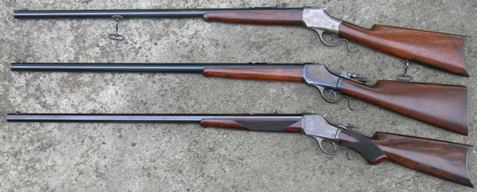
As we know, Ross was not the only one to build a straight pull rifle. There’s quite a few examples to be had.
Here is a Steyr straight-pull built up by Peterlongo of Innsbruck that I have:
And what a difference light can make in showing the wood:
I don’t completely avoid modern rifles. Here’s a Mauser .270 WCF (trying to keep some Winchester in the topic) I have with sights that I can actually see well enough to hit a target with:

April 3, 2018
Offline
CAPT Herbert Mc Bride, an officer in WW I with both the Canadian and US Army, writes of the Ross rifle chambered in .303 British that was used as a general infantry rifle and sniper version with some effect in France. His rare ” A Rifleman Went to War” outlines the Canadian use of the Ross rifle in WW I. It is a well-written and documented account.
The effectiveness of the .280 Ross in Africa might have been somewhat enhanced had solid bullets been more available or perhaps controlled expansion bullets similar to those now made by Nosler, Woodleigh, and Swift. WDM “Karamoja” Bell was successful using the .275 Rigby (7X57 Mauser cartridge) against elephant due to a long parallel- sided solid metal-cased bullet of about 175 grs at medium velocity, very accurately placed.
November 19, 2006
Online
450 Fuller said
CAPT Herbert Mc Bride, an officer in WW I with both the Canadian and US Army, writes of the Ross rifle chambered in .303 British that was used as a general infantry rifle and sniper version with some effect in France. His rare ” A Rifleman Went to War” outlines the Canadian use of the Ross rifle in WW I. It is a well-written and documented account.
The effectiveness of the .280 Ross in Africa might have been somewhat enhanced had solid bullets been more available or perhaps controlled expansion bullets similar to those now made by Nosler, Woodleigh, and Swift. WDM “Karamoja” Bell was successful using the .275 Rigby (7X57 Mauser cartridge) against elephant due to a long parallel- sided solid metal-cased bullet of about 175 grs at medium velocity, very accurately placed.
I’ve read this book. It’s recommend it. Capt. McBride had quite a war experience and he describes it well. Written by a man who was there.
November 19, 2006
Online
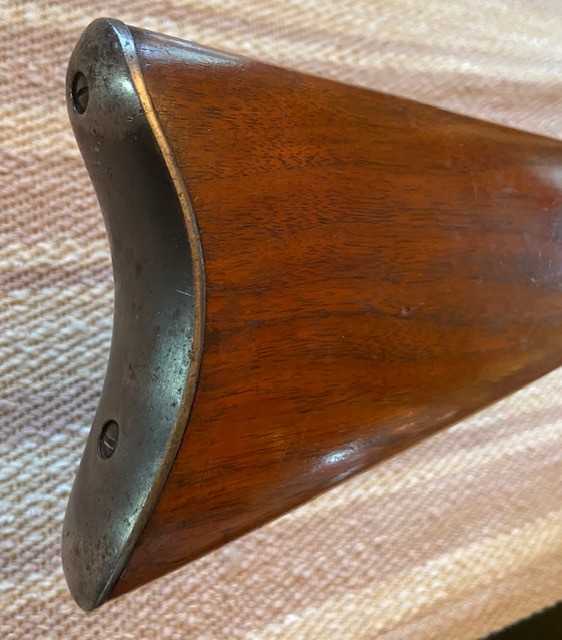
Bill mentioned his Browning T-bolt staight-pull .22 rimfire. I don’t have a T-bolt but I do have a pair of straight-pull .22’s. They are both Ross Cadets of course and the one with the checkering is a one-of-a-kind special order. They are commercial Cadets, which are not often seen. Nearly all the Cadets you will find are military versions. The plainer Cadet was available in Canada only. It is identified by a buttplate specific to that variation. A fellow Ross collector has only seen three in 70+ years of Ross collecting.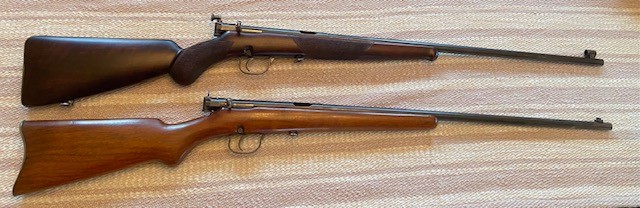
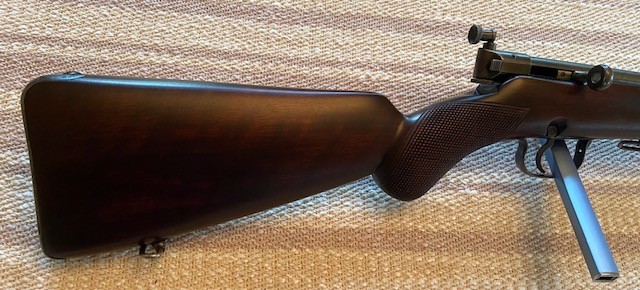
I’m trying something very new for me. I’m going to see if I can post photos directly – without using my usual outside hosting site. I have tentative optimism that I will be successful.
October 14, 2024
Offline
Pictures worked Steve! You certainly have some rare and interesting rifles. I have to say that I am a bit jealous.

April 15, 2005
Offline
steve004 said
I’m trying something very new for me. I’m going to see if I can post photos directly – without using my usual outside hosting site. I have tentative optimism that I will be successful.
Now that you have mastered the direct upload, I am commanding that you continue doing so! 
Bert
WACA Historian & Board of Director Member #6571L
November 19, 2006
Online
Bert H. said
steve004 said
I’m trying something very new for me. I’m going to see if I can post photos directly – without using my usual outside hosting site. I have tentative optimism that I will be successful.
Now that you have mastered the direct upload, I am commanding that you continue doing so!
Bert
I’ll do my best! As least I have the instructions to refer back to. Assuming I can find them again
April 15, 2005
Offline
steve004 said
Bert H. said
steve004 said
I’m trying something very new for me. I’m going to see if I can post photos directly – without using my usual outside hosting site. I have tentative optimism that I will be successful.
Now that you have mastered the direct upload, I am commanding that you continue doing so!
Bert
I’ll do my best! As least I have the instructions to refer back to. Assuming I can find them again
I have confidence that you will…
WACA Historian & Board of Director Member #6571L
March 15, 2020
Offline
I just found a W R A 280 cartridge in my junk. I don’t need it. Anyone interested in it? Don
November 19, 2006
Online
This is the best explanatory piece of information I have seen on the topic of the Ross bolt. It hits all the points and at the end, you get to see a Ross fired with the bolt assembled incorrectly:
https://www.forgottenweapons.com/myth-and-reality-of-the-ross-mkiii/
April 15, 2005
Offline
steve004 said
This is the best explanatory piece of information I have seen on the topic of the Ross bolt. It hits all the points and at the end, you get to see a Ross fired with the bolt assembled incorrectly:
https://www.forgottenweapons.com/myth-and-reality-of-the-ross-mkiii/
Awesome video and explanation!
Bert
WACA Historian & Board of Director Member #6571L
January 20, 2023
Online
Absolutely. There’s an expression that came into common use in the Nineteen Eighties, in contracts for the sale of an ongoing business, after industrial videos started being extensively used in-house as teaching tools: “Show-How”, a riff on “know-how.” Show-how became shorthand for the intellectual property businesses accumulate like assembly videos, maintenance videos, safety videos, etc.
This video is a great piece of show-how. Well produced, geat pacing, understandable narrative, enough camera time on the mechanisms for the viewer to grasp what’s being shown. I watched parts of it twice. A great thing about show-how videos.
Steve, I think I actually understand enough about how the Ross action operates- after watching this video — that I can now see just how slick a .280 Ross sporter would be!
[However, I passed on the Jackson Armory Mk IIII and bought another 99 EG – a 250.]
- Bill
WACA # 65205; life member, NRA; member, TGCA; member, TSRA; amateur preservationist
"I have seen wicked men and fools, a great many of both, and I believe they both get paid in the end, but the fools first." -- David Balfour, narrator and protagonist of the novel, Kidnapped, by Robert Louis Stevenson.
April 15, 2005
Offline
I found it interesting that the bolt rotates counterclockwise on the Ross, whereas my Remington 742 rotates the bolt clockwise when locking into battery.
Bert
WACA Historian & Board of Director Member #6571L


