

 Log In


December 13, 2006
 Offline


Just watched a video of Andrew? Of BTO Range . . . .
He was talking about a Winch. M94, saying the serial number was applied in the “polishing room” BEFORE the receiver was assembled into a complete rifle . . . .
Then . . . . .when the entire rifle was “accepted” at the warehouse, the number was again, recorded.
He says Madis used the warehouse number/date to establish DOM . . . .while I think WCA uses the polishing room record for the DOM.
If the polishing room number on the NAKED receiver is what is called the DOM . . . .how can that be, if that date was ONLY the receiver?
Wouldn’t the warehouse number be MORE accurate as it is now a COMPLETE RIFLE?
I’m confused . . .straighten me out! . . . .PLEASE!!

April 15, 2005
Offline

Jim,
The Polishing Room date is the precise date that the serial number was stamped on the receiver frame (prior to final poilshing and then bluing it). Prior to having a serial number assigned & stamped on the receiver frame, it was an untraceable lump of machined steel. Per Federal law, the act of stamping a serial number on a firearm frame is the official date of manufacture, as it then becomes traceable item. That also is the offical date that WACA uses.
Now, having cleared up that question, the “received in warehouse” date documented the specific date when the rifle was ready for sale… not when it was actually fully assembled (manufactured). Keep in mind that many production events occurred after the final assembly, but prior to the gun being logged into the warehouse for sale & shipment. The following is a brief synopsis of the production steps beginning with serialization:
1. Serial number applied to receiver frame, then final polishing.
2. Sent to the bluing room (or in rare cases case color finishing).
3. Sent to the assembly room in a bin containing dozens of blued serialized receiver frames.
4. Physical assembly begins, culminating in a complete functioning firearm.
5. Inspection for Fit, Finish, & Function (stamp applied near trigger).
6. Sent to the Proofing Room for test fire with a proof load and then inspected again and the “WP” in oval applied to the barrel and receiver frame.
7. Sent to sight in room, fired 6 – 10 rounds to set the sights.
8. Sent to packing room, cleaned, oiled/greased, and packed.
9. Sent to warehouse for sale/shippment.
The time interval between the serial number application date and the received in warehouse date was typically 7 – 14 days, but it could sometimes be much shorter, or much longer. The final date of note is the sale/shipment date which could be as little as the same date as it was received, to as much as 19-years later.
The CFM Factory letters currently provide three dates; (1) Polishing Room SNA (serial number application) date; (2) Received in warehouse date; (3) Shipped (sold) date.
These are a few examples of a Model 1894 factory letter with the three different dates;
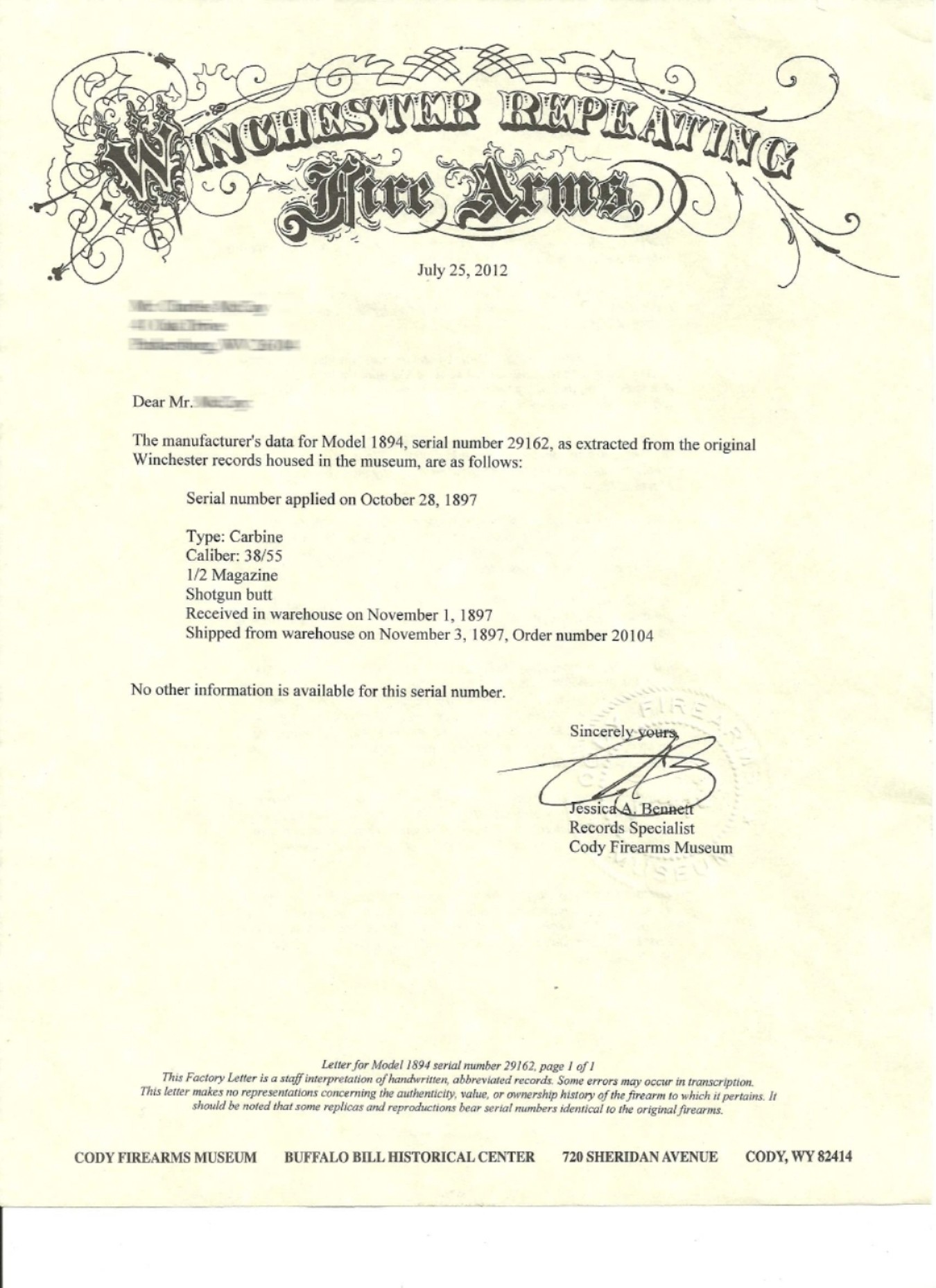
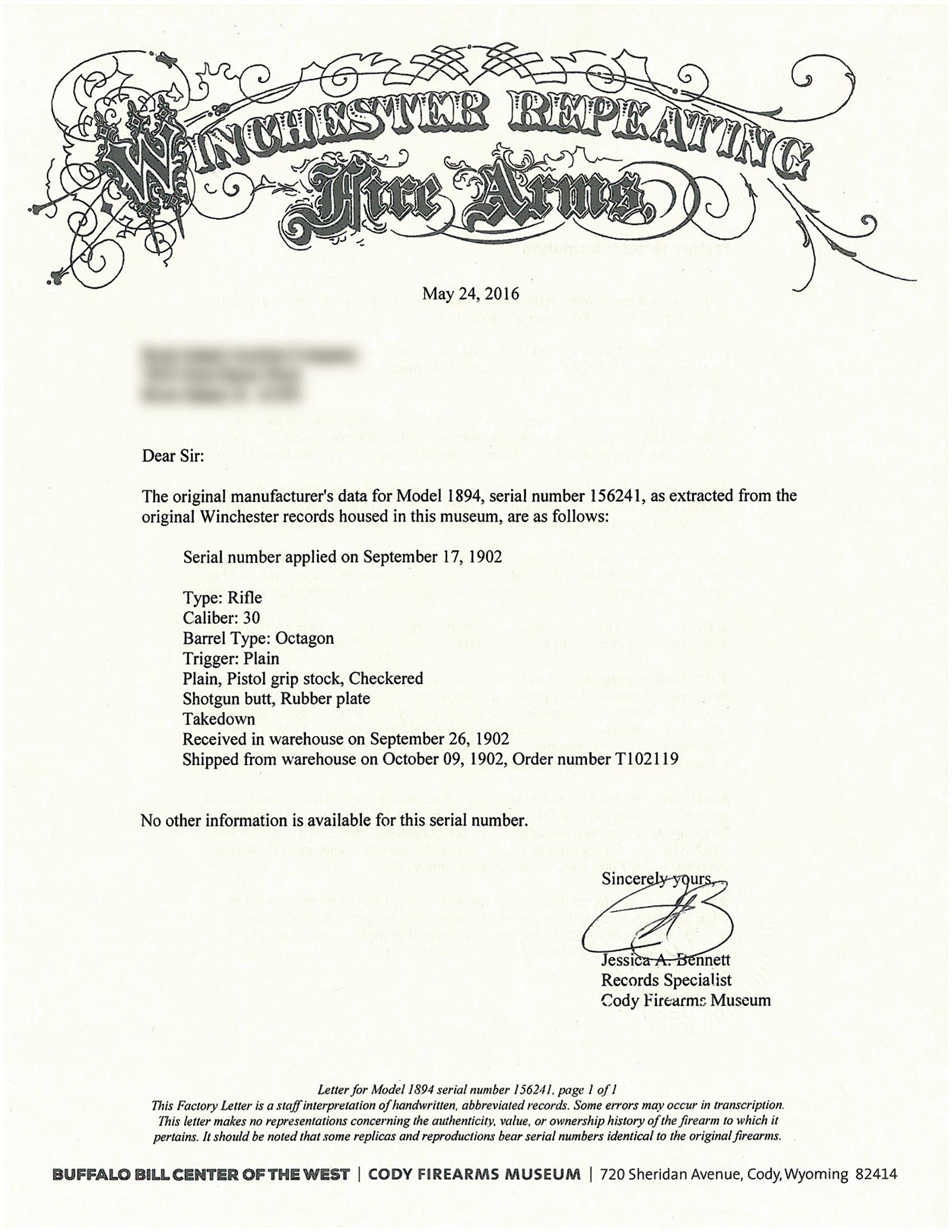
Now with all of that stated, the dates of manufacture that George Madis used (and published) for the Model 1894 were very apparently not any of the aforementioned dates, most especially the “antique” serial number range.
Bert
WACA Historian & Board of Director Member #6571L
December 13, 2006
Offline
WOW! Bert . . . . .
What a GREAT, DETAILED REPLY to my question! . . . . .
MANY, MANY, MANY THANKS!!


1 Guest(s)
