

 Log In


September 19, 2014
 Online

Chris, you have very valid points. As to your question, I don’t know. However all the US big names went to ‘factory authorized’ service centers rather than do the work themselves. I imagine Pauline may have a good idea as I imagine she knew when they stopped that (except for custom shop repairs). Tim

May 23, 2009
 Offline
tim tomlinson said
Chris, you have very valid points. As to your question, I don’t know. However all the US big names went to ‘factory authorized’ service centers rather than do the work themselves. I imagine Pauline may have a good idea as I imagine she knew when they stopped that (except for custom shop repairs). Tim
My question being, When did this practice occur for Winchester? For which model firearms? And what proof do you offer as such? Or is this just a theory?
I have seen factory correspondence of Winchester performing work in regards to re-bluing, re-stocking, re-checkering, re-plating as late as the early 1960s. Most notably regarding two 1of1000 rifles that were found during the 1950s Paramount Movie search. They were re-blued, re-gold plated, engraving touched up, stocks refinished etc.
Regarding the Model 21 Shotgun, its my understanding is that they would re-work them at the New Haven factory only and did so until the plant closed.
Sincerely,
Maverick
WACA #8783 - Checkout my Reloading Tool Survey!
https://winchestercollector.org/forum/winchester-research-surveys/winchester-reloading-tool-survey/

April 15, 2005
Offline

When the newly formed U.S.R.A.Co. purchased the New Haven factory from Olin, part of the sales agreement was that they would not do any warranty work or repair any of the firearms previously manufactured by Winchester Olin. Olin contracted with at least four different companies/shops to perform any warranty work required. Those four shops were listed in the Winchester Model 100 recall notice that was issued in July of 1990.
W. R. Long Gunsmiths
2007 Brook Road North
Cobourg, Ontario K9A4W4
Canada
Frank LeFever & Sons
RD 2 Box 31
Lee Center, NY 13363
USA
Bolsa Gunsmithing
7404 Bolsa Avenue
Westminister, CA 92683
USA
Nu Line Guns
1053 Caulks Hill Road
Harvester, MO 63303
USA
WACA Historian & Board of Director Member #6571L

March 14, 2022
Offline
Buck1967 said
Rick C said
Buck1967, the best way I can explain, it doesn’t mean it’s not collectable to certain individuals and I’m sure others here, including Bert, can elaborate or expand better than I can but, a restored gun to Most collectors has no collector value.
Rick I swear I’m not trying to be obtuse but where do we draw the line? Grandpa has a Winchester and passes it down to his son who in turn sands it down and restains the butt when his own son is say 5 and then that son inherits it when dad passes away. Son may not even know dad did anything to the rifle and thus innocently believes it is original. He then innocently sells it to you or I. Did we then get ripped off? Isn’t the reality that there has to 1000’s and 1000’s of such Winchesters that were restored and none of us even know? My ignorance may be on full display here but how would any of us know if a rifle were one of those? Are we really saying fixing a scratch devalues the rifle? Literally an itch we can’t scratch? 😀 again, very much appreciate the education to help in my buying decisions!
Buck1967, Wow, nice buggy!! This is not apples and oranges. An antique firearm, coin, etc, doesn’t compare imo. This beautiful wagon is a true example of when a restoration probably does increase the value if it is in a sad state of decay, so your query does have merit. It reminds me of the show “Rick’s Restoration”(no pun intended). Stunning and valuable!
Rick C
June 15, 2024
Offline
This has been a really interesting thread, and I think begs the question of whether or not this Association should attempt to set definitions of original, restored, refurbished, etc. so that there is a common baseline and understanding. You guys know I am a fan of AI to help jump start things, so I asked my favorite bot for guidance and here’s what it burped out. If the members agree there is value in coming to consensus on this then maybe we start a new thread and try to work through to a final version. I would suggest starting with agreeing on the name / number of categories first and then working through the definitions. No pride in authorship (prompting AI) so if the below makes no sense, then throw it out 🙂
1. Factory Original (All-Original)
Meaning:
The firearm remains exactly as it left the factory in all major respects.
Requirements:
- Original finish: bluing, case-hardening, color, oil finish, etc.
- Original wood (no sanding, no refinishing, no replaced buttplate or forend).
- All parts original: screws, springs, sights, magazine tube, firing pin, small parts.
- Original markings unaltered.
- Honest wear, patina, aging, or thinning is acceptable and expected.
Disqualifiers:
- Any refinishing: reblue, cold blue, re-case, re-nickel, stock sanding, restaining.
- Replacement parts—even correct, original Winchester/Colt/etc. parts from a donor gun.
- Repaired cracks, recut checkering, polished screws.
- Altered or enhanced markings.
2. Factory Correct
Meaning:
All types of parts and finishes are the same as the factory originally used, but some may not be the original parts.
Examples:
- A replaced hammer, magazine spring, or sight that is correct for the year/model.
- A barrel replaced with a period-correct factory barrel.
- Recut or improved checkering not allowed in this category; that becomes “restored.”
This acknowledges authenticity without claiming originality.
3. Refinished
Meaning:
The firearm’s finish has been renewed but not necessarily fully restored.
Typical examples:
- Reblued or cold-blued barrel/receiver.
- Re-case-hardened frame.
- Stock sanded and given new oil, or poly.
- Markings may appear softened or polished over.
Collector impact:
- Significant drop from original value.
- Acceptable for shooters, not for investment-grade collecting.
4. Restored
Meaning:
The firearm has been intentionally brought back to like-new or near-factory appearance, often using significant work.
Typical restoration actions:
- Full reblue or correct-style charcoal blue.
- Full re-case hardening (e.g., Turnbull restoration).
- Recut checkering.
- Stock replaced with a correct pattern or heavily refinished.
- Replacement of lost or worn parts with correct reproductions or period originals.
A high-end restoration may be highly respected, but it is still not original.
Auction houses often use:
- “Professionally restored”
- “Expertly restored”
- “Restored to near factory new”
5. Sympathetically Restored
Meaning:
Restoration done with the minimum necessary intrusion, preserving as much original material and appearance as possible.
Examples:
- Steam dents from wood without sanding.
- Touch-up bluing only in small bare areas.
- Repair cracks with invisibly spliced wood but retain original finish.
- Clean rust and protect metal without rebluing.
- Replace only a safety-critical part.
This is a favored approach for historically important pieces.
6. Conserved / Preservation State
Meaning:
The firearm has NOT been cosmetically altered, only stabilized to prevent further deterioration.
Examples:
- Cleaning active rust, applying oil to protect metal.
- Waxing a dry stock without sanding or changing color.
- Removing old gunk, not altering finish.
- Mechanically cleaning or repairing internals without altering external appearance.
Museums use this approach for historically significant firearms.
7. Refurbished
Meaning:
Work done to improve functionality or condition, but not attempting full restoration or factory replication.
Examples:
- A firearm that’s been arsenal-refurbished (e.g., Garands, Mosins, SKSs).
- Replaced springs, pins, ejector, extractor, etc.
- Mixed finishes (e.g., reblued barrel, untouched receiver).
- Stock refinished but metal left alone.
A refurbished firearm may look good but will not command collector premiums.
8. Modified / Customized / Upgraded
Meaning:
The firearm no longer matches factory configuration.
Examples:
- Drilled and tapped receivers.
- Rebarreled to different calibers.
- Cut-down barrels or stocks.
- Added recoil pads not original to the model.
- Engraving added later.
- Sights replaced with modern or non-factory patterns.
- Polished internal parts to non-factory standards.
These changes typically hurt collector value, although custom guns by famous makers (e.g., Griffin & Howe, Sedgley) remain desirable.
9. Antique / Untouched
A special subcategory used by auction houses:
“Untouched” means:
- No cleaning
- No polishing
- No rust removal
- No sharpening of screws
- No stock conditioning
- No modern oils or waxes
- No alterations at all
This is often reserved for high-value antiques where even gentle cleaning can reduce historical integrity.
December 21, 2006
Offline
This gun , ser#3599 is 1 of 3 case colored 1894’s I’ve had, this one,3699, being original , ser#15147 was completely restored/rebuilt by Turnbull and ser#15333 had the case coloring redone, both of the “restored” guns were one of one guns with the features they had but neither one of them brung the money that #3599 will bring, My opinion only. So I guess what I am experiencing is this: an original condition gun with somewhat lesser condtion is more valuable than a high condition, restored gun, rarity aside.
W.A.C.A. life member, Marlin Collectors Assn. charter and life member, C,S.S.A. member and general gun nut.
May 23, 2009
Offline
Henry Mero said
So I guess what I am experiencing is this: an original condition gun with somewhat lesser condtion is more valuable than a high condition, restored gun, rarity aside.
Those are pretty much the facts regarding the current state of the collecting community and sentiment. I don’t see this changing anytime soon. Perhaps over time, maybe, but would imagine this will always be the case.
Can you think of an example in any collecting field where an item that is restored is more valuable than an original high condition item?
WACA #8783 - Checkout my Reloading Tool Survey!
https://winchestercollector.org/forum/winchester-research-surveys/winchester-reloading-tool-survey/
April 15, 2005
Offline
Addressing topic post #45
I am in agreement with the information posted. There might be a few minor nuances that could be added, but it concisely covers the topic very nicely.
Bert
WACA Historian & Board of Director Member #6571L
December 9, 2002
Offline
Bert,
I’m in agreement with you on it, as I feel, Alaska94 did a great job with it, and I like the idea of incorporating it here as a category type of classification, maybe that can be added to the main menu.
I will add that my family is big on hollering out, use, “Chat GPT”, and many of us have as I do myself, and I have corrected, “Chat GPT”, and correct it with facts sand verifying where and how I got my information, as credible sources, and it’ll make the corrections, and come back, verifying that I was correct.
With that said, you have my vote.
Anthony
February 17, 2022
Offline
Henry Mero said
This gun , ser#3599 is 1 of 3 case colored 1894’s I’ve had, this one,3699, being original , ser#15147 was completely restored/rebuilt by Turnbull and ser#15333 had the case coloring redone, both of the “restored” guns were one of one guns with the features they had but neither one of them brung the money that #3599 will bring, My opinion only. So I guess what I am experiencing is this: an original condition gun with somewhat lesser condtion is more valuable than a high condition, restored gun, rarity aside.
So Henry are you saying you purchased said 1894 for monetary assurances or the pure aspect of collecting and preserving?
October 20, 2022
Offline
How would a gun that was sent back to the factory and refinished or change calibers etc. And is listed that way in the records? Would that classify as factory original?
April 15, 2005
Offline
KWD57 said
How would a gun that was sent back to the factory and refinished or change calibers etc. And is listed that way in the records? Would that classify as factory original?
With verifiable proof that a Winchester was returned and reworked (rebarreled or refinished etc.), it is my opinion that the impact to the value is almost non-existent, as the gun is still arguably “factory original”.
Bert
WACA Historian & Board of Director Member #6571L
May 23, 2009
Offline
KWD57 said
How would a gun that was sent back to the factory and refinished or change calibers etc. And is listed that way in the records? Would that classify as factory original?
Key word being Factory.
Back in 1950, I could see how such a stance or such a viewpoint at that point time it would not make sense to call a refinished or changed gun as factory original. A lot of the very old time collectors would likely have felt that way. But you’re talking about a bi-gone era. Collectors in the age like George Madis in his prime of collecting or more exactly someone like his father, who was a gun dealer, likely could have held such a stance.
But as seeing how you haven’t been able to buy a Winchester marked firearm from New Haven, CT for the last 20 years and there is literally no factory left.
If it was done by Winchester, then its factory original in my book.
Maverick
WACA #8783 - Checkout my Reloading Tool Survey!
https://winchestercollector.org/forum/winchester-research-surveys/winchester-reloading-tool-survey/
December 9, 2002
Offline
KWD57 said
How would a gun that was sent back to the factory and refinished or change calibers etc. And is listed that way in the records? Would that classify as factory original?
As I am in agreement with both Bert and Mavericks statements, let me put it in another way.
If someone changes a Winchester in their shop, or wherever, and refinishes it, in various different ways, whether to improve it for they’re own use, or to make a buck, and in some cases many do a hack job on it, or change the firearm from it it’s original configuration, well we call that a Frankenchester.
As Winchester collectors, we have to have some kind of parameters to go by.
If you read and search the Winchester History, and dig into they’re research and development over many years of existence, you will understand more of what we’re trying to explain to you.
With the factory manufacturing several million Rifles over several years, and a customer service based industry, where they would literally, build you’re firearm, with many special requests, from a proven list of special options, and if you wanted anything changed on you’re Winchester, you could send it back, and they would do it and verify it with the proper documentation. Hence the Factory records!
Not everyone is a Winchester collector. I think you’re also splitting hairs with you’re terminology, “Sent back to the factory”. Many of us collectors, who own Winchesters, don’t hide the fact when sharing with other collectors, that statement when asked, “Did it come that way Originally”? That’s when when the conversation comes up, about being sent back to the factory, and in many cases is not known what was done, as the records only show, the dates it was sent back and then shipped out again.
I am trying to understand you’re view point!
Anthony
July 8, 2012
Offline
Bert H. said
KWD57 said
How would a gun that was sent back to the factory and refinished or change calibers etc. And is listed that way in the records? Would that classify as factory original?
With verifiable proof that a Winchester was returned and reworked (rebarreled or refinished etc.), it is my opinion that the impact to the value is almost non-existent, as the gun is still arguably “factory original”.
Bert
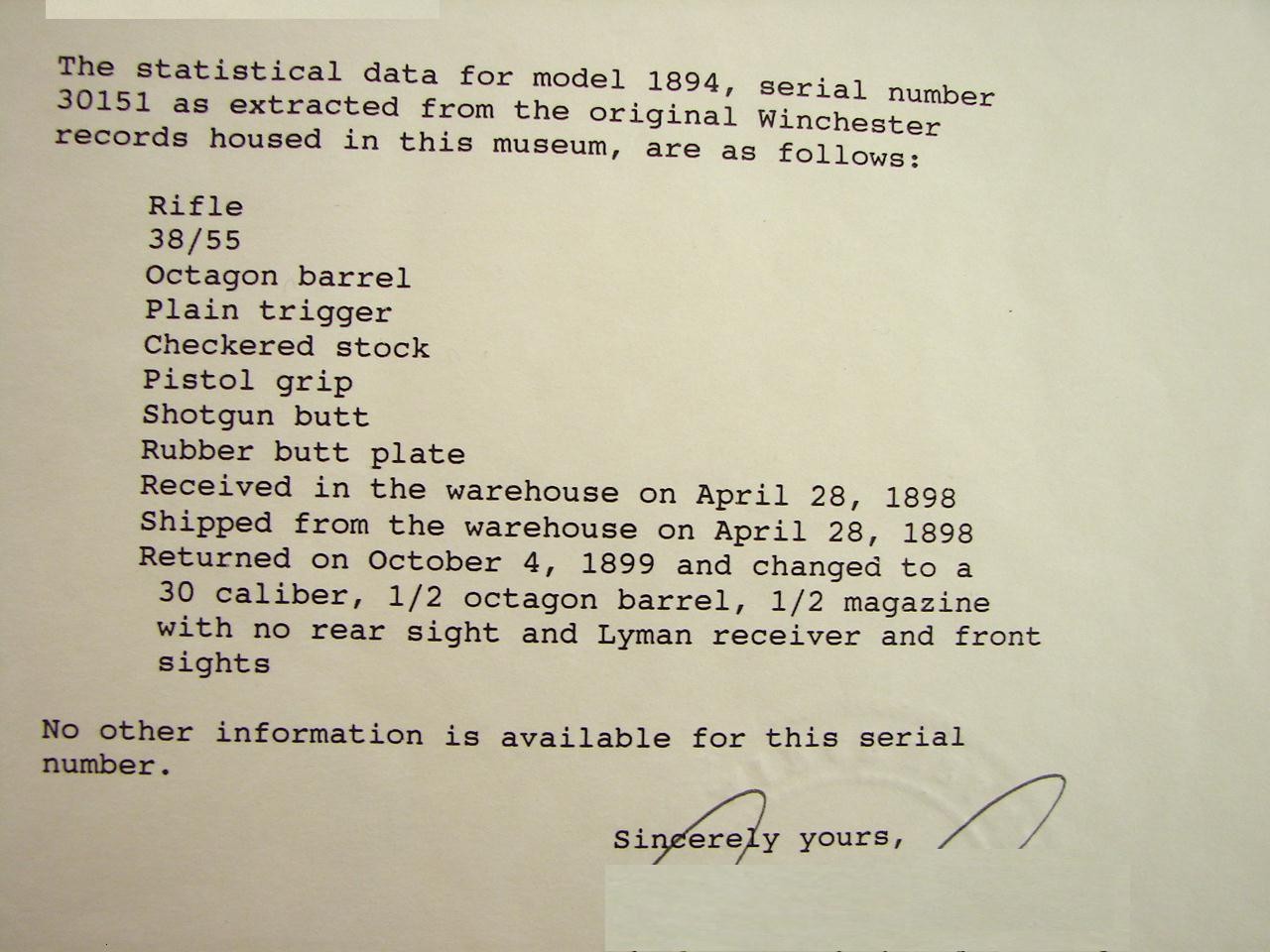
Kind of like this Model 1894 Deluxe I own?
December 21, 2006
Offline
Tom; I bought ser#3599 for several reasons, first and foremost it is a damn nice c.c.’d 1894,(to My eyes), second; it fit right in to My 1894 collection, not having a c.c.’d gun at the time, third; I felt it was a very good buy and a good investment, which it has proven to be, I have been offered substantially more than what I payed, fourth ser#3599 is a very early second model having first models with higher ser#’s puts this gun in a very special catagory , to Me and My collection.
W.A.C.A. life member, Marlin Collectors Assn. charter and life member, C,S.S.A. member and general gun nut.
December 21, 2006
Offline
Al; that is one of the nicest, clear cut “return” letters I’ve seen, wouldn’t it be nice if They’de done that all the time.
W.A.C.A. life member, Marlin Collectors Assn. charter and life member, C,S.S.A. member and general gun nut.
July 8, 2012
Offline
Thanks Henry. It sure would’ve been nice if they had.
April 15, 2005
Offline
tionesta1 said
Bert H. said
KWD57 said
How would a gun that was sent back to the factory and refinished or change calibers etc. And is listed that way in the records? Would that classify as factory original?
With verifiable proof that a Winchester was returned and reworked (rebarreled or refinished etc.), it is my opinion that the impact to the value is almost non-existent, as the gun is still arguably “factory original”.
Bert
Kind of like this Model 1894 Deluxe I own?
Exactly… a Model 1894 that was reworked (rebarreled) by Winchester and clearly documented. You have a very nice factory “original” Winchester 
WACA Historian & Board of Director Member #6571L
October 20, 2022
Offline
A friend of mine that has since passed away had a winchester model 1876 that was a one of a thousand it had been rechambered to another caliber which required the rear of the barrel to be shortened and part of the barrel markings were removed with the barrel alterations. I do not know if winchester would do that type of alteration or would replace the barrel entirely. But I remember my friend when he sold the gun he got substantially less than what a one of one thousand went for at that time. I did not know if he had a letter on the gun but the gun was in very high condition other than the alteration. It has alway stuck in the back of my mind that if he could prove that winchester did the work would it be reduced in valuation that much. I believe he got $30,000 when they were going for over $100,000 about 15 years ago.


1 Guest(s)
