

 Log In


A while back, I contacted the Cody Firearms Museum and received the original manufacturers’s data for my Model 1897, serial number 86058. It stated the following:
“Serial number applied on November 01, 1899
Type: Shotgun
Barrel Length: 30 inches
Trap
New Ejector
Takedown
Received in warehouse on November 07, 1899
Shipped from warehouse on November 08, 1899, Order number 42387″
I have two specific questions about the gun that some of the more knowledgable members probably know:
1) Are there any very early examples of the Trap model that lack the “Trap Gun” engraving on the bolt slide? While my gun is very original, it has a bolt slide with no markings. I know its provenance, it’s a family piece. But, of course, I have no idea if my great-grandfather had to replace the bolt slide for some reason.
2) Could one purchase a second barrel, with the same serial number, from Winchester at a later date? My gun has two “Full” choke barrels, a 30″ which is mentioned in the Cody Museum document, and a 28″ barrel with the same serial number and exact same writing and patent dates. Since the Cody Museum document doesn’t mention the 28″ barrel, I assume it was acquired later. I’m not surprised one could get extra barrels, but I’m surprised they would apply the serial number of the receiver on barrels purchased at a later date.
Thanks for any information on the gun, Jon.

April 15, 2005
 Offline
Question 1. None that I am aware of or verified.
Question 2. Yes, a second barrel assembly could be purchased at a later date. That stated, Winchester clearly stated that if a second barrel assembly was desired, that the gun must be returned to the factory so that the new (second barrel assembly) could be properly fitted. A retuned gun would have a “R & R
entry in the ledger records with the date of return and the work order number associated with it. That “R & R” event would have been documented on the factory letter. The fact that the second barrel (28″) has the exact same markings on it (including the patent dates) tells us that it is very close to the same age as the original gun (no more than 1-year apart). If the gun had been returned to Winchester even just 18-months after it was manufactured, the patent dates marked on the barrel the new barrel would not all be the same.
For all who are interested, just this past week I submitted a brand new 40-page article for publication in the WACA Collector magazine that details the entire production history of the Winchester Model 1897. Brad Dunbar is currently beginning the formatting & editing process for it.
Bert
WACA Historian & Board of Director Member #6571L

March 31, 2009
Offline
Bert H. said
For all who are interested, just this past week I submitted a brand new 40-page article for publication in the WACA Collector magazine that details the entire production history of the Winchester Model 1897. Brad Dunbar is currently beginning the formatting & editing process for it.
Bert
Can’t wait to see this.
Bert, thank you so much for the information.
It’s interesting, and rather confounding, that the second barrel isn’t listed in the original manufacturer’s specification sheet and no “R & R” is listed. As I said above, the serial numbers and the patent dates are the same. I looked the barrels over again and did find one difference that to me makes no sense, but might have some significance in dating the barrels. The 30′ barrel, which would be the one listed on the Cody Museum document, does not have the Winchester steel proof mark at the top between the “12” and the receiver. However, the 28″ barrel, which the Cody Museum doesn’t acknowledge, does have the steel proof mark in that spot.
I look forward to reading your article on the Model 1897.
Jon
April 15, 2005
Offline
[email protected] said
Bert, thank you so much for the information.
It’s interesting, and rather confounding, that the second barrel isn’t listed in the original manufacturer’s specification sheet and no “R & R” is listed. As I said above, the serial numbers and the patent dates are the same. I looked the barrels over again and did find one difference that to me makes no sense, but might have some significance in dating the barrels. The 30′ barrel, which would be the one listed on the Cody Museum document, does not have the Winchester steel proof mark at the top between the “12” and the receiver. However, the 28″ barrel, which the Cody Museum doesn’t acknowledge, does have the steel proof mark in that spot.
I look forward to reading your article on the Model 1897.
Jon
Jon,
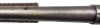
Are you referring to the superposed “WP” in an oval Proof Mark stamp? Can you send me clear pictures of the all the factory markings on each barrel?
Something like this…

Bert – [email protected]
WACA Historian & Board of Director Member #6571L
Bert,
As you shared with me via email, the “WP” proof mark wasn’t applied to barrels until July, 1905. So, it would appear that my extra barrel is a “R & R” after the midpoint of 1905. I’m curious when the October 16, 1900 patent was added to the barrels? Knowing when that patent was added (my extra barrel is lacking it) should pretty much nail down the timeframe the “R & R” was done.
Also closing the timeframe in which the “R & R” was done, I’ve read that a separate “P” in a circle/oval mark (distinct from the “WP”) was introduced around 1908-1913 for replacement barrels. If true, that would narrow it down to at least that 1905-1913 timeframe. Is the “P” in a circle mark and the associated time frame true?
Finally, I’ve noticed from my very limited experience that the early barrels that lack the “WP” mark seem to show more loss of bluing. The photo above labeled “Type-3-Barrel-marking” has a dull silver finish with a bit of “brown patina” that is very similar to my “non proofed” barrel. Is that typical and is there any reason for this outside of them being older?
Thanks again for your information and patience, Jon
April 15, 2005
Offline

[email protected] said
Bert,
As you shared with me via email, the “WP” proof mark wasn’t applied to barrels until July, 1905. So, it would appear that my extra barrel is a “R & R” after the midpoint of 1905. I’m curious when the October 16, 1900 patent was added to the barrels? Knowing when that patent was added (my extra barrel is lacking it) should pretty much nail down the timeframe the “R & R” was done.
Also closing the timeframe in which the “R & R” was done, I’ve read that a separate “P” in a circle/oval mark (distinct from the “WP”) was introduced around 1908-1913 for replacement barrels. If true, that would narrow it down to at least that 1905-1913 timeframe. Is the “P” in a circle mark and the associated time frame true?
Finally, I’ve noticed from my very limited experience that the early barrels that lack the “WP” mark seem to show more loss of bluing. The photo above labeled “Type-3-Barrel-marking” has a dull silver finish with a bit of “brown patina” that is very similar to my “non proofed” barrel. Is that typical and is there any reason for this outside of them being older?
Thanks again for your information and patience, Jon
The October 16, 1900 patent date was added to the barrel roll marking in October of 1900 (very near serial number 115000), but there was an overlap period of time when the both the Type-3 and Type-4 barrel markings were still in use.
Type-4 barrel marking;


At the time when Winchester began stamping the “WP” proof mark (in July of 1905), most of the barrels were marked with the Type-5A roll marking.


Based on the dates when the various barrel markings were used, it does not make any sense that the barrel you have with a Type-3 patent date has a Proof mark on it, and it cannot be used to definitively determine when the R&R might have occurred.
The (P) Mail Order proof mark was instituted in 1914 and it replaced the “OF” marking (on the bottom of the barrel).
The early barrels (before Proof marks) are materially identical to those that were manufactured all the way through the mid 1930s (when Winchester changed the bluing from “rust blue” to “Du-light blue”). The older the gun is, the more likely the bluing will have worn off or have turned to a brown patina… it is simply a function of age and use.
Bert
WACA Historian & Board of Director Member #6571L
Bert,
Ok, I’m going to put this to bed after I propose one last “Hail Mary” theory as to why this 28″ barrel has a Type-3 patent mark and a “WP” proof mark. My receiver 86058 also has a “WP” proof mark. I assumed it was supposed to, but I’m seeing some information that the proof marking on the receivers didn’t begin until after 1905 as well. Is it possible (or even likely) that my receiver and the 28″ barrel were returned to the manufacturer for a factory repair sometime after proof marking became the custom and they were “proofed” and so stamped in the repair process?
In this scenario, the 30″ barrel stayed home and didn’t get the same treatment and proof mark. If rebluing was done during a significant factory repair, that might explain why the receiver and 28″ barrel have a better retained finish than the 30″ barrel that is the same age. It might even explain what happened to the “TRAP GUN” engraved breech bolt that should be in it. Sure, there probably should be a factory record if repairs were done, but it’s obvious the factory record keeping had some holes in it.
In the end, I tend to learn towards both barrels being purchased initially with the gun, whether the Cody records show it or not. All three pieces have the 86058 serial number and both barrels have the Type-3 patent marking. The gun originally shipped on November 8, 1899, and given the speed of shipping back then, he may not have received it until December 1899. If the 28″ barrel was acquired later through a “R & R”, the receiver would have to go through the slow process of being shipped back to the factory and be fitted with the new barrel before October 1900 to have the Type-3 barrel marking. That is possible, but it seems an unlikely scenario, especially considering how little would be gained in adding a 28″ Full barrel when you already have a 30″ Full barrel.
Yet, all I know for sure is that I love shooting the thing.
Jon
April 15, 2005
Offline
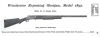
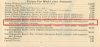
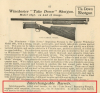
There are a number of different possibilities surrounding the 28″ barrel assembly and how/why both it and the receiver frame have post July 1905 applied proof marks on them. Having stated that, I do not believe that the 28″ barrel assembly was originally manufactured and shipped with the gun as a 2-barrel set. I say that because Winchester was very consistent with documenting the much more expensive (higher grade and special order) guns in the ledger records. A Model 1897 Trap Gun was an expensive upgrade, and a factory 2-barrel set was special order significant extra expense item. The total cost per the February 1899 catalog for a Trap Gun w/interchangeable barrel assembly would have been $67 as opposed to $25 for a standard grade gun.

My theory is that your gun (the receiver frame) was returned to the factory sometime shortly after July 1905 to have an interchangeable barrel assembly fitted to it, and in the process, Winchester refinished the receiver frame and proof tested it with the new barrel and then marked both parts prior to returning it to the owner.
Bert
WACA Historian & Board of Director Member #6571L
Bert H. said
There are a number of different possibilities surrounding the 28″ barrel assembly and how/why both it and the receiver frame have post July 1905 applied proof marks on them. Having stated that, I do not believe that the 28″ barrel assembly was originally manufactured and shipped with the gun as a 2-barrel set. I say that because Winchester was very consistent with documenting the much more expensive (higher grade and special order) guns in the ledger records. A Model 1897 Trap Gun was an expensive upgrade, and a factory 2-barrel set was special order significant extra expense item. The total cost per the February 1899 catalog for a Trap Gun w/interchangeable barrel assembly would have been $67 as opposed to $25 for a standard grade gun.
My theory is that your gun (the receiver frame) was returned to the factory sometime shortly after July 1905 to have an interchangeable barrel assembly fitted to it, and in the process, Winchester refinished the receiver frame and proof tested it with the new barrel and then marked both parts prior to returning it to the owner.
Bert
Your theory makes total sense except for that Type-3 patent marking on the 28″ barrel. Surely they didn’t have a pre October, 1900 barrel just laying around to use on a post July 1905 new barrel-fitting R & R.
Maybe the gun actually made two return trips to the factory. The first being prior to October, 1900 to have the 28″ barrel fitted, then a second trip post July 1905 for some factory repair, during which the receiver and barrel received the “WP” proof mark. That may be the most reasonable way of explaining the “anachronistic” markings on the gun and barrel. I wish the Cody Museum had found some repair or refitting records on the gun.
Jon


1 Guest(s)
