

 Log In


September 16, 2019
 Offline


Hi everybody,
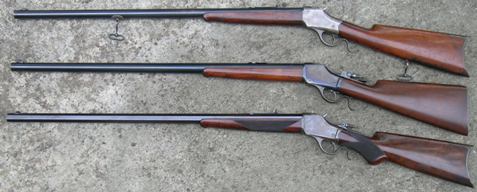
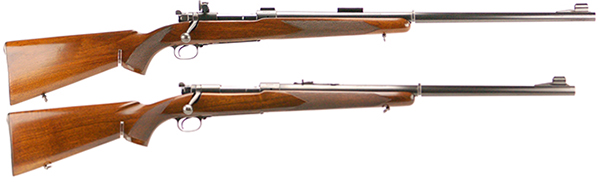
I have owned and seen many different Winchesters with so much difference in color of the wood – how come it ranges from almost black to the typical red tones? Was it custom order, was it due to the hard use, sweaty hands – or just different wood ?
Love to hear what you guys think….

April 15, 2005
Offline
F.K. said
Hi everybody,
Was it custom order, was it due to the hard use, sweaty hands – or just different wood ?
All of the above…
Bert
WACA Historian & Board of Director Member #6571L

November 5, 2014
Offline
F.K.
My “theory” is that much of the variability in wood color seen on Winchesters in similar condition is b/c the factory used THE SAME process to finish stocks regardless of the character of the wood. At least with M70s, it was stain, seal, fill, lacquer (two coats), checker, umber puffed on the checkering (later changed to stain), final lacquer coat. Same steps, same stain/filler/lacquer… No particular effort to make all M70 stocks look the same beyond imparting the color from the stain and filler… So you ended up with anything from “pecan” to “dark walnut”…
Of course the stain was sprayed by hand and the filler rubbed in by hand (that’s where most of the added “color” comes from), so I’m sure there was a little room for variation depending on the workman applying the finish. But I think (???) that the variability arises from using a mass production process (everything done the same) to a starting material that was variable.
Yes… When it comes to M70s they did change the color of the filler in the 1960s, which accounts for the ligghter color of some late M70 stocks. I have a copy of the Product Change Order around here somewhere…
Just my take,
Lou
WACA 9519; Studying Pre-64 Model 70 Winchesters

January 20, 2023
Offline
What Bert says.
For simplicity, let’s confine the discussion to the period from the inception of WRA through 1980.
American Black Walnut, jugens negra, was always the standard material for stocks and forearms, although not always available in the quantities required and with enormous variations in color and grain, largely depending whether the blank was mostly heartwood or sapwood and, to a lesser extent, from what part of the country the tree came from.
When Black Walnut ran short, wood from the sweetgum tree, liquidambar styraflua, was substituted, which is structurally suitable but uninteresting, and sometimes other species.
For fancy wood with extra color and grain, the stumps of Black Walnut were favored and reserved. In the British gunmaking business, fancy English Walnut a/k/a French or Circassian Walnut blank is often admiringly called “a hunk of stump.”
While the difference in species yields great variations in the color of the raw wood, how it is finished and with what makes a huge difference.
Black Walnut can be very coarse-grained and porous and Winchester routinely used a black material to fill the pores. All the specks and splots of black are not original wood.
The red-brown color of Winchester wood came from an alcohol based dye sprayed on to homogenize the different colors of the wood within a raw blank, which could range from Palamino blond to green to Ebony black. Owmers who elect to refinish an old Winchester stock are sometimes shocked when they remove the old finish.
Oil finishes turn dark with years of exposure to the Sun, whether linseed oil or tung oil or some other variety. Add enough drying and curing agents to the oil and it is called varnish. It will degrade too but it takes longer.
But for the most part, Winchester’s standard topcoat was not varnish but clear sprayed lacquer because it was quicker and looked nice until it started flaking and peeling. Lacquer is not very resistant to water.it can be helped by wiping on Tru-Oil or boiled linseed oil and rubbing off the excess.
Toward the end of ownership by Olin, modern urethane varnishes began to be employed, certainly by 1964 although some say sooner. Oil based urethane varnish is warm toned, hard and durable. It is not easily touched up or removed.
- Bill
WACA # 65205; life member, NRA; member, TGCA; member, TSRA; amateur preservationist
"I have seen wicked men and fools, a great many of both, and I believe they both get paid in the end, but the fools first." -- David Balfour, narrator and protagonist of the novel, Kidnapped, by Robert Louis Stevenson.
November 18, 2004
Offline
Zebulon said it well and I will add…. for 150 years Winchester and other gun companies sourced wood by various means. I’m talking color and maybe grain and burl. I believe 15 Midwest states provided good quality walnut. Early logging provided premium old growth from a region with certain unique local soil, rainfall, and growth maturity. I have heard the major gun manufacturers owned some timber land and leased or contracted for walnut delivery by standards. After 20, 25 years that area and supply was exhausted. Next location. Repeat for 7 time periods, 150 years. I’ve noticed major 20 year trends of reds, browns, blacks, golden in my collecting time. Think about what you’ve seen of Winchester, Remington, Marlin, Colt guns for identical 20, 25 year color trends.


1 Guest(s)
