

 Log In


May 23, 2009
 Offline

Chuck said
At first when the smokeless powder came out, or sooner, Winchester frowned upon reloading but soon changed his ways. Winchester probably realized what was going to happen and he wanted his cut of the market. It’s all about making money.
Your statement is very confusing to me. Oliver Winchester was dead by 1880. Well before Smokeless was on the market.
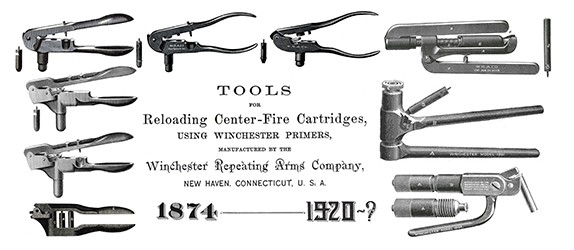
Regarding reloading, the very first Reloading Tool for Center-Fire ammunition was patented and put on the market by WRACo with the first tool’s patent held by William Wirt Winchester, which is Oliver’s son. When smokeless powder came onto the scene around 1895, WRACo as a company both discouraged and had recommendations on reloading with smokeless powder. But you’ll notice very few Smokeless cartridge calibers were made and sold in their reloading tools.
Winchester as a company certainly had a knack for buying up the competition and shelving them to help restrict the market share in their favor.
Sincerely,
Maverick
WACA #8783 - Checkout my Reloading Tool Survey!
https://winchestercollector.org/forum/winchester-research-surveys/winchester-reloading-tool-survey/
May 23, 2009
Offline
1873man said
The 73 was the same price as the 92 from the catalogs from about 1892 to 1910.
In 1918, the 73 was more expensive than the 92 by $3.
92 round barrel rifle $23.50, octagon $25.00, carbine $23.00
73 round barrel rifle $26.50, octagon $28.00, carbine $26.00
Bob
Bob,
Thanks for the hard research work (I wasn’t home to pull my catalogs off the shelf). Glad you took the “correct me if I’m wrong” statement to heart. That certainly puts the theory about them being more economical to bed. At least as far as when you look at the standard company catalogs is concerned.
I guess who knows then. Trying to understand why the general public will do a certain thing is not always easy to understand!
I do wonder if dealer discounts somehow came into play and if a certain retailers were able to discount one model more than the other.
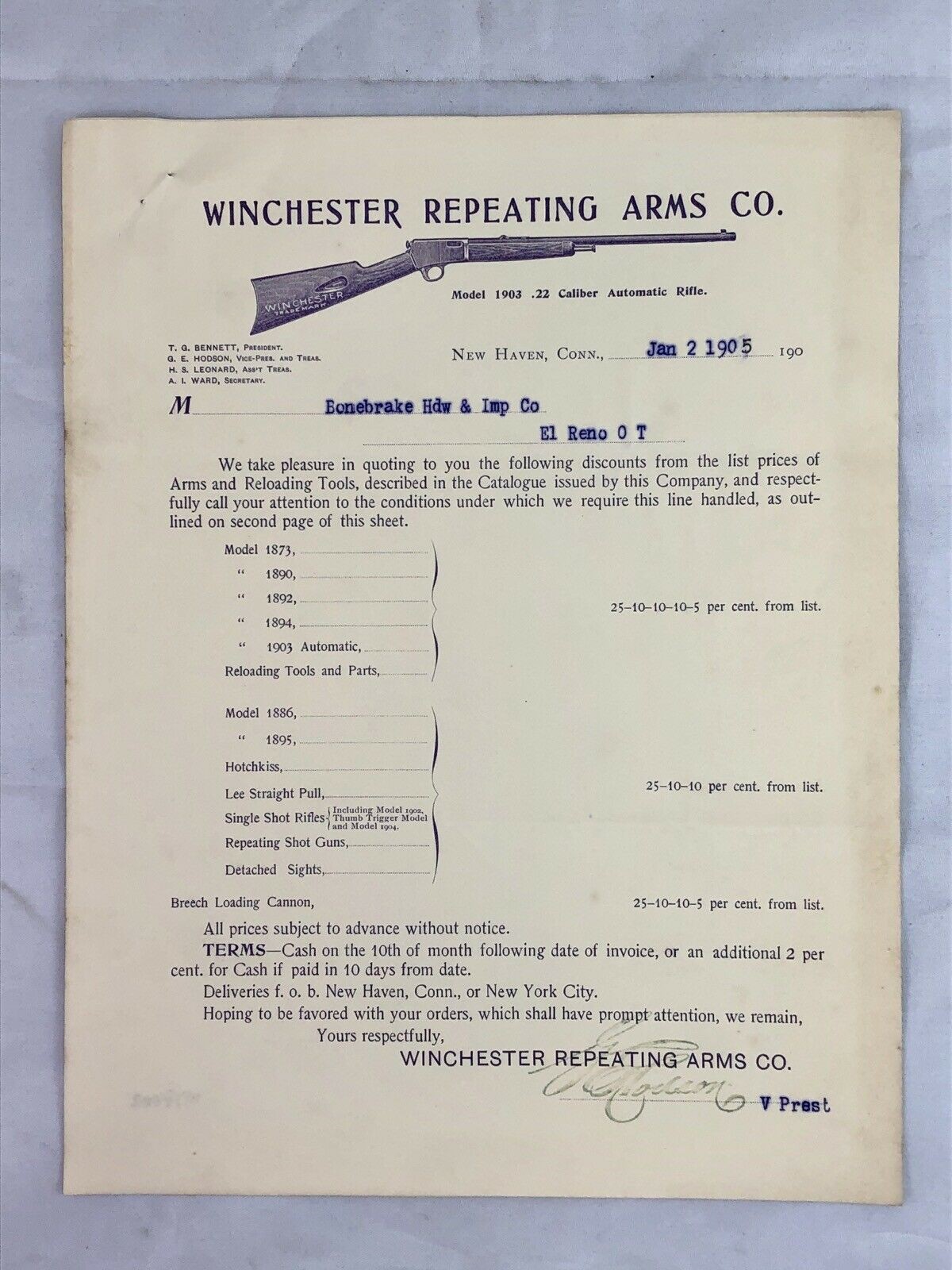
This January 2, 1905 factory dealer discount letter is an example of what I’m talking about. I may be wrong again, but I think this reads as a 25% discount on the Model 1873, 10 % discount on the other models and a 5% discount on reloading tools to factory authorized dealers.
Sincerely,
Maverick
WACA #8783 - Checkout my Reloading Tool Survey!
https://winchestercollector.org/forum/winchester-research-surveys/winchester-reloading-tool-survey/

March 31, 2009
Offline
Maverick said
Chuck said
At first when the smokeless powder came out, or sooner, Winchester frowned upon reloading but soon changed his ways. Winchester probably realized what was going to happen and he wanted his cut of the market. It’s all about making money.
Your statement is very confusing to me. Oliver Winchester was dead by 1880. Well before Smokeless was on the market.
Regarding reloading, the very first Reloading Tool for Center-Fire ammunition was patented and put on the market by WRACo with the first tool’s patent held by William Wirt Winchester, which is Oliver’s son. When smokeless powder came onto the scene around 1895, WRACo as a company both discouraged and had recommendations on reloading with smokeless powder. But you’ll notice very few Smokeless cartridge calibers were made and sold in their reloading tools.
Winchester as a company certainly had a knack for buying up the competition and shelving them to help restrict the market share in their favor.
Sincerely,
Maverick
I purposely didn’t say O.F. Winchester. Sorry for the confusion. I have posted on this topic before. But there are statements by the company recommending not to reload their smokeless cartridges. But that didn’t last long. When did the company start selling smokeless?

January 20, 2023
Offline
A major reason Winchester warned against reloading early smokeless cartridges was not greed but safety.
Mercuric primers when fired exhale chemical residue that would react with brass, rendering the case brittle and liable to rupture in time. This was not a problem with black powder cartridges.
Bulky black powder when ignited would insulate the brass and carry away the harmful residue.
When smokeless cartridges were introduced, the residue of nitrocellulose was too small in quantity to protect the brass. After a couple of reloadings, cases would sometimes burst and blind or maim the shooter.
Metals chemistry was not the science it later became. For a while, Winchester didn’t know why it was happening but knew it was clearly associated with repeated reloadings of smokeless powder.
That was the reason for the warning. Non-Mercuric priming compounds solved the problem eventually.
- Bill
WACA # 65205; life member, NRA; member, TGCA; member, TSRA; amateur preservationist
"I have seen wicked men and fools, a great many of both, and I believe they both get paid in the end, but the fools first." -- David Balfour, narrator and protagonist of the novel, Kidnapped, by Robert Louis Stevenson.
May 23, 2009
Offline
Zebulon said
A major reason Winchester warned against reloading early smokeless cartridges was not greed but safety.
I’m sure another factor was the liability and concern about lawsuits. For some reason people think lawsuits are a relatively new thing, but Americans have been suing each other since practically the founding of the country. The other glaring factor was human error. People would simply think that they could reload with the same amount of powder with smokeless as you could with black powder.
I don’t think brass would have been as much of a concern, as they could always sell more brass, but your market base starts to shrink when they blow themselves up with the powder. Also no matter what type of primer was used, simple human error would still cause people to make dangerous loads that could kill them.
Winchester started loading & selling their paper shot shells in October 1893. As far as I can determine they started loading & selling center-fire cartridges with smokeless in the year 1895. According to Dan Shuey, WRACo was experimenting with these early “Nitro” powders as soon as they came to market with receiving and experimenting with smokeless powder from Belgium in April 1888. These early Nitro Smokeless powder are not the same as modern smokeless. WRACo continued experimenting with smokeless, Lesmoke, and manufacturing their own Ball powders for years to come.
Sincerely,
Maverick
WACA #8783 - Checkout my Reloading Tool Survey!
https://winchestercollector.org/forum/winchester-research-surveys/winchester-reloading-tool-survey/

April 15, 2005
Offline
Maverick said
Zebulon said
A major reason Winchester warned against reloading early smokeless cartridges was not greed but safety.
I’m sure another factor was the liability and concern about lawsuits. For some reason people think lawsuits are a relatively new thing, but Americans have been suing each other since practically the founding of the country. The other glaring factor was human error. People would simply think that they could reload with the same amount of powder with smokeless as you could with black powder.
I don’t think brass would have been as much of a concern, as they could always sell more brass, but your market base starts to shrink when they blow themselves up with the powder. Also no matter what type of primer was used, simple human error would still cause people to make dangerous loads that could kill them.
Winchester started loading & selling their paper shot shells in October 1893. As far as I can determine they started loading & selling center-fire cartridges with smokeless in the year 1895. According to Dan Shuey, WRACo was experimenting with these early “Nitro” powders as soon as they came to market with receiving and experimenting with smokeless powder from Belgium in April 1888. These early Nitro Smokeless powder are not the same as modern smokeless. WRACo continued experimenting with smokeless, Lesmoke, and manufacturing their own Ball powders for years to come.
Sincerely,
Maverick
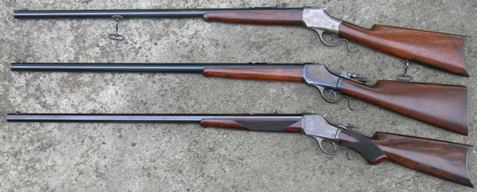
Winchester started manufacturing smokeless powder Single Shot rifles in 30 U.S. cartridge early in the year 1894. The 30 WCF was introduced a full year later in May 1895.
Bert
WACA Historian & Board of Director Member #6571L
January 20, 2023
Offline
Maverick said
I’m sure another factor was the liability and concern about lawsuits. For some reason people think lawsuits are a relatively new thing, but Americans have been suing each other since practically the founding of the country. The other glaring factor was human error. People would simply think that they could reload with the same amount of powder with smokeless as you could with black powder.
I don’t think brass would have been as much of a concern, as they could always sell more brass, but your market base starts to shrink when they blow themselves up with the powder. Also no matter what type of primer was used, simple human error would still cause people to make dangerous loads that could kill them.
Well, yes, lawsuits have been a popular indoor sport almost since the Norman Invasion of Britain in 1066, which was the advent of the development of the Common Law of England, which is expressly adopted as American law in our own Constitution.
However, our American product liability law is a much more recent development, one that did not exist when smokeless powder was being introduced by Winchester.
Someone injured because he packed his 30 WCF cases with smokeless as if it were black powder, would have had a hard time retaining counsel to prosecute a suit for negligence against Winchester. The legal notion of an “unreasonably dangerous product” didn’t exist.
What did exist were the twin defenses of contributory negligence and assumption of risk. “We told you but you didn’t listen and did it anyway. It’s on you, Bubba.”
There was no need for Winchester’s management to worry about product liability damages. No fault torts didn’t exist.
I think Winchester DID feel the need to warn customers to refrain from doing what was leading to exploding Winchesters, to preserve its reputation for high quality products – and to protect themselves from ordinary negligence suits based on a “failure to warn” — an established principle of Common Law.
- Bill
WACA # 65205; life member, NRA; member, TGCA; member, TSRA; amateur preservationist
"I have seen wicked men and fools, a great many of both, and I believe they both get paid in the end, but the fools first." -- David Balfour, narrator and protagonist of the novel, Kidnapped, by Robert Louis Stevenson.

September 22, 2011
Offline
Zebulon said
Maverick said
I’m sure another factor was the liability and concern about lawsuits. For some reason people think lawsuits are a relatively new thing, but Americans have been suing each other since practically the founding of the country. The other glaring factor was human error. People would simply think that they could reload with the same amount of powder with smokeless as you could with black powder.
I don’t think brass would have been as much of a concern, as they could always sell more brass, but your market base starts to shrink when they blow themselves up with the powder. Also no matter what type of primer was used, simple human error would still cause people to make dangerous loads that could kill them.
Well, yes, lawsuits have been a popular indoor sport almost since the Norman Invasion of Britain in 1066, which was the advent of the development of the Common Law of England, which is expressly adopted as American law in our own Constitution.
However, our American product liability law is a much more recent development, one that did not exist when smokeless powder was being introduced by Winchester.
Someone injured because he packed his 30 WCF cases with smokeless as if it were black powder, would have had a hard time retaining counsel to prosecute a suit for negligence against Winchester. The legal notion of an “unreasonably dangerous product” didn’t exist.
What did exist were the twin defenses of contributory negligence and assumption of risk. “We told you but you didn’t listen and did it anyway. It’s on you, Bubba.”
There was no need for Winchester’s management to worry about product liability damages. No fault torts didn’t exist.
I think Winchester DID feel the need to warn customers to refrain from doing what was leading to exploding Winchesters, to preserve its reputation for high quality products – and to protect themselves from ordinary negligence suits based on a “failure to warn” — an established principle of Common Law.
Bill,
Why are product liability lawsuits more common now? Are people just that mor dumb now? Or are folks looking for easy money? Are attorneys advertising more and they, themselves get easy money? Or…???
I think with big tobacco lawsuits they ask for big money, settle for $10 million, which is still a lot of money, and the attorneys get a third of that.
November 19, 2006
Offline

Continuing the topic of the ’73 Winchester, here’s a .38-40 I have. Factory letter states a .38 caliber rifle shipped on 5-21-90 with an octagon barrel, plain trigger, 1/2 mag with the notation, “casehardened.” The rifle is not in high condition but the bore is absolutely beautiful. The wood isn’t so bad either:
March 31, 2009
Offline
All good points. But for the life of me I can not think where I found the info? But I’m sure if there was a reason, I don’t remember if there was a reason?
January 20, 2023
Offline
Ian, product liability suits are more common now – and I would guess have been more common since changes in the law that were taking place in the early Sixties, when I was in school. Some of these changes were made by legislation and others by appellate court decisions. What they collectively added up to was a new form of tort.
Historically, to recover damages for a personal injury, the plaintiff was required to prove the defendant acted (or failed to act), had a duty to do so, failed in his duty either intentionally or negligently, and so caused Plaintiff’s injury. That is a case of “tort” – an old French law word.
Product liability law is based on the principle of an “inherently dangerous product.” The defendant need not have done it intentionally or negligently but, if he creates an inherently dangerous product and puts it in commerce, he is liable for the damage it causes.
A classic teaching hypothetical was this. A man buys a pet tiger. He wishes to bring it home. He is worried it may escape his custody and hurt someone, so he consults zoo experts and hires an engineering firm experienced in building tiger cages to construct one in his yard. After it is done, he brings the tiger home and installs it in the cage.
One day, the tiger nevertheless manages to escape the cage and kills and eats several children before being dispatched by the local police.
The Mayor and the townspeople are well and truly outraged and a crowd of them show up at the tiger owner’s doorstep, demanding justice. The owner comes out and pleads his innocence. “I spent hundreds of thousands of dollars building the most secure facility known to engineering science. IT IS NOT MY FAULT.”
The Mayor answers, “That may be so but it is not our fault either. And you are the one who brought the tiger to town.”
Product liability law grew out of changes in commerce. We can argue about whether some lucky lung cancer victim got excessively rich because he smoked for 40 years. It is little harder to argue with a damage award to a homeowner with third degree burns over 80% of his body caused by a gas furnace designed by morons in violation of every industry standard.
In both cases, the required proofs are the same. As for “easy money” I can tell you that, if you propose to sue Ford because your client, the estate of the fellow and his wife who got burned to a crisp in their exploding Pinto, you had better bring your lunch, a lantern, and several hundred thousand dollars to pay the various investigating and testifying experts, for the next 7 to 10 years. Corporate America does not die young just because you sue it.
I am personally unaware of any suit brought against a tobacco company in which a lawyer filed a suit and did nothing more than make a humongous settlement demand and then settle for X millions. Typically, those kinds of cases require several years, the financial wherewithal to extend half to a whole million dollars in costs and fees for years, extensive travel and depositions, and complete preparation to the point of announcing “ready” for trial. Several thousand hours of work plus the money loaned.
Is it a business? Yes, on both sides of the docket. Are juries dumb? Not in my experience. I think they can get real mad if they think they’re being lied to. Wouldn’t it be better if we took all the lawyers out of the system and just established a panel of “unbiased experts” who will “do what’s fair”. Maybe, if I could appoint who sits on the panel.
- Bill
WACA # 65205; life member, NRA; member, TGCA; member, TSRA; amateur preservationist
"I have seen wicked men and fools, a great many of both, and I believe they both get paid in the end, but the fools first." -- David Balfour, narrator and protagonist of the novel, Kidnapped, by Robert Louis Stevenson.
December 9, 2002
Offline
steve004 said
Continuing the topic of the ’73 Winchester, here’s a .38-40 I have. Factory letter states a .38 caliber rifle shipped on 5-21-90 with an octagon barrel, plain trigger, 1/2 mag with the notation, “casehardened.” The rifle is not in high condition but the bore is absolutely beautiful. The wood isn’t so bad either:
Steve,
That’s a beautiful, and original, as you know, very nice rifle! A special order rifle with the Case Hardened receiver, and Special Wood. I would not only like to see the Letter, but it would be great to know if the tang, has three, XXX’s stamped on it, or possibly Four, as that would is special! 
I Like everything about it!
Thanks for sharing!
Tony
May 23, 2009
Offline
It would probably get into the weeds for this topic, but doing some research on WRACo they had quite a few different lawsuits by them and against them for many years for various reasons of which several having to do with gunpowder. In 1924 they were even sued by the Boy Scouts of America of all things. I think WRACo would have been weary of receiving a lawsuit on reloading with smokeless. In the early 1900s they were also facing quite a bit strife in regards to government regulations towards the shipping and handling of firearms ammunition, etc. Even going to great lengths to defend against such issues.
Bert,
I didn’t realize the 30-40 Krag was being chambered in the Single Shot before the Model 95, but makes perfect sense.
Sincerely,
Maverick
WACA #8783 - Checkout my Reloading Tool Survey!
https://winchestercollector.org/forum/winchester-research-surveys/winchester-reloading-tool-survey/
January 20, 2023
Offline
Maverick said
It would probably get into the weeds for this topic, but doing some research on WRACo they had quite a few different lawsuits by them and against them for many years for various reasons of which several having to do with gunpowder. In 1924 they were even sued by the Boy Scouts of America of all things. I think WRACo would have been weary of receiving a lawsuit on reloading with smokeless. In the early 1900s they were also facing quite a bit strife in regards to government regulations towards the shipping and handling of firearms ammunition, etc. Even going to great lengths to defend against such issues.
Bert,
I didn’t realize the 30-40 Krag was being chambered in the Single Shot before the Model 95, but makes perfect sense.
Sincerely,
Maverick
Maverick, I want to depart the weeds now.
Your friend,
Bill
- Bill
WACA # 65205; life member, NRA; member, TGCA; member, TSRA; amateur preservationist
"I have seen wicked men and fools, a great many of both, and I believe they both get paid in the end, but the fools first." -- David Balfour, narrator and protagonist of the novel, Kidnapped, by Robert Louis Stevenson.
March 31, 2009
Offline
Maverick said
It would probably get into the weeds for this topic, but doing some research on WRACo they had quite a few different lawsuits by them and against them for many years for various reasons of which several having to do with gunpowder. In 1924 they were even sued by the Boy Scouts of America of all things. I think WRACo would have been weary of receiving a lawsuit on reloading with smokeless. In the early 1900s they were also facing quite a bit strife in regards to government regulations towards the shipping and handling of firearms ammunition, etc. Even going to great lengths to defend against such issues.
Bert,
I didn’t realize the 30-40 Krag was being chambered in the Single Shot before the Model 95, but makes perfect sense.
Sincerely,
Maverick
An article in the New Haven Evening Register, Monday, Jan 25, 1892 says that Winchester has perfected a 30 Cal cartridge for the Military. Doesn’t mention the powder.
November 19, 2006
Offline
Anthony said
steve004 said
Continuing the topic of the ’73 Winchester, here’s a .38-40 I have. Factory letter states a .38 caliber rifle shipped on 5-21-90 with an octagon barrel, plain trigger, 1/2 mag with the notation, “casehardened.” The rifle is not in high condition but the bore is absolutely beautiful. The wood isn’t so bad either:
Steve,
That’s a beautiful, and original, as you know, very nice rifle! A special order rifle with the Case Hardened receiver, and Special Wood. I would not only like to see the Letter, but it would be great to know if the tang, has three, XXX’s stamped on it, or possibly Four, as that would is special!
I Like everything about it!
Thanks for sharing!
Tony
Tony –
Thanks for the compliment. I like the rifle quite a bit. And it is accurate! However, time really flies and I need to bring it along on a range trip soon. I see in my range book I haven’t had it there since 2015. How can time fly by so fast? The information I provided included everything noted in the letter. There is no mention of fancy wood. It seems I’ve seen examples where when rifles with special features were ordered x(in this case the half magazine and case hardening) they often put a higher grade of wood on (not necessarily 3 or 4x). I can’t recall what was stamped on the tang. The rifle really needs much more condition to be much of a collector, but as I said, I like it!
April 15, 2005
Offline
Maverick said
It would probably get into the weeds for this topic, but doing some research on WRACo they had quite a few different lawsuits by them and against them for many years for various reasons of which several having to do with gunpowder. In 1924 they were even sued by the Boy Scouts of America of all things. I think WRACo would have been weary of receiving a lawsuit on reloading with smokeless. In the early 1900s they were also facing quite a bit strife in regards to government regulations towards the shipping and handling of firearms ammunition, etc. Even going to great lengths to defend against such issues.
Bert,
I didn’t realize the 30-40 Krag was being chambered in the Single Shot before the Model 95, but makes perfect sense.
Sincerely,
Maverick
I did some digging through the Single Shot records, and the first two rifles manufactured for the 30 U.S. (30-40) cartridge were serial numbers 67205 & 67218 both received in the warehouse on 5/22/1894… one full year before the first Model 1894 was made in 30 WCF.
Bert
WACA Historian & Board of Director Member #6571L
November 19, 2006
Offline
Bert H. said
Maverick said
It would probably get into the weeds for this topic, but doing some research on WRACo they had quite a few different lawsuits by them and against them for many years for various reasons of which several having to do with gunpowder. In 1924 they were even sued by the Boy Scouts of America of all things. I think WRACo would have been weary of receiving a lawsuit on reloading with smokeless. In the early 1900s they were also facing quite a bit strife in regards to government regulations towards the shipping and handling of firearms ammunition, etc. Even going to great lengths to defend against such issues.
Bert,
I didn’t realize the 30-40 Krag was being chambered in the Single Shot before the Model 95, but makes perfect sense.
Sincerely,
Maverick
I did some digging through the Single Shot records, and the first two rifles manufactured for the 30 U.S. (30-40) cartridge were serial numbers 67205 & 67218 both received in the warehouse on 5/22/1894… one full year before the first Model 1894 was made in 30 WCF.
Bert
Interesting. When was the first Single Shot in .30 WCF manufactured?
April 15, 2005
Offline
steve004 said
Bert H. said
Maverick said
It would probably get into the weeds for this topic, but doing some research on WRACo they had quite a few different lawsuits by them and against them for many years for various reasons of which several having to do with gunpowder. In 1924 they were even sued by the Boy Scouts of America of all things. I think WRACo would have been weary of receiving a lawsuit on reloading with smokeless. In the early 1900s they were also facing quite a bit strife in regards to government regulations towards the shipping and handling of firearms ammunition, etc. Even going to great lengths to defend against such issues.
Bert,
I didn’t realize the 30-40 Krag was being chambered in the Single Shot before the Model 95, but makes perfect sense.
Sincerely,
Maverick
I did some digging through the Single Shot records, and the first two rifles manufactured for the 30 U.S. (30-40) cartridge were serial numbers 67205 & 67218 both received in the warehouse on 5/22/1894… one full year before the first Model 1894 was made in 30 WCF.
Bert
Interesting. When was the first Single Shot in .30 WCF manufactured?
Serial number 71787 on October 29th, 1895. The 30 WCF was apparently not a popular caliber for the Single Shot. With the 30 U.S. (Krag) cartridge being the first smokeless powder cartridge offered in the Single Shot, and it being ballistically superior to the 30 WCF, the vast majority of shooters that wanted a .30 caliber cartridge chose it over the 30 WCF.
Bert
WACA Historian & Board of Director Member #6571L
November 19, 2006
Offline
Bert H. said
steve004 said
Bert H. said
Maverick said
It would probably get into the weeds for this topic, but doing some research on WRACo they had quite a few different lawsuits by them and against them for many years for various reasons of which several having to do with gunpowder. In 1924 they were even sued by the Boy Scouts of America of all things. I think WRACo would have been weary of receiving a lawsuit on reloading with smokeless. In the early 1900s they were also facing quite a bit strife in regards to government regulations towards the shipping and handling of firearms ammunition, etc. Even going to great lengths to defend against such issues.
Bert,
I didn’t realize the 30-40 Krag was being chambered in the Single Shot before the Model 95, but makes perfect sense.
Sincerely,
Maverick
I did some digging through the Single Shot records, and the first two rifles manufactured for the 30 U.S. (30-40) cartridge were serial numbers 67205 & 67218 both received in the warehouse on 5/22/1894… one full year before the first Model 1894 was made in 30 WCF.
Bert
Interesting. When was the first Single Shot in .30 WCF manufactured?
Serial number 71787 on October 29th, 1895. The 30 WCF was apparently not a popular caliber for the Single Shot. With the 30 U.S. (Krag) cartridge being the first smokeless powder cartridge offered in the Single Shot, and it being ballistically superior to the 30 WCF, the vast majority of shooters that wanted a .30 caliber cartridge chose it over the 30 WCF.
Bert
Thanks Bert – so the first M1894 in .30 WCF went out the door before the first Single Shot in .30 WCF. Must have been by about four or five months.
It’s not surprising the .30/40 was more in demand than the .30 WCF in the Single Shot.


