
 Log In


September 19, 2014
 Offline

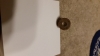
Chuck, I took cell phone photos and selected a side view and a view of the head. Note in the latter the dimple in the middle. Priming compound was supposed to be largely eliminated away from there plus a cork disk was placed in the head to assure no chain firing in the magazine tube. The case is a two piece case as can be seen. The cartridge was chambered in the Model 1868 Musket, serial number 18, which can be viewed in Houze’s book. Until I got the cartridge, I was not sure of what it was really chambered for. This cartridge is also sometimes known as the .47 OFW as the bullet measures at 0.465″ in diameter.
Tim



April 15, 2005
Offline

Tim… you just proved the old idiom (or axiom) “you can’t teach an old dog and new tricks” is False! I am impressed!!
Bert – a.k.a Hanes
WACA Historian & Board of Director Member #6571L
September 19, 2014
Offline
Bert, These photos would not satisfy Rob, tho! Tim (or Fruit).

July 17, 2012
Offline
Tim,
I know nothing about cartridges but I love to research. Thanks for the images and documentation for this rare cartridge.
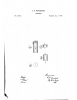
I am a bit confused though, your document references Winchester’s patent 60,841 dated Jan 1, 1867. Here is that patent, it does not seem to be related to your cartridge. Is there a typo on your spec sheet?
Best Regards,

WACA Life Member #6284 - Specializing in Pre-64 Winchester .22 Rimfire
July 17, 2012
Offline
Tim,
Nevermind, I found it. Someone got a bit dyslexic on your spec sheet, the actual patent is 60814 (not 60841).
Thanks again for the cool info!
Best Regards,

WACA Life Member #6284 - Specializing in Pre-64 Winchester .22 Rimfire
September 19, 2014
Offline
Yeah, I also had to unscramble the index number to get the correct patent! Forgot to mention that small detail! Tim

March 31, 2009
Offline
tim tomlinson said
Chuck, I took cell phone photos and selected a side view and a view of the head. Note in the latter the dimple in the middle. Priming compound was supposed to be largely eliminated away from there plus a cork disk was placed in the head to assure no chain firing in the magazine tube. The case is a two piece case as can be seen. The cartridge was chambered in the Model 1868 Musket, serial number 18, which can be viewed in Houze’s book. Until I got the cartridge, I was not sure of what it was really chambered for. This cartridge is also sometimes known as the .47 OFW as the bullet measures at 0.465″ in diameter.Tim
Great stuff Tim.

Back in the late 60’s, I remember my Father had a Winchester 45-90. I only saw one cartridge for it, but I do remember it being a straight case, no shoulder. Back then I had no idea what that rifle was worth, but I do know it was in very good shape. When I was in the Navy, about 1967, while in California, I had my Mother ship that 45-90 to me, so I could buy a new Triumph 650 motorcycle. Believe me, I have regretted it ever since. I would love to have that rifle today. I shoot a Ruger #1 chambered in 300 H&H. Now that is a fine rifle as well.

October 29, 2011
Offline
I know this is an old thread, But on page 125 of the Houze book, he lists SN 62311. This 1876 was received in the warehouse in 1890,
Caliber 45-90-500 long range, only one was made. Was the cartridge made from 45-75? Or a straight wall 45-90? Bill
September 19, 2014
Offline
Bill and others, the .45-90 in either 500 grain bullet or 450 grain bullet used a standard .45-75 case with no headstamps. Powder was compressed and the paper patched bullets seated out further to accommodate the extra powder. The regular .45-90 WCF will not chamber by a fair amount as the bullet and neck would need to go into the throat of the barrel. Will Sullivan’s Auction had a low condition 1876 for sale over a year ago and it was touted as being one in .45-90 WCF. I attempted to correct him but was blown off. After all, the barrel and receiver were so marked, so must have been a prototype!! Yeah, marked by electro pencil in shakey writing, too! Somewhere in the archives should be a picture of the correct .45-90-500 cartridge I have and displayed with my 1876’s years ago. IF really needed, I imagine I could provide a newer picture somehow. I don”t do well taking pictures tho. Tim
March 31, 2009
Offline
426crown said
I know this is an old thread, But on page 125 of the Houze book, he lists SN 62311. This 1876 was received in the warehouse in 1890,
Caliber 45-90-500 long range, only one was made. Was the cartridge made from 45-75? Or a straight wall 45-90? Bill
I doubt the 45-90 case was used unless this single shot had a modified action. Look at the picture of the 45-90-450 long range cartridge shown on page 124. It is not a straight wall. The issue I have is that the 1876 production action probably is not long enough to cycle a 45-90 case? A 50-95 case, the longest case used in a 76, is .48″ shorter than the 45-90. The 45-75 is even a bit shorter than the 50-95.
A deeper dive into the archives is needed.
March 31, 2009
Offline
tim tomlinson said
Bill and others, the .45-90 in either 500 grain bullet or 450 grain bullet used a standard .45-75 case with no headstamps. Powder was compressed and the paper patched bullets seated out further to accommodate the extra powder. The regular .45-90 WCF will not chamber by a fair amount as the bullet and neck would need to go into the throat of the barrel. Will Sullivan’s Auction had a low condition 1876 for sale over a year ago and it was touted as being one in .45-90 WCF. I attempted to correct him but was blown off. After all, the barrel and receiver were so marked, so must have been a prototype!! Yeah, marked by electro pencil in shakey writing, too! Somewhere in the archives should be a picture of the correct .45-90-500 cartridge I have and displayed with my 1876’s years ago. IF really needed, I imagine I could provide a newer picture somehow. I don”t do well taking pictures tho. Tim
We were typing at the same time. No pics no proof.
September 19, 2014
Offline
Page 1 of this thread, dated 2 NOV 2020 has my picture of the .45-90-500 next to a normal .45-75-350. Bill resurrected an old topic for sure! Tim.
March 31, 2009
Offline
tim tomlinson said
Page 1 of this thread, dated 2 NOV 2020 has my picture of the .45-90-500 next to a normal .45-75-350. Bill resurrected an old topic for sure! Tim.
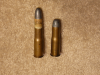
Since the rifle was a single shot 76 all Winchester had to do was increase the free bore in the chamber to have enough space to load this longer bullet. And change the twist rate.
September 19, 2014
Offline
Chuck and Bill, plus others,
Chuck, I can chamber the .45-90-500 in all of my .45-75 rifles. No free bore needed. The .45-90 WCF? Yes. Free bore would definitely be needed.
I have gone back to some of my original notes comparing the cartridges in serious discussion. Will summarize them here:
.45-75-350 by WRA Co. Brass length, 1.889 COAL 2.277 Bullet diameter .453 just above brass WEIGHT 585.0 gr
.45-90-500 Brass length, 1.887 COAL 3.044 Bullet diameter .4535 just above brass WEIGHT 747.1 gr
Should you do the math, the powder charge is a bit shy of a full 90 grains, assuming the bullet really weighs 500 grains. Lots of small assumptions here.
Tim
September 19, 2014
Offline
Chuck, I have no ideas just how well (or not) the single loading cartridge did in actual shooting as now days you, I and others have to consider twist rates. The laws of physics didn’t change that I know of. So—without tighter twist, just how well did it group? Did the one with the barrel marked for this single loading cartridge happen to have a tighter twist? Seems every new discovery only asks new and more questions. But we scratch what surfaces we can. One day, maybe some obscure note will surface? Tim
March 31, 2009
Offline
Tim, I had forgot, like others here, that you had these cartridges. Really cool. The 45-75 chambers must have a lot of free bore. Any bullet that fits can be shot in any twist rate barrel and as you stated no one knows what this 76 had. Knowing Winchester I bet they took care of this when making the barrel.
You know I collect cartridges, where and when did you come across these? I know you have others too. I’d like to hear the stories.
September 19, 2014
Offline
Chuck, I can only recall the source of the .46/.47 OFW cartridge. That one came from Ray Giles. The short version of the story is that Dan Shuey gave me 3 or 4 names that might have one of the rare cartridges and one of them might sell one to me. One of the fellows was apparently into a dementia and that was a short and embarrassing discussion. Ray had one and did not care to sell. The others either no longer had one or did not care to sell. About a month later, Ray called me and offered to sell the cartridge for what he had paid, knowing it would go into a display of 1876 rifles. The rest of that story is now history. There are or were about 12 known to exist. The .45-90-500 is now a faded memory on its acquisition. But there are more of them out there than the .46/.47 OFW. I haven’t looked in a long time, but do think many are in the cigar box of unidentified cartridges that get hauled around! Not having a headstamp does not help! Tim


