

 Log In


April 3, 2018
 Offline


While commenting on a resurrected thread involving the Model 1876 and the 45-100 cartridge, it occurred that a clarification was in order with a newer treatment of the subject.
Winchester is somewhat responsible for this gray area confusion due to their early catalog offerings versus exceptions to their own advertising, catalogs, and actual chamberings. An example of this is the “45-100” chambering. Winchester chambered the 1885 rifle to order for the 45-90 WCF, the 45-100 Ballard, and the 45-100 Sharps Straight. These are listed in Frank Barnes’ “Cartridges of the World”.
As if that was not enough, Harold F. Williamson in his “Winchester-The Gun That Won The West”, page 96 – mentions William H. Wright hunter, guide, naturalist and author of “The Grizzly Bear”. Wright, stating in 1909 within “The Grizzly Bear” speaks of ” my single-shot rifle, made to order for me by the Winchester people, the 45-100, in which I shot 100 grains of powder and 600 grains of lead. It was one of the guns that killed at both ends. But I liked it better than any I have ever carried. I used it for years…”
That rifle was an 1885 rifle, chambered in a large enough cartridge to handle 100 grains of black powder along with a 600 grain bullet. Both the Ballard and the Sharps 45-100 Straight could handle 550 gr bullets so a 600 gr bullet could be possible. These 45-100 cartridges cannot be the ones mentioned in the Winchester catalog as being chambered in the 1876 rifle, as both the chamber length and case volume of black powder would be prohibitive.
As the owner of a period 1885 HW manuf in 1887 -in 45-60WCF, using 350-400 gr lead bullets, a 600 gr bullet from any 45-100 cartridge would indeed handle grizzlies, as Wright relates in his book.

April 15, 2005
Offline
What Iis the serial number of said “45-100” rifle ?
In my detailed research and survey of the original Winchester Single Shot factory records, there were no documented “45-100” cartridge rifles made. There were (30) that were made and marked “45 Sharps 3 ¼” or “45-120 S.S”.. The 45 3 ¼” cartridge was/is also known as the Sharps 45-120. If the 45 Sharps 3 ¼ (45-120) was loaded with a heavier than standard bullet (450 grain), the powder charge would have to have been reduced.


Bert
WACA Historian & Board of Director Member #6571L
April 3, 2018
Offline
Bert:
I have copies of both Williamson’s Winchester book and an original copy of William Wright’s 1909 “The Grizzly Bear”.
There is no reference to the serial number of Wright’s 1885 SS rifle in either book. It would be a real research task or problem to determine that rifle’s serial number, as Wright sold it somewhere in Washington State, later buying an 1894 Winchester in 30 WCF to take its place.
The real question is the nature of the specific details and actual caliber he gave out in both books: a 45-100 cartridge with a 600 gr bullet. He also intimates that it was a custom order. It could have been a 45-120 with only enough case room for 100 grs of powder, as a 600 gr bullet would occupy quite a lot of room, even if paper patched. Then there is the possibility that it was a custom 1885 in 45 Sharps Straight, and the SN was not entered. There are no details provided as to specifics of handloaded or factory ammunition used in the rifle.
One question that is answered as to Wright’s rifle caliber: he was charged by a grizzly at close quarters earlier in the 1890s and almost mauled or killed. He was carrying a Winchester 1873 in 44 WCF with a faulty extractor. After his close call, he wished for a more powerful rifle-and got it.
April 15, 2005
Offline
I am of the belief that he special (custom) ordered a high-wall rifle in 45-120 with a faster rifling twist to handle the heavier bullet. As you mentioned, stuffing a 600-grain bullet in the 45-120 case would reduce the available powder space a fair bit.
Bert
WACA Historian & Board of Director Member #6571L

March 31, 2009
Offline
Bert H. said
What is the serial number of said “45-100” rifle ?
In my detailed research and survey of the original Winchester Single Shot factory records, there were no documented “45-100” cartridge rifles made. There were (30) that were made and marked “45 Sharps 3 ¼” or “45-120 S.S”.. The 45 3 ¼” cartridge was/is also known as the Sharps 45-120. If the 45 Sharps 3 ¼ (45-120) was loaded with a heavier than standard bullet (450 grain), the powder charge would have to have been reduced.
Bert
Bert, I know you meant 3-1/4″. First signs of old age. 
Sharps did load a 45-100-550 2.4″ straight case.
March 31, 2009
Offline
Bert H. said
I am of the belief that he special (custom) ordered a high-wall rifle in 45-120 with a faster rifling twist to handle the heavier bullet. As you mentioned, stuffing a 600-grain bullet in the 45-120 case would reduce the available powder space a fair bit.
Bert
All these black powder loads were highly compressed loads. When using a longer/heavier bullet you normally use less powder to control the excess pressure caused by the heavier bullet.
My Sharps shoots a 45-2.1″ with a 550 grain bullet. The barrel twist is 1:18″.
April 3, 2018
Offline
In the 1880s-1890s at the time William Wright was hunting Grizzlies in the Selkirks, US-Canadian border- there were a number of “45-100” cartridges out on the market.Frank Barnes illustrates both the 45-100 Ballard and the 45-100 Sharps Special (Straight). Ironically, his “Cartridges of the World” book on page 125 illustrates the Sharps paper-patched 45-100 cartridge and the headstamp/ sidestamp is WRA Co. The 45-90 WCF might also chamber in the Sharps 45-100 -chambered 1885 . My thinking is if Winchester made the cartridge, they could easly chamber the 1885 SS for it. Sharps had closed its doors by the 1890s.
My judgmented thought on this is that Wright was a peculiar bear hunter. If he said it was a 45-100 cartridge firing a 600 gr bullet, it probably was, and a close call with a grizzly made him mighty particular. His comment on recoil with the 600 gr bullet is also an indicator. Wright’s book is recommended reading.
{Barnes mentions that the original Sharps rifles had 45 caliber barrels with bores that measured .451 rather than the larger more common .458 as seen in other rifles. But even these might vary rifle to rifle. I have a Sharps in 45 2.1 and years ago owned an original Meachem conversion Sharps in 45 2.1, with both of these rifles barrels marked “Old Reliable”. }
April 15, 2005
Offline
I do not believe that Winchester ever made or marketed a “45-100” cartridge. I have all of the Winchester catalogs from 1885 through the early 1960s, and the early catalogs have extensive listings for all of the many cartridges the Winchester manufactured and sold. None of them list a “45-100”. Further, in my detailed cartridge survey of the Single Shot model (published in the Winter 2021 edition of the Winchester Collector magazine), there no records of a “45-100” Ballard or Sharps cartridge rifle made or special ordered. The largest Ballard cartridge that Winchester chambered a high-wall rifle for was the 40-90 Ballard. For the .45 caliber Sharps cartridges, the numbers are as follows;
45 Sharps 2 4/10 – 8
45 Sharps 2 6/10 – 24
45 Sharps 2 3/4 – 4
45 Sharps 2 7/8 – 47
45 Sharps 3 1/4 – 30
I suspect that any of the longer Sharps cartridges (2 3/4, 2 7/8, or 3 1/4) could be loaded with 100 grains of BP and a 600-grain bullet, but the rifling twist rate most likely would not be fast enough to stabilize a 600-gr bullet. Of course, shooting Grizzlies at relatively short range would not need a fully stabilized bullet.
Bert
WACA Historian & Board of Director Member #6571L
March 31, 2009
Offline
Bert H. said
I do not believe that Winchester ever made or marketed a “45-100” cartridge. I have all of the Winchester catalogs from 1885 through the early 1960s, and the early catalogs have extensive listings for all of the many cartridges the Winchester manufactured and sold. None of them list a “45-100”. Further, in my detailed cartridge survey of the Single Shot model (published in the Winter 2021 edition of the Winchester Collector magazine), there no records of a “45-100” Ballard or Sharps cartridge rifle made or special ordered. The largest Ballard cartridge that Winchester chambered a high-wall rifle for was the 40-90 Ballard. For the .45 caliber Sharps cartridges, the numbers are as follows;
45 Sharps 2 4/10 – 8
45 Sharps 2 6/10 – 24
45 Sharps 2 3/4 – 4
45 Sharps 2 7/8 – 47
45 Sharps 3 1/4 – 30
I suspect that any of the longer Sharps cartridges (2 3/4, 2 7/8, or 3 1/4) could be loaded with 100 grains of BP and a 600-grain bullet, but the rifling twist rate most likely would not be fast enough to stabilize a 600-gr bullet. Of course, shooting Grizzlies at relatively short range would not need a fully stabilized bullet.
Bert
The Sharps 45-2.4″-100 is the same length as the Win 45-90. But, the Sharp’s rim thickness is .006″ less. This length cartridge can hold 100 grains. It is just compressed more.
April 3, 2018
Offline
In reviewing my Winchester 1891 catalog, WRA offered many loaded cartridges including a paragraph on the Sharps 45-100 Special. With the 600 gr bullet, that limits the choice and narrows the field of possible cartridges. My choices are between the Sharps 45-100 Special and the Winchester 45-120, based on that 600 gr bullet.
The 1891 catalog also lists the 1885 SS standard rifle at the retail price of $15 (US). The barrel length was usually ordered at 30 in-full octagon, and buttstock could be crescent rifle or shotgun style. My chips would be on the SB buttstock style for this particular rifle.
This compares to $21 retail for the standard 1886 Model rifle. A dollar went a long way in the 1890s.

May 23, 2009
Offline
Bert H. said
I do not believe that Winchester ever made or marketed a “45-100” cartridge. I have all of the Winchester catalogs from 1885 through the early 1960s, and the early catalogs have extensive listings for all of the many cartridges the Winchester manufactured and sold. None of them list a “45-100”. Further, in my detailed cartridge survey of the Single Shot model (published in the Winter 2021 edition of the Winchester Collector magazine), there no records of a “45-100” Ballard or Sharps cartridge rifle made or special ordered. The largest Ballard cartridge that Winchester chambered a high-wall rifle for was the 40-90 Ballard. For the .45 caliber Sharps cartridges, the numbers are as follows;
45 Sharps 2 4/10 – 8
45 Sharps 2 6/10 – 24
45 Sharps 2 3/4 – 4
45 Sharps 2 7/8 – 47
45 Sharps 3 1/4 – 30
I suspect that any of the longer Sharps cartridges (2 3/4, 2 7/8, or 3 1/4) could be loaded with 100 grains of BP and a 600-grain bullet, but the rifling twist rate most likely would not be fast enough to stabilize a 600-gr bullet. Of course, shooting Grizzlies at relatively short range would not need a fully stabilized bullet.
I think what we have here is a simple issue over the use of said nomenclature by Winchester and by said author.
I’ll add to the confusion even further! I have yet to find any Winchester rifle (firearm) or cartridge marked “45-100”. But, Winchester did make & sell a Winchester Reloading Tool marked “45-100 S.S.P.” with the S.S.P. meaning either Sharps Special Patched or Sharps Straight Patched. I have one in my collection.
Also, per the back of some later Winchester Reloading Tool Instruction Sheets is listed together three (2.4,2.6,2 7/8) cartridges for reloading with 100 grains of black powder. The reason all three of these lengths are noted is because the “45-100S.S.P.” Tool has and adjustable chamber. Therefore you could load these various different lengths / weights of paper patched bullets in the same reloading tool.
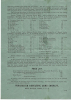
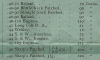 Closeup of the listing showing the three cartridges available in one tool.
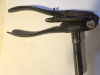 My model 1882 Reloading Tool in 45-100S.S.P.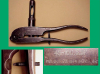
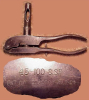 Here a couple of other examples marked 45-100S.S.P. Winchester wasn’t always consistent on how they marked this tool and I believe the tool being marked “45-100S.S.P.” is likely the latest version of the marking. Here are some other tool caliber markings compared with each other along with the 45 Sharps 3 1/4. Which you will notice is on its own line on the instruction sheet.
 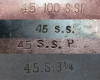 And here is another example tool merely marked 45S.S.P.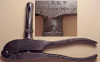
Again I have yet to find and don’t know of or heard of any cartridge collectors that have any Winchester head stamped cartridges marked “45-100”. Most of these early Sharps cartridges are often without head stamp. I’ve only seen Winchester head stamps with nomenclature like used for those three cartridges. 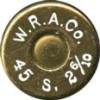
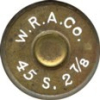
I don’t know if that helps clear anything up for you fellows. I suppose its possible the said author could have merely had one of these different Model 85s that was chambered in 1 of the 3 different cartridges. This is not the only example of the Reloading Tools having different nomenclature from what was used on the cartridges and what was used on the rifles.
Sincerely,
Maverick
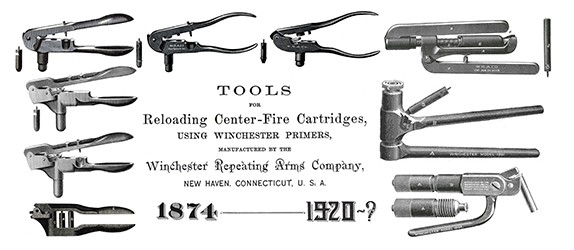
WACA #8783 - Checkout my Reloading Tool Survey!
https://winchestercollector.org/forum/winchester-research-surveys/winchester-reloading-tool-survey/


1 Guest(s)
