

 Log In


June 22, 2026
 Offline

Hello all. I recently acquired a pre-64 Model 70 in 375 H&H from a friend of mine.
Based on the serial number, it is a 1948 production, and to my untrained eyes appears relatively unmolested? This isn’t a collector grade rifle, but I think it is an honest shooter rifle that has been to Africa a few times and will likely be going back again with me in 2027.
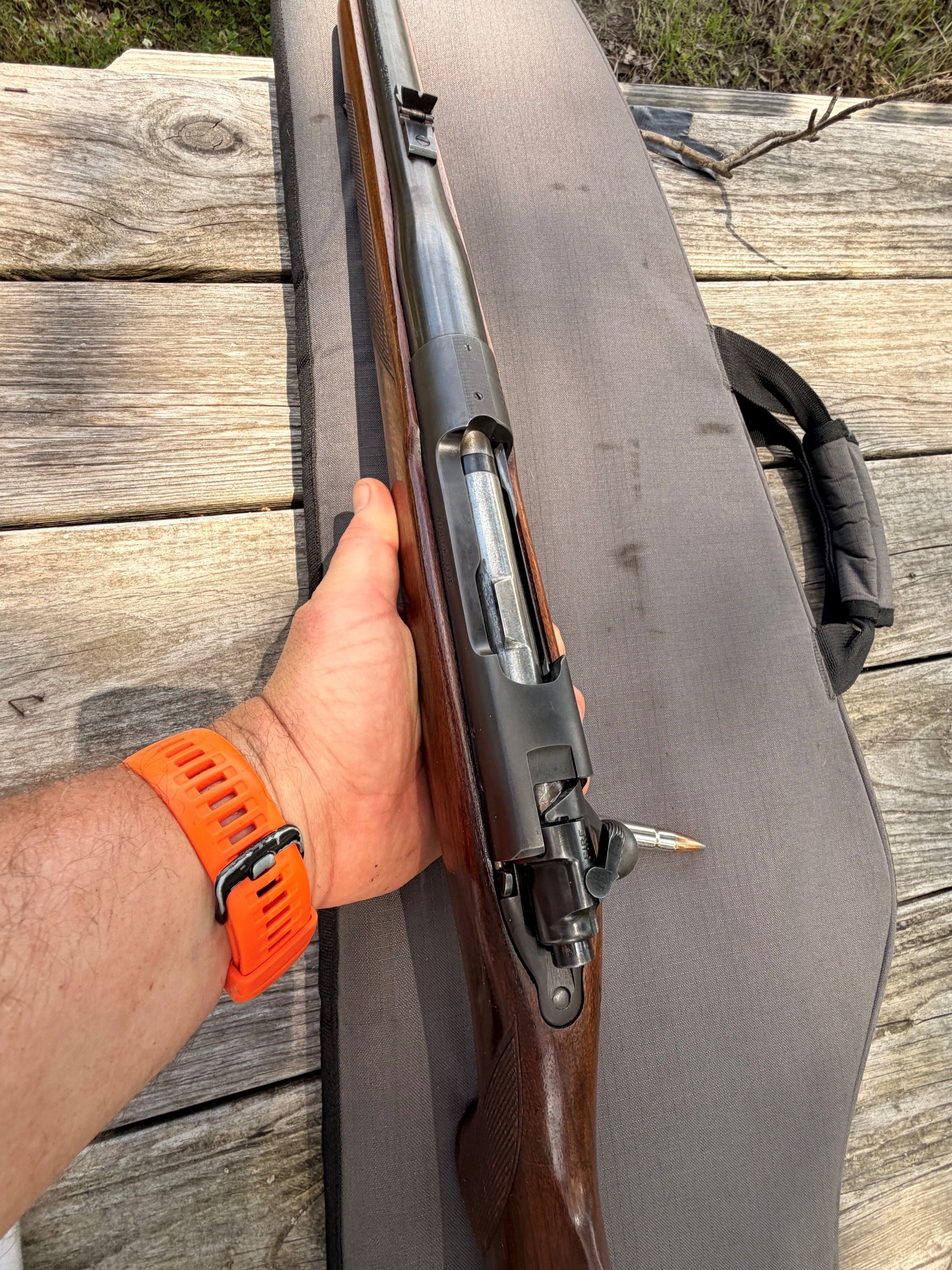
The rear of the receiver has not been D&T for a scope, etc. which brings me to my conundrum. I enjoy shooting irons, but my eyesight doesn’t allow for me to do it very effectively anymore.
I have been told to potentially find a Lyman site, Skinner site, G&H side mount, red dot on the front receiver using a Weaver style base, and some say just drill and tap… which I am highly against doing.
I would much prefer just shooting the irons she came with but unfortunately I can no longer do that and feel confident while hunting. And this is a hunting rifle for me first and foremost. This is only my second pre-64, so I am by no means an expert on them, and any advice or guidance would be highly appreciated. Thank you.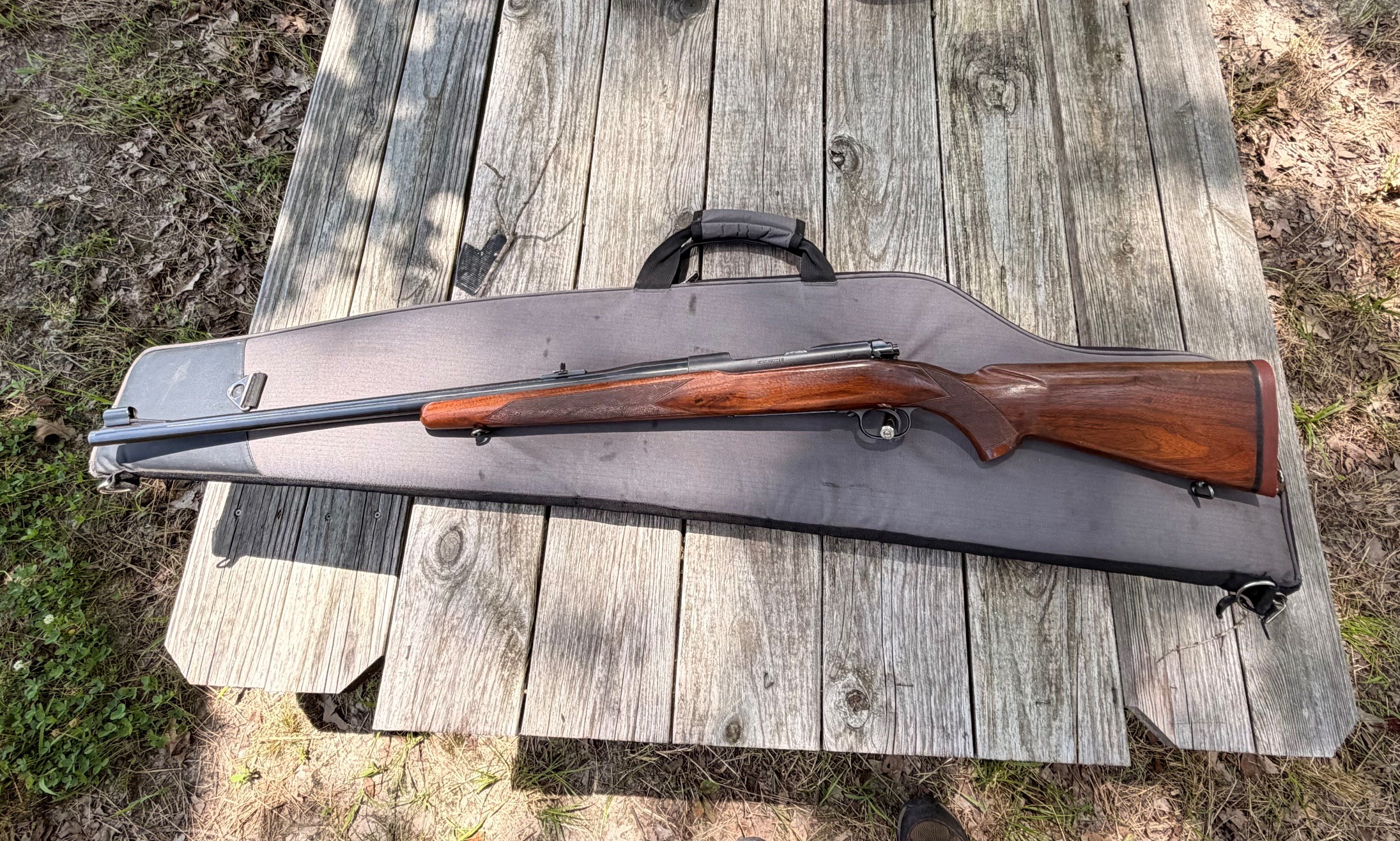

August 27, 2014
Offline

Nice gun…
Great decision not to drill…
Another option is a Stith mount
“If you can’t convince them, confuse them”
President Harry S. Truman

November 7, 2015
Offline
I like the idea of a Lyman or Redfield receiver sight as long as it won’t require modification of the stock. Are you comfortable with aperture sights? Red dot sights are certainly a viable option but would look a little odd on this classic rifle, some may require removal of existing sights. Tedk’s suggestion is a very good one if you can find a Stith mount. I think the best choice will be dictated by your hunting opportunity, shooting style and eyesight limitations. You’re off to a great start with this rifle!
Mike

June 1, 2023
Offline
Since the Lyman #6 sight will fold flat and be out of the line of sight, there is an easy solution. Were the rifle mine, I would mount a Lyman #48 WJS receiver sight using the factory drilled and tapped holes on the left rear receiver. If you acquire one of the later 48 WJS sights, it would not require any modifications to the rifle whatsoever.
Best of luck on your upcoming safari.
BRP
June 22, 2026
Offline
I appreciate the feedback, this is helpful. Honestly I have not used an aperture sight in a long time but that might be worth a try. Looking at ebay there seems to be a lot of variation in the 48 WJS and range from $200-$300. Is there anything specific I should look for in a 48 WJS that would work for my application? Sorry if this should be obvious, I am really not familiar with them and not sure exactly what to look for. thanks again for the help here!

January 20, 2023
Offline
The very early Lyman 48 sight required cutting a piece from the left stock wall to allow the sight to be correctly seated against the receiver.
The later ones don’t. Perhaps someone who owns an earlier one will.post a picture of the sight base, showing you what to avoid.
I believe most of the Lyman 48 WJS sights available on eBay are the later version with short base.
An alternative would be a Redfield 70 or 80, neither of which required cutting the stock.
I strongly suggest you consult our member Ben Tolson, a knowledgeable dealer in these sights. I would buy from him with confidence.
There are two versions of the same Redfield and Lyman sights, the Target version and the Hunter version. The “T” version has knobs for windage and elevation adjustments that are knurled for cranking in changes (” clicks”) as the situation requires. The “H” version has rounded knobs with screwdriver slots that are intended to be set during a range session and then left alone. Like a scope.
For your purpose, the Hunter version would be preferable.
The base of Redfield and Lyman sights is coded to indicate which rifle the base fits. The base is stamped with the code. The stamped code does not include a T or a W because the knobs are interchangeable. The original cardboard box containing the sight indicates T or H on its label.
A Lyman 48 sight coded “WJS” fits the Winchester Model 70 rifle. A 48 WJS-H has Hunter knobs.
A Redfield 70 sight coded “W” fits the Winchester Model 70 rifle. A 70-WT has target knobs.
- Bill
WACA # 65205; life member, NRA; member, TGCA; member, TSRA; amateur preservationist
"I have seen wicked men and fools, a great many of both, and I believe they both get paid in the end, but the fools first." -- David Balfour, narrator and protagonist of the novel, Kidnapped, by Robert Louis Stevenson.
January 8, 2025
Offline
I can’t tell exactly how that sight mounts from the pictures, so my ignorance makes me ask. Is there a 3/8 dovetail through the barrel? I can see the rear screw, but I do not see a front one. Need someone to educate me on how the rear sight mounts.
turnbull makes a 3/8 dovetail picatinny mount so that someone can put a modern red dot on a vintage rifle.
I agree with txgunnut that it would be silly, however, I’ve never hunted in Africa, I’ve never been in combat, but should I, having a forward mounted red dot only looks silly if I don’t need to use it.
-Adam
June 22, 2026
Offline
thank you. I sent Ben a PM. Last night I dug out one of my other M70s and took off just the front base (Leupold). It mounted up nicely on the front receiver of my pre-64. I had a cheap red dot on a .357 mag lever gun with a quick detach base. If I don’t find another solution, this might work where I can use the red dot when needed for hunting, and easily remove it otherwise, with the only addition being the weaver base on the front receiver, which could also be easily removed. I agree it looks goofy with it on, but if I can remove when not needed, it might work for my hunting situations. I would love to take this rifle next year for eland, wildebeest and sable but I have to be able to see the target and this might be the ticket. I will see how it does at the range this weekend, if it holds zero, etc. it is a cheaper red dot for sure.

November 5, 2014
Offline
Hi Buckums-
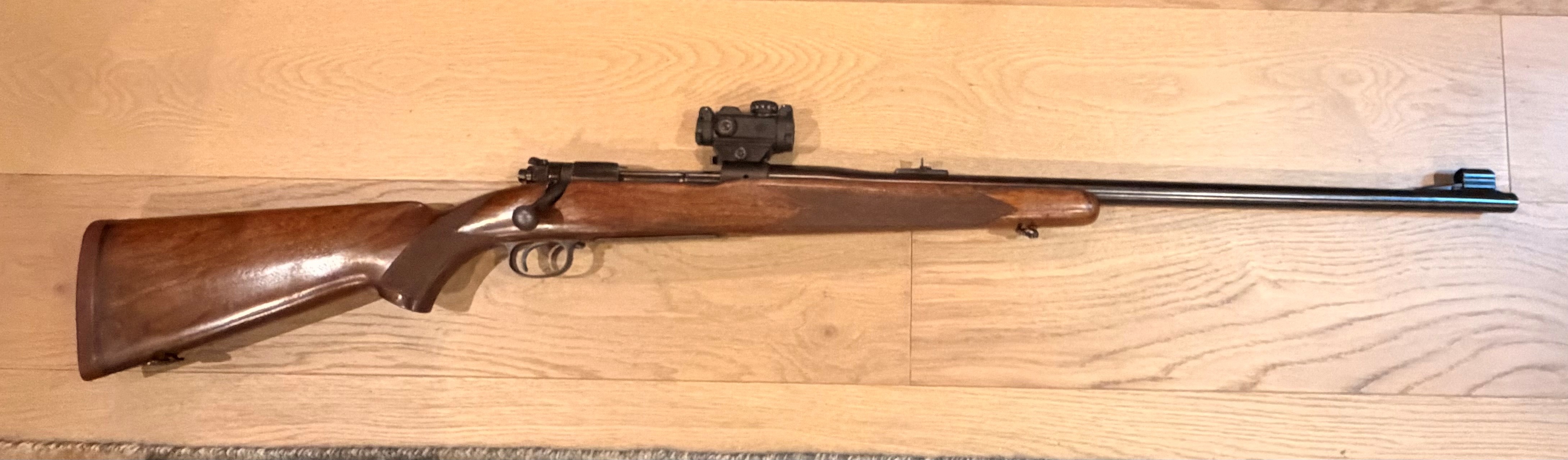
That looks like a very nice collectable M70. Would you be willing to give me the serial number (by PM if you prefer) so I can enter it in the M70 survey? Winchester didn’t factory D&T the bridge of H&H length actions until late 1950, around s/n 170,000. It even says so in their catalogs of the time.
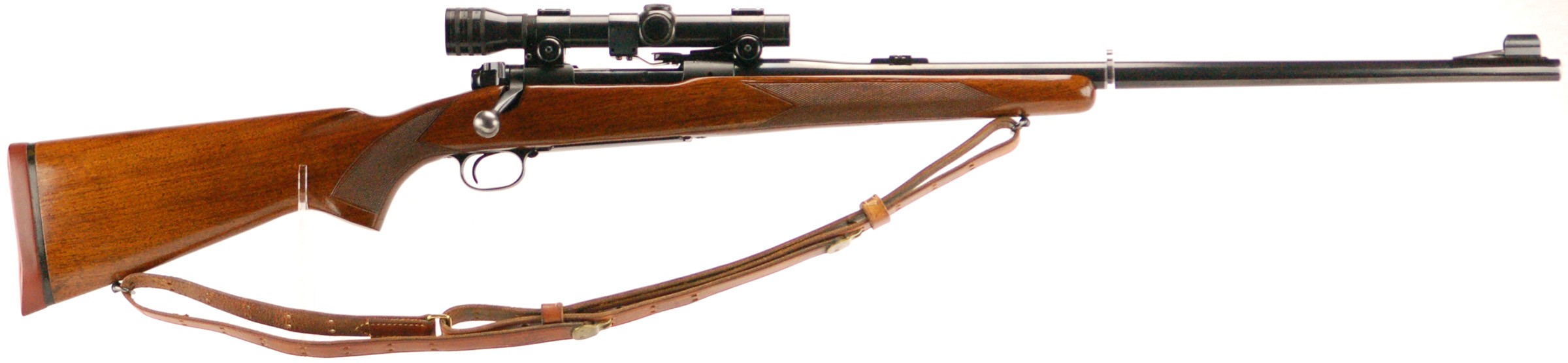
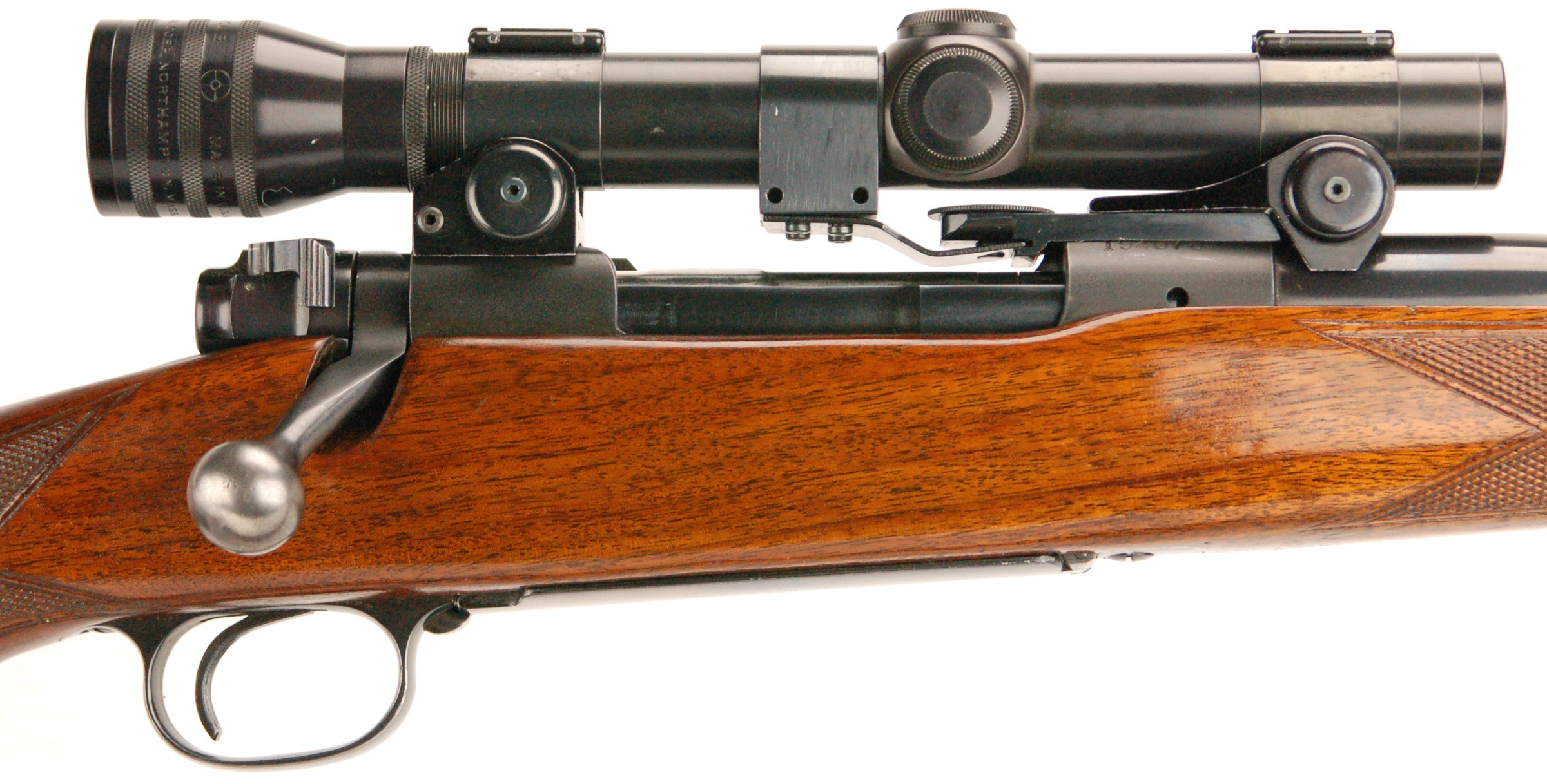
As has been discussed, you have several options that don’t require maiming the bridge. You’d have a very (impossible?) time finding a Stith “Install-It-Yourself” style mount for the 375 Magnum barrel contour, since that mount used the rear sight dovetail (that you barrel doesn’t have) and receiver sight holes to secure the mount. However, the Stith Master Mount, which used the receiver sight holes and front receiver ring holes, was made for the H&H length action. It was a rugged (ugly) externally adjustable mount but you could attach just about any scope with it. It looks like this on a 375 H&H M70. The rear mount extends down the left side of the receiver to attach via the receiver sight holes. The scope on this one is a Stith 2 3/4X “Double” (meaning it has internal adjustments) but you could mount any 1-inch tube scope as long as the objective bell isn’t huge:
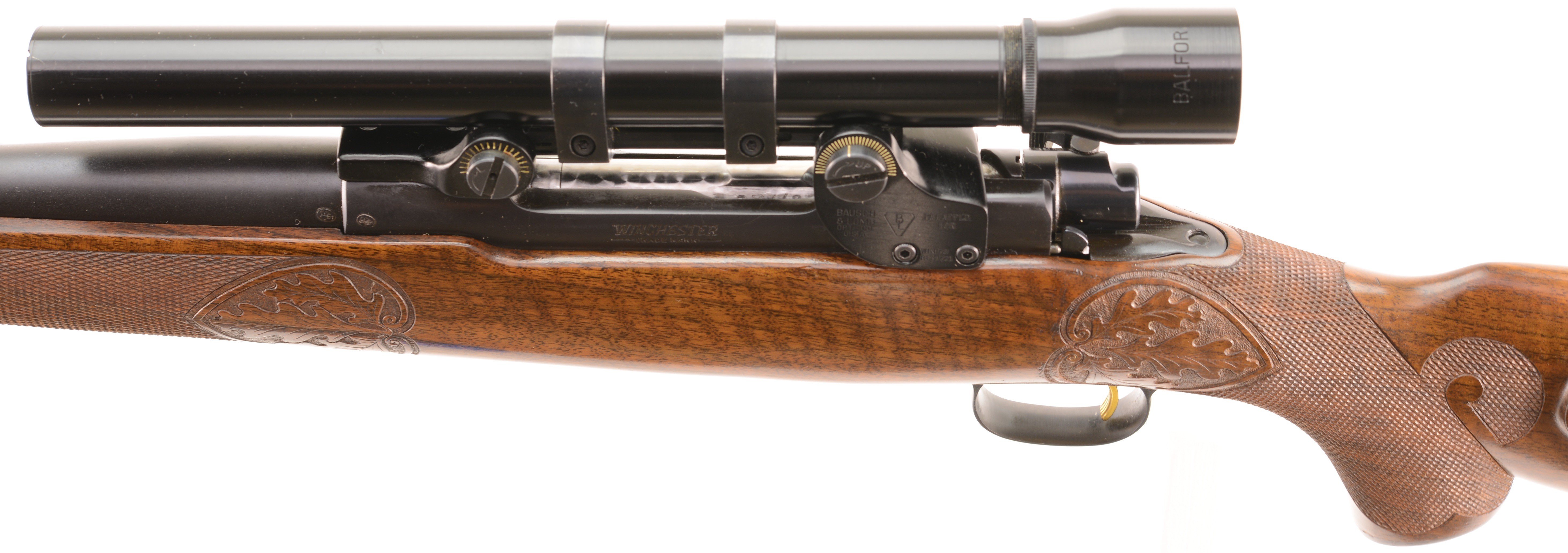
Another option is that Bausch & Lomb made a version of their externally adjustable mount that likewise didn’t requie the bridge to be D&T. It looks like this on an undrilled 1948 300 H&H Magnum:
While these are “vintage” mounts, I don’t think they’re too hard to find on eBay, etc. They’re the two best options I can think of for an undrilled H&H length M70 action.
There are many receiver sight options. As Zeb pointed out, in 1947 Lyman changed the base block of the 48WJS such that it could be installed without removing a chunk of the stock. After 1950 it could be had with either the “Target” or “Stayset” knobs. The only downsides to that one is that on the 1947-1950 version the elevation screw did protrude a little at the bottom so it can’t be put all the way down without creating a “divot” in the stock, and depending on the individual stock the bottom edge of the base block still sometimes contacted the wood, leaving an impressed “scar” when removed.
But there are many options, for example the Lyman 57WJS or Redfield 70W and 80W sights, where the base block was entirely above the wood. No problems there. For a 375 Magnum that you’re probably not going to shoot over 200 yards you don’t need a huge amount of elevation adjustment.
Hope this Helps,
Lou
WACA 9519; Studying Pre-64 Model 70 Winchesters
June 22, 2026
Offline
Thanks Lou. Super helpful and thanks for your kind remarks on my rifle.. this one is a keeper for me! For sure I want to avoid scaring the stock so thank you for that info, and sounds like Lyman 48WJS might not be the best option for my rifle, which is a 1948 mftr date I believe. I would expect to keep my shots under 150 yards… I like to move in and get as close as possible. Below is a pic where you can make out the serial number. Thank you again. This forum is proving to be a great resource and glad I am glad that I joined. 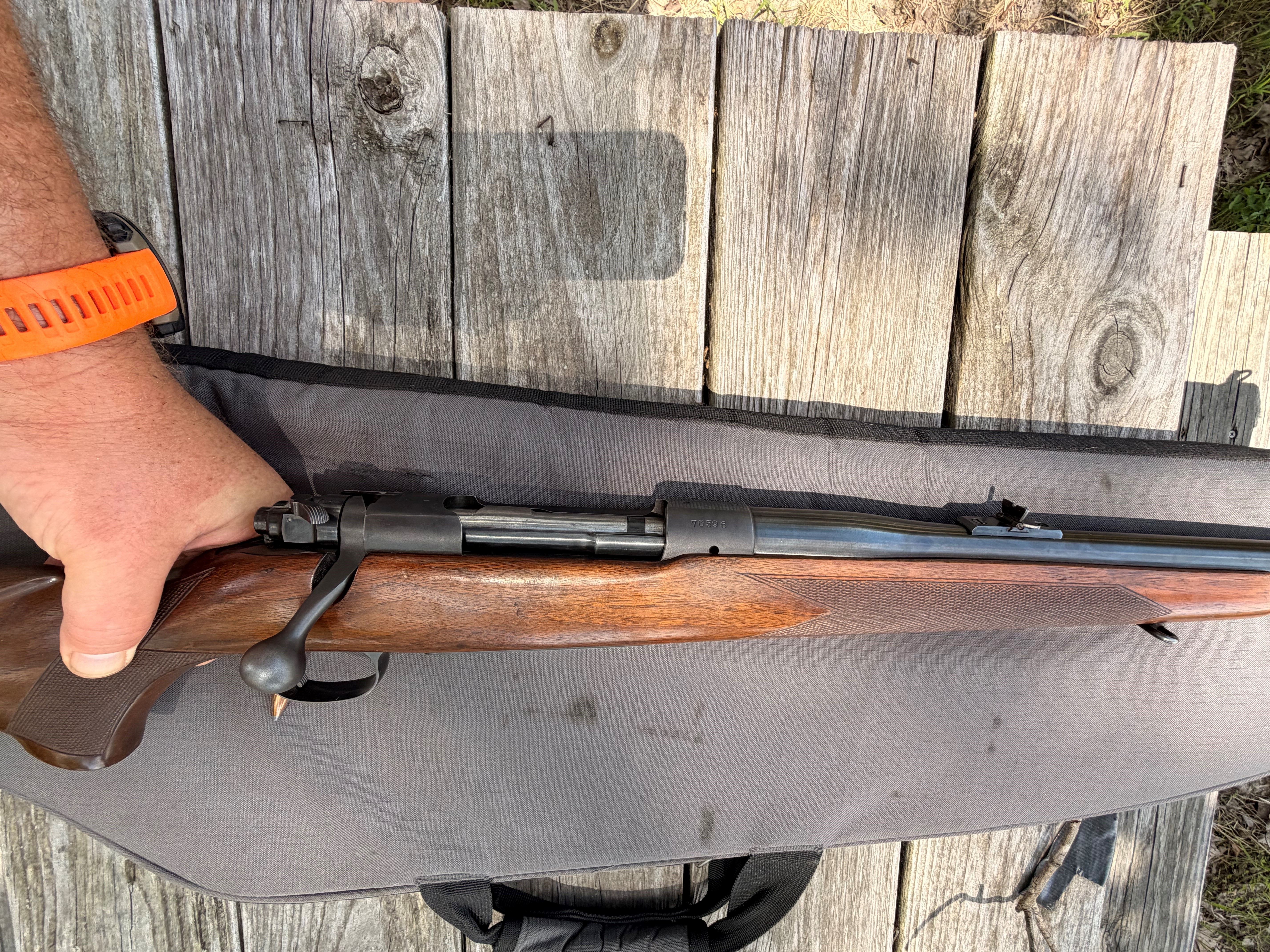
January 20, 2023
Offline
I will second Lou”s suggestion of either the Redfield 70 or 80, with “W”coded base.
I have both and prefer the 80 because it has a slide release button (like the Lyman 48) allowing for rapid large changes in elevation when sighting in or for removing the slide entirely.
The quality of construction of the Redfield and Lyman sigjts is the same.
The last Model 80 sights were made of aluminum, which I’ve never seen. However, steel versions of the 80 are not uncommon and there are plenty of the Model 70
QUESTION FOR LOU: wouldn’t removing a few threads off the bottom of the elevation screw of the Lyman 48 solve that problem? That’s what I had to do for my Lyman 48 on my 52C Sporting.
- Bill
WACA # 65205; life member, NRA; member, TGCA; member, TSRA; amateur preservationist
"I have seen wicked men and fools, a great many of both, and I believe they both get paid in the end, but the fools first." -- David Balfour, narrator and protagonist of the novel, Kidnapped, by Robert Louis Stevenson.
November 5, 2014
Offline
Hi Zeb-
Yes it would…
But the easier solution would be to buy a Lyman 48WJS made after 1950 in the first place. They made them until about 1975 and there are a ton of later ones out there. IIRC only the 1947-1950 version of the “half block” Lyman 48WJS had that protruding elevation screw issue.
The other “issue”, where the sharp inside corner of the base can contact the wood, making it hard to get the sight in full contact with the receiver, remains however. It’s hit or miss. Final shaping/sanding of pre-64 M70 stocks was done by hand, so there’s a little variability from stock to stock in how thick that side wall of the stock it. It’s not a big/noticeable difference, until you try and put a receiver sight on and find it won’t fit flush b/c it contacts the wood.
Personally, I’d go with the Redfield. I’ve yet to have a problem with one of them fitting and, like you said, the quality is there…
Best,
Lou
WACA 9519; Studying Pre-64 Model 70 Winchesters
November 5, 2014
Offline
Hi Buckums-
Thank you for the extra photo!!! Turns out I have one very close to your serial number (s/n 77043).
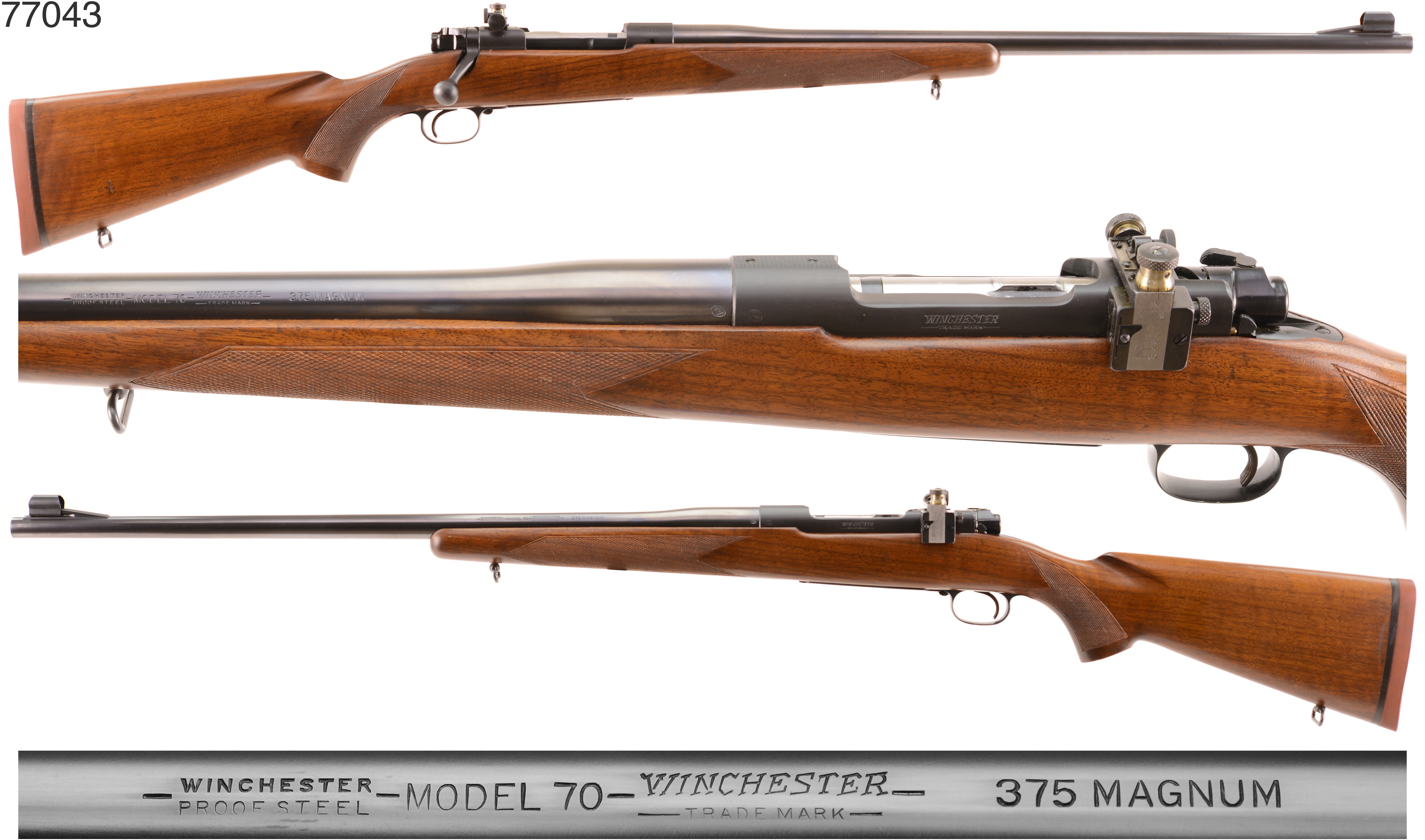
Mine must have been made for the factory Lyman 48WJS isght b/c the barrel lacks the two D&T holes for the base that secures the Lyman 6W. I do not think this was a “special order” feature. Rather, it appears that Winchester made some 375 Magnum contour barrels without holes intending them for G7017C (375 Magnum with Lyman receiver sight). S/N 77072 doesn’t have D&T holes in the barrel either…
Best,
Lou
WACA 9519; Studying Pre-64 Model 70 Winchesters
June 22, 2026
Offline
Very cool!!
January 20, 2023
Offline
Lou, Why did Winchester tap a pair of holes on the receiver ring – apparently for a scope – but not elsewhere? Did they assume a scope block would be mounted on the barrel in a place to be determined by the user? Or was the user to employ the receiver sight holes in the manner of the Stith Streamline rear mount?
Thanks,
Bill
- Bill
WACA # 65205; life member, NRA; member, TGCA; member, TSRA; amateur preservationist
"I have seen wicked men and fools, a great many of both, and I believe they both get paid in the end, but the fools first." -- David Balfour, narrator and protagonist of the novel, Kidnapped, by Robert Louis Stevenson.
November 5, 2014
Offline
Hi Zeb-
I’ll have to break out my Ouija board to answer that one!!! 
I believe it had something to do with the state of optics as they were most often used on rifles at the time the M70 was being designed c.1934. The two holes atop the front receiver ring are described in catalogs as being there to permit mounting of a telescopic sight block. So I’m assuming they were thinking of the long telescopic sights with externally adjustable mounts, e.g. Lyman, Fecker, Litschert, and later Unertl. Not internally adjustable low power scopes mounted close to the receiver using a top mount.
Given that 1930’s scopes were prone to fogging or failure, at the time the popular approach to installing what we think of as a “hunting scope” was the G&H side mount, b/c it allowed easy removal of the scope (or even using iron sights by looking under the scope). Winchester would even install a G&H mount for you on special order, but it’s not clear how many they installed compared to guns sent to G&H or G&H mounts installed by outside gunsmiths. Yes, the Redfield JR mount (and it’s predecessor) were available n the later 1930’s…
As for where the front scope block was supposed to go… Certainly the Target rifles (National Match, Target Model and Bull Gun) came with factory scope blocks on the barrel. As for standard barrels the user had two options: a cross dovetail block (Lyman BK usually works) installed in the rear sight dovetail OR drill a couple holes out in front of the barrel boss for a scope block. Because mount spacing determines the incremental change produced by one “click” of a micrometer adjustable mount, the serious scoped rifle shooter tended to opt for the latter approach. Using the rear sight dovetail put the mounts a bit too close together, making the click adjustments more like 1/3 MOA than 1/4 MOA…
An interesting (to me) side note. The factory blueprint for the 26-inch standard contour barrel (drawn 5-22-35) which at the time was for the M54 220 Swift barrel b/c 300 H&H Magnum was never a M54 cartridge, DOES show two D&T holes atop the barrel for a scope block. They just never made them that way, except maybe (???) on special order… But somebody was thinking about it!!!
When thinking about the “no-drill” scope mounts offered by Stith (Install-It-Yourself, Quick-Easy-Detachable, Master Mount) and Bausch & Lomb, I find it helpful to remember that when these products were introduced (some in the post-war 1940s) the vast majority of M70s out there (the first 60,500 or so) were not drilled. It wasn’t until 1949, when M70 serial numbers reached 120,000, that the number of factory drilled M70s in circulation equalled the number of undrilled pre-wars. So there was a market niche to be filled…
In short, Hellifino what they were thinking…
Lou
WACA 9519; Studying Pre-64 Model 70 Winchesters
January 20, 2023
Offline
It sounds like they weren’t sure but felt somebody might find them useful.
I had a Stith Streamline mount for my 1951 Model 70 Standard style and found it rock solid. However, the front “cup” was sized for Weaver 3 and the solid rings required you to completely unscrew and remove the ocular bell to install the scope. Not workable for any Nitrogen gas filled scope.
I shined it on, along with the K3 and the rifle itself.
I have operated but never owned the famous G&H side mount, for two reasons.
First, the cost of the mount itself and the gunsmithing fee to saw a chunk of your stock off to expose enough of the receiver wall to install several heavy duty screws and pins to hold the scope base in place for Eternity plus six months, against the recoil of up to a Bofors Oerlikon anti-aircraft piece.
Second, I could not bear to see any bolt action game rifle I ever cared to own disfigured in the way necessary to accommodate the G&H mount.
I suppose if I ever hit the jackpot of some huge lottery and grew bored enough to place an order with Holland for.one of their magazine rifles in 375 H & H, I might consider having them build one complete with a G&H detachable side mount. It is the only rifle thst would look “right” with one. Like the old Brit taxis, it would look charmingly ugly.
- Bill
WACA # 65205; life member, NRA; member, TGCA; member, TSRA; amateur preservationist
"I have seen wicked men and fools, a great many of both, and I believe they both get paid in the end, but the fools first." -- David Balfour, narrator and protagonist of the novel, Kidnapped, by Robert Louis Stevenson.
June 22, 2026
Offline
Thanks for all of the info here. I will post this in the Swap Meet section, but please let me know if anyone can help me source a Redfield 80W. Thanks again.
Trey
January 20, 2023
Offline
Buckums said
Thanks for all of the info here. I will post this in the Swap Meet section, but please let me know if anyone can help me source a Redfield 80W. Thanks again.
Trey
Trey, a lot of these micrometer sights are regularly traded on eBay. If you can find one on swapmeet it will likely be cheaper but I would keep a weather eye on eBay.
I had to buy my Redfield 80.coded for a Model 86/71 on eBay and had to win a bidding war to get it. As I recall, it cost me $375 plus shipping and tax and that was at least 15 to 20 years ago.
I would guess the W code sights are much more common but the eBay market is principally a market for collectors of these sights, which increases buyer competition and price.
- Bill
WACA # 65205; life member, NRA; member, TGCA; member, TSRA; amateur preservationist
"I have seen wicked men and fools, a great many of both, and I believe they both get paid in the end, but the fools first." -- David Balfour, narrator and protagonist of the novel, Kidnapped, by Robert Louis Stevenson.


1 Guest(s)
