

 Log In


December 13, 2006
 Offline

For a few years now, I’ve had in my collection, an early Featherweight M70.
Serial #221891
I’m of the belief it was made in June, 1952.
Am I correct on this date?
Thanks-a-Bunch!

August 27, 2014
Offline
You’re correct, June 1952
“If you can’t convince them, confuse them”
President Harry S. Truman

November 5, 2014
Offline

Hi Jim-
If you don’t mind… Does it have a low comb or Monte Carlo stock, and what is the rear sight? Marbles 69 folding or Winchester 22K sporting type?
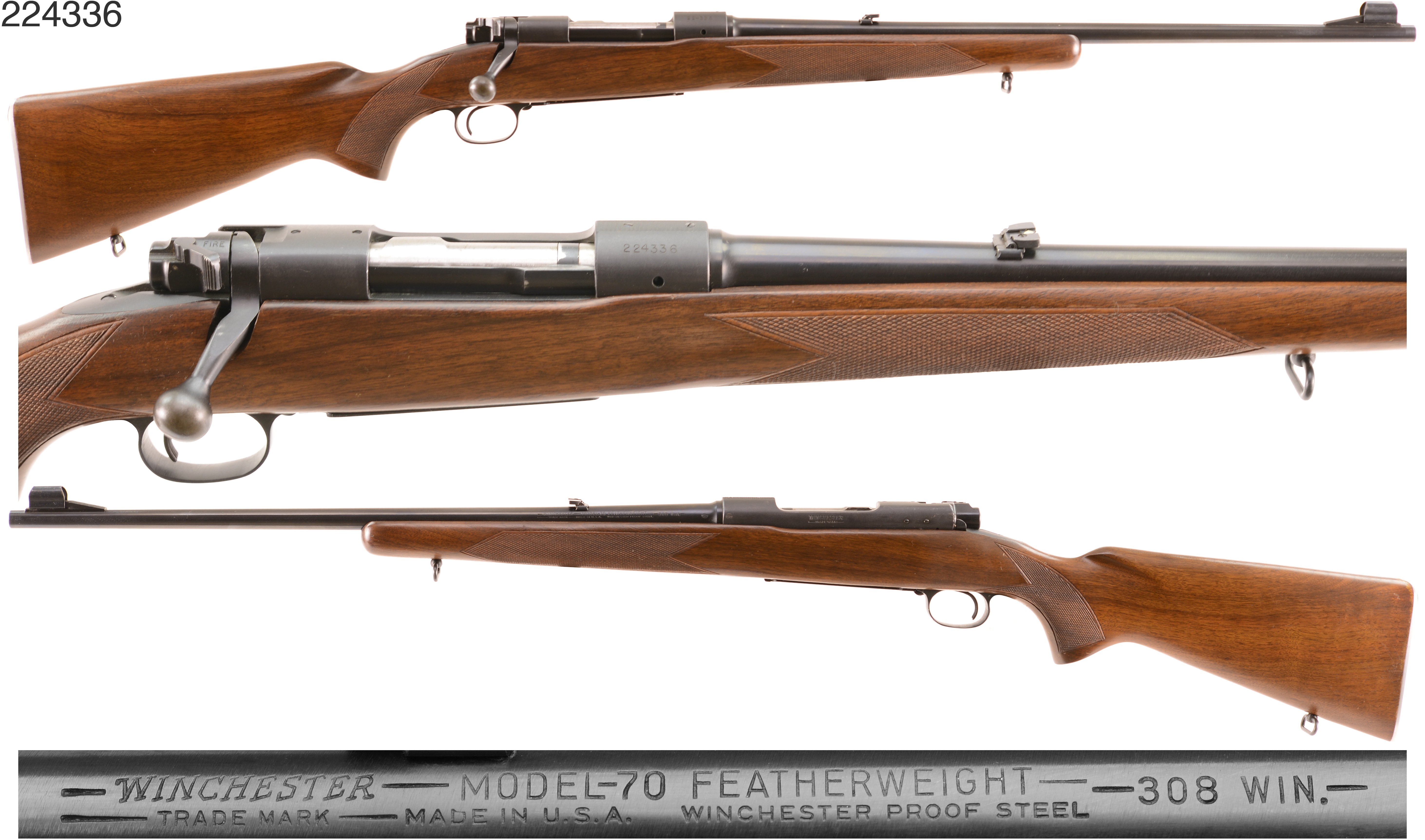
Yours is indeed an early one. Somewhere around 219,000 is where the earliest M70 Featherweights in the survey fall (with a few exceptions)… My earliest regular Featherweight is s/n 224336:
Best,
Lou
WACA 9519; Studying Pre-64 Model 70 Winchesters
December 13, 2006
Offline
Louis Luttrell said
Hi Jim-
If you don’t mind… Does it have a low comb or Monte Carlo stock, and what is the rear sight? Marbles 69 folding or Winchester 22K sporting type?
Yours is indeed an early one. Somewhere around 219,000 is where the earliest M70 Featherweights in the survey fall (with a few exceptions)… My earliest regular Featherweight is s/n 224336:Best,
Lou
Hi Lou . . . .
My Featherweight has a Monte Carlo stock . . . .and the rear sight is just like the one you pictured. (I guess it is a folding Marbles)
I would say the rifle is in about 90-95% condition.
I installed a 3-9×40 Leupold.
About when did they offer these early Featherweights in calibers OTHER THAN 308?

January 20, 2023
Offline
Lou will have a more fulsome and exact answer but I believe the 243.358, 270, and 30/06 were added in 1955. The 358 was later eliminated from the catalog in 1959 or 1960. The 264 Winchester Magnum was introduced in 1962 along with a variant model Festherweight called the Featherweight Westerner.
By far, the largest pre-64 Model 70 Featherweight production was in 30/06 Springfield. It wasn’t even close. Why?
Men born in 1923 were eligible for military service when Pearl Harbor was attacked in 1941. Survivors were only 40 years old in 1963. Those born in 1943 were eligible for service in Korea by 1951. Survivors were only 30 in 1963.
It is a safe bet most men who bought new pre-64 Featherweights during the years of production – 1952 through 1963 – either were serving or had served in an American military branch during wartime or were closely related to someone who was or had done. The standard infantry rifle and light machine gun cartridge during WWII and Korea was the .30/06 Springfield.
Alhough the 7.62 x 51mm a/k/a 308 WCF cartridge was adopted in about 1952 to replace the 30/06 as the standard NATO infantry rifle cartridge, the Springfield cartridge was still in wide use by NATO affiliated armies in 1963.
In Southeast Asia, some units of the United States Marines still fought with the 1903 Springfield chambered in 30/06. The squad infantry weapon was still the 30/06 BAR. The M60 had not yet completely replaced the .30 Browning machine gun.
The pre-64 Model 70 Featherweight offered no material weight, or any length, reduction when chambered in 308 instead of 30/06. The 308 version was built with the same action as the 30/06 version, with a shorter bolt stop. The 30/06 Featherweight could do anything the 308 version could do — and a not insignificant amount more at the heavy bullet end. Most buyers of the Featherweight couldn’t see any reason to choose the 308 chambering.
Does that mean the 308 Featherweight is a poor choice? Of course not. An excellent marksman can humanely kill anything that walks on the American Continent with a well placed, modern 180 grain bullet out of a .308 WCF rifle. It has a superior reputation for accuracy. The shorter cartridge in a light, handy SAKO Forrester I once owned is delightful to carry in the field. Would a 30/06 loaded with the 250 grain Barnes to maximum safe velocity be better for Coastal Brown bear or bull Elk? Yes, if that is what you hunt.
Both Featherweights I’ve owned are in 30/06, one of which I just bought. If everything else had been the same – production year, condition, price – but the chambering had been 308, I’d have still bought it in a New York minute. But the collector market values relative scarcity.
- Bill
WACA # 65205; life member, NRA; member, TGCA; member, TSRA; amateur preservationist
"I have seen wicked men and fools, a great many of both, and I believe they both get paid in the end, but the fools first." -- David Balfour, narrator and protagonist of the novel, Kidnapped, by Robert Louis Stevenson.
November 5, 2014
Offline
Hi Jim-
I’m reviewing the catalogs right now for a chapter. But I’ve only gotten to 1950, so this is from (feeble/failing) memory…
The 243 WIN (MC only), 270 WIN (MC and low comb), 30-06 (MC and low comb) and 358 WIN (low comb only) were added in 1955, like Zeb said. The 358 WIN was only in the catalog for 1955-56, but both ’55 and ’56 barrel dates are known so they didn’t make the barrels all at once. Low comb stocks were last cataloged in 1959. The Featherweight-Westerner, 264 WIN MAGNUM, with MC stock and factory recoil pad, hit the catalog in 1962.
The issue of sights on Featherweights is interesting b/c it generates some controversy. (I have a feeling that BoRich is going to get after me again!!! Dave Riffle gave me grief some years ago!!! ). In the original catalog listings of the Featherweight in 1952 (308 WIN only) BOTH stock styles were described (and pictured) as having the folding rear sight (Marbles 69). Based on what I’ve seen in the survey, I believe this does reflect actual production. The “tall” Winchester 22K sporting type rear sight for low comb Featherweights comes into play in 1954 (so you see it on later 1953 receivers).
I have two relatively early low comb 308 WIN Featherweights. S/N 224336 (1952) has the Marbles 69 (like yours), which was certainly correct for the MC comb. The other (S/N 271309) is a late 1953 gun. Still a Type III-2 action (solid bolt handle). It has the Win 22K. I think both are correct. Others may disagree!!!
Best,
Lou
WACA 9519; Studying Pre-64 Model 70 Winchesters
December 13, 2006
Offline
WOW! . . . .
You guys are great!
I might have to LOWER my condition rating a mite, as the floorplate and hinge has been worn “bright” from hand-holds in the Vermont/New Hampshire whitetail woods!
But the stock exhibits ONLY TWO MINOR handling marks, so I guess the former owner/hunter was VERY CAREFUL!
(Thank You, former owner . . .who ever you are!)

August 8, 2024
Offline
Louis, When you are right you are right! I have the original poster announcing the Model 70 Feather Weight, and it is pictured with a Marbles 69 flip up sight. This is on the low comb stocked Feather Weight. I have also seen them cataloged later with a 22K rear sight for the low comb Feather Weight. I have seen guns made after 1954 with both style sights on the low comb Feather weight. Evidence of a mark made by the elevator would be a clue on what style sight was original to the gun.
Interestingly, When my Father in Law purchased his Model 70 .30’06 new in 1958 He told me that he picked the Standard over the Feather Weight. He was small in stature, and thought that the Feather Weight would kick to much in that caliber.
The other thing is that 40 years ago I can remember when a Model 70 Feather Weight in .308 was not very popular. The .30’06, or really any other caliber in the Feather Weight was much more popular, and would cost the buyer more money. I remember reading an article in Shooting Times by Bill Jordan. He wrote that he purchased a Model 70 Feather Weight in .308 Winchester. Not to impressed with that caliber. Well, He had it changed to the more appropriate .270 Winchester. It is kinda funny how times change.
January 20, 2023
Offline
Jim, Don’t sweat the blue wear on the bolt and on the anodized floorplate. Only a rifle that has never been used in the field lacks those chacteristics.
Those slight areas of wear are the best assurance you can have that the steel has not been refinished. In effect, those little flaws are proof of originality.
Only those collectors who seek NIB specimens of seventy year old rifles care about them and virtually all of such high dollar players have been defrauded at least once.
It is increasingly difficult every year to detect a fraudulent refinish, unless the piece is so rare and expensive it can justify elaborate scientific testing.
I suspect the best grifters operate in a middle price marketplace and are skilled and disciplined enough to age pieces to less than perfect, as assurance of originality. They never get caught.
- Bill
WACA # 65205; life member, NRA; member, TGCA; member, TSRA; amateur preservationist
"I have seen wicked men and fools, a great many of both, and I believe they both get paid in the end, but the fools first." -- David Balfour, narrator and protagonist of the novel, Kidnapped, by Robert Louis Stevenson.
November 5, 2014
Offline
Hi Bob-
Here’s my later low comb 308 WIN Featherweight (late 1953 receiver, probably early 1954 assembly)…
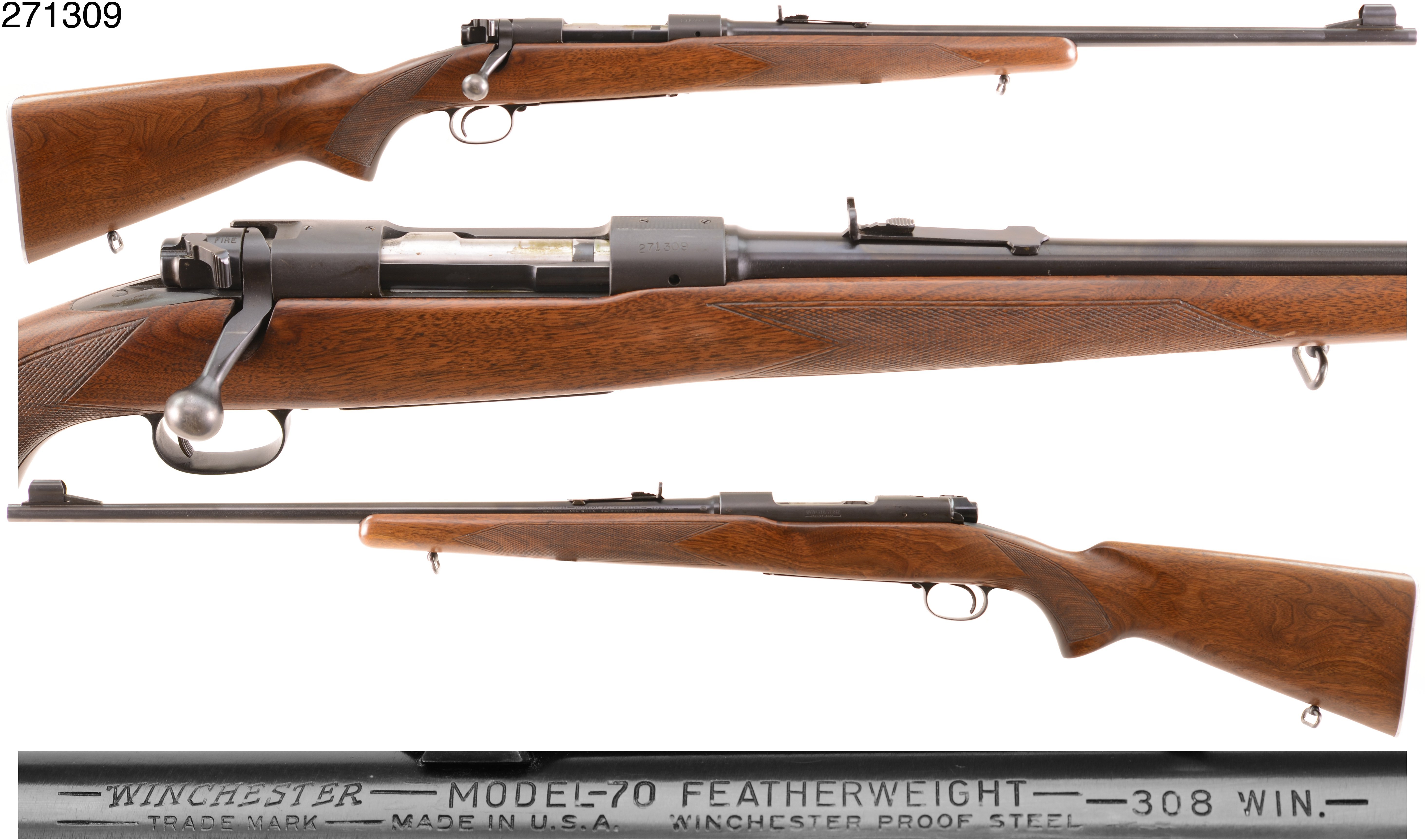
My thought is that Winchester always preferred a “sporting” style rear sight with the low comb stock that their own literature described as being designed for use with metallic sights. Longer sight radius. But, IMHO, in 1952 they didn’t have a sporting style sight that would work with the skinny Featherweight barrel. Hence the “tall” 22K that came along in 1954-ish.
I’m also inclined to think (agree) that by 1957 or so they didn’t care anymore. They also weren’t making too many low comb Featherweights by then. I too have seen later low comb Featherweights with the Lyman 16A flip sight and ZERO trace it had ever been anything else…
Hi Zeb-
I’m sure you know that Winchester, having been involved in developing the T-65 cartridge (7.62 NATO) cartridge that they subsequently commercialized as the 308 Winchester, designed their “lightweight” rifle (the Featherweight) around the cartridge. If I could only have one Featherweight it would be in 308 WIN. I’m not sure you actually gain much from a 30-06 in a 22-inch barrel anyway…
The more interesting topic to research is the Model 80. I’m looking into that one. It never made it out of the R&D stage, but CFM has at least three of the prototypes. It was what the Featherweight was supposed to be…
Best,
Lou
WACA 9519; Studying Pre-64 Model 70 Winchesters
December 13, 2006
Offline
Lou or Zeb . . . .
Do you have any M70 Featherweights listed in your “registry” with the 24” barrel?
I’m thinking they are really scarce!
(My 6/52 Featherweight is to get some “exercise” later this week.)
January 20, 2023
Offline
Not Zeb. Only Lou know stuff like that. Compared to Lou, think of me as Valetudo, Jupiter’s smallest moon.
- Bill
WACA # 65205; life member, NRA; member, TGCA; member, TSRA; amateur preservationist
"I have seen wicked men and fools, a great many of both, and I believe they both get paid in the end, but the fools first." -- David Balfour, narrator and protagonist of the novel, Kidnapped, by Robert Louis Stevenson.
November 5, 2014
Offline
Hi Jim-
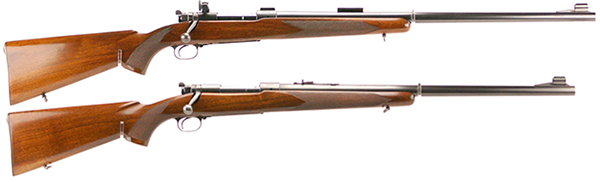
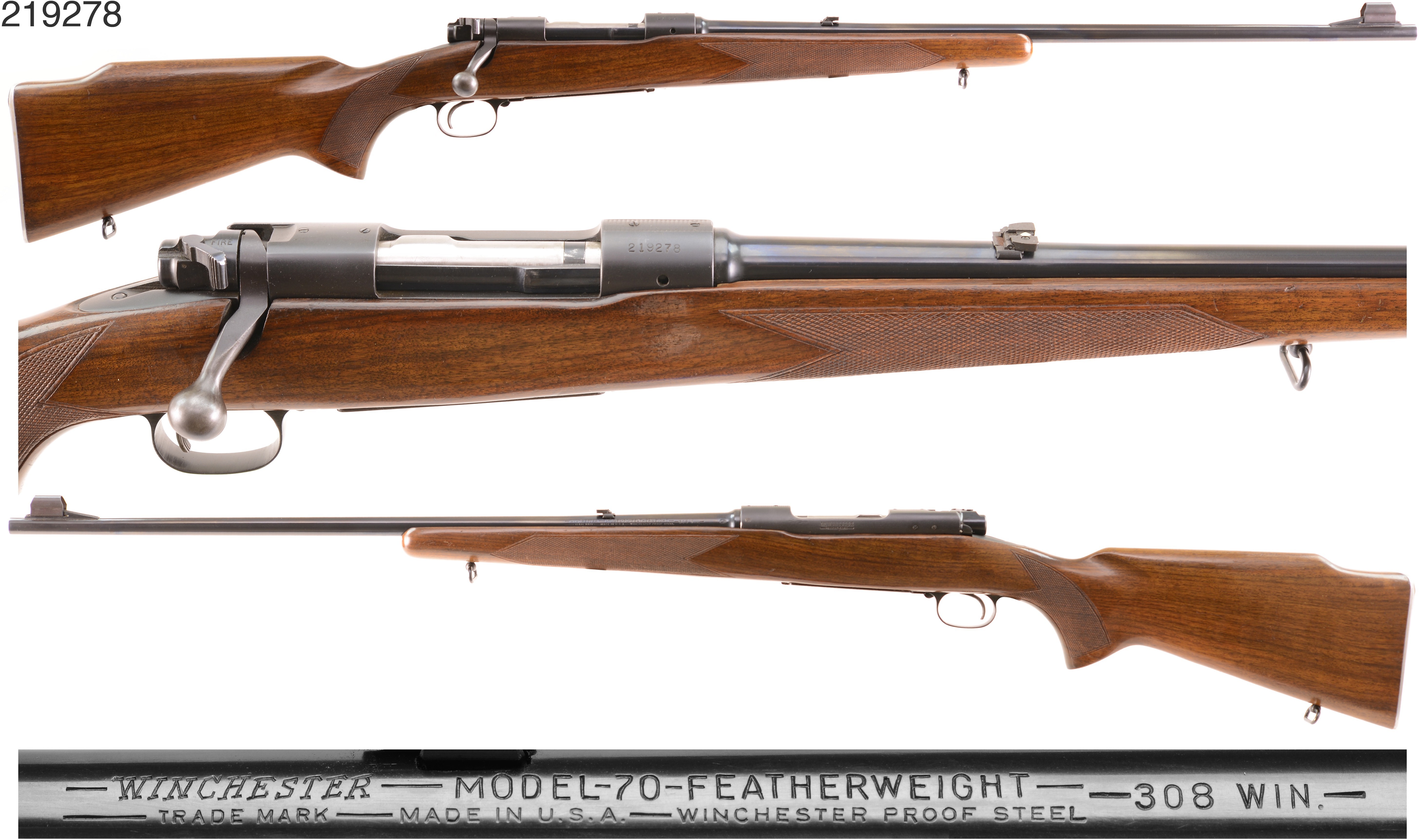
At present I have (4) of the 24-inch Featherweights recorded by serial number, one of which I consider “sketchy”. I know the location of another legit one, but I do not (as yet) have a serial number on it. This is out of about (800) 308 WIN Featherweights recorded. So I’m inclined to agree with you that they’re scarce.
This is my 24-inch Featherweight. Very early serial number for a Featherweight. Wayne Miller let me get this one from his collection a couple years ago.
Best,
Lou
WACA 9519; Studying Pre-64 Model 70 Winchesters
January 20, 2023
Offline
Louis Luttrell said
“Hi Zeb-
I’m sure you know that Winchester, having been involved in developing the T-65 cartridge (7.62 NATO) cartridge that they subsequently commercialized as the 308 Winchester, designed their “lightweight” rifle (the Featherweight) around the cartridge. If I could only have one Featherweight it would be in 308 WIN. I’m not sure you actually gain much from a 30-06 in a 22-inch barrel anyway… “
Even in 22″ barrels, the Springfield is the more flexible and powerful cartridge. The current SAAMI maximum average pressure specification for the Springfield is 60k PSI and 62k PSi for the 308 WCF. The smaller cartridge must be loaded to its pressure limit to reach within 100 foot seconds of the Springfield’s muzzle velocity and then only with 150 and 165 grain bullets, according to SAAMI testing. At 180 grains, the velocity gap opens to about 200 fs.
The smaller cartridge has insufficient powder capacity to produce useful velocities with a bullet heavier than 200 grains.
- Bill
WACA # 65205; life member, NRA; member, TGCA; member, TSRA; amateur preservationist
"I have seen wicked men and fools, a great many of both, and I believe they both get paid in the end, but the fools first." -- David Balfour, narrator and protagonist of the novel, Kidnapped, by Robert Louis Stevenson.
August 27, 2014
Offline
Louis Luttrell said
Hi Jim-
At present I have (4) of the 24-inch Featherweights recorded by serial number, one of which I consider “sketchy”. I know the location of another legit one, but I do not (as yet) have a serial number on it. This is out of about (800) 308 WIN Featherweights recorded. So I’m inclined to agree with you that they’re scarce.
This is my 24-inch Featherweight. Very early serial number for a Featherweight. Wayne Miller let me get this one from his collection a couple years ago.Best,
Lou
Good stuff there Lou🙂
“If you can’t convince them, confuse them”
President Harry S. Truman
August 27, 2014
Offline
Have parted ways with most of my Fwts. Two remain a 308 low comb and 270 Super Grade Fwt
“If you can’t convince them, confuse them”
President Harry S. Truman
August 25, 2009
 Online
Lou, Ted and Bill
Just when I think I know what I think I really know, you guys come up with a configuration that I never dreamed of.
A featherweight with a 24 inch bbl would be so cool.
Would this be a special order or was it cataloged in some way.
I am trying to grasp the logic for not purchasing a standard rifle if I felt I needed a 24 bbl in the mid 50s.
Weight difference would be negligible. Aesthetically an argument could be made for no bbl boss.
Obviously they do exist, just wondering why
Doug
November 5, 2014
Offline
Hi Doug-
See if this screenshot off my laptop comes out legible. If it does, read the blurb on “barrel”.
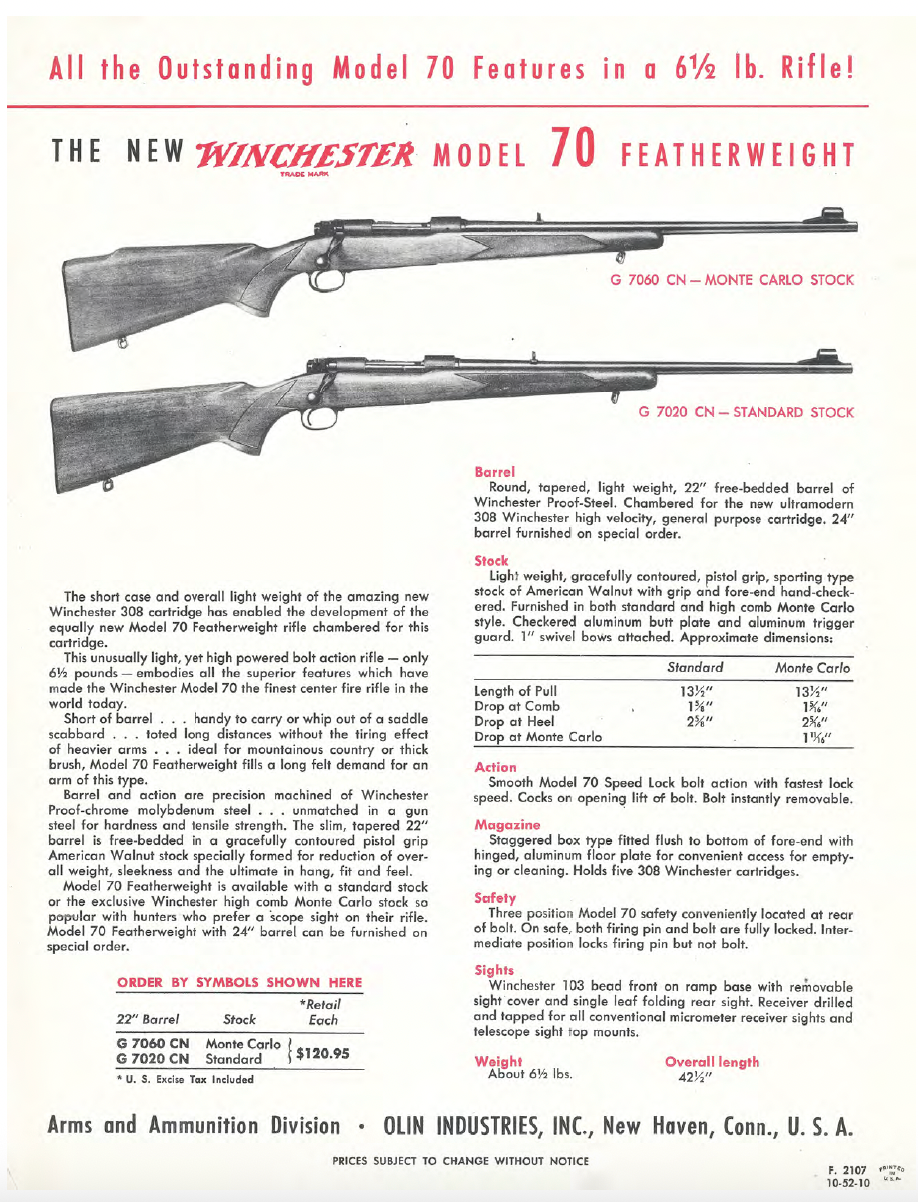
This is the forth page of the brochure introducing the Model 70 Featherweight. The “24” barrel furnished on special order” was a cataloged option from 1952 through 1954, so it only affects the 308 Winchester chambering. It did not have unique catalog symbols. G7020C was the low comb and G7060C was the Monte Carlo. These were the only two catalog symbols for the Featherweight until 1955 when they added other chamberings.
The extra 2 inches of Featherweight barrel doesn’t add much weight. It’s still VERY noticeably lighter than a contemporary 30-06 Standard rifle. (The 308 Winchester was NEVER cataloged in Standard rifle, but it was offered in the National Match and Target Model on special order, and a modest number of Bull Guns were made in 308 WIN).
I suppose (???) that Winchester thought the longer barrel would improve ballistic performance a little over the regular 22-inch barrel. Not sure why, but if I had been going to buy a Featherweight in 1952, I would have wanted the 24-inch one. Price was the same, you just might have had to wait a little longer to get it…
WADR to Zeb… The ballistics of the 308 Winchester are pretty much the same as the 30-06 with one-step lighter bullet. The 150 grain bullet in 308 Winchester was about the same as a 165 grain 30-06, 165 grain about the same as 180 grain, etc. I can understand that a 30-06 would be preferable if a heavy bullet was needed, for example for elk or bears, but for Hill Country whitetails I think I’d be happy enough with 165 grain bullets in the 308 Winchester (in a much lighter weight rifle).
Just my take…
Lou
WACA 9519; Studying Pre-64 Model 70 Winchesters
January 20, 2023
Offline
Doug,
Lou and Ted will have the details but the 24″ barrel Featherweight was a very early [EDIT] special order feature style that had few takers before it was eliminated. I can say that in 1952, while a barrel less than 24″ long was becoming popularized by custom gunmakers and shooting editors, Winchester might have been concerned 22″ was still a little avant garde for most American buyers of high power bolt action rifles.
As usual, the United States Army’s selection of an Infantry rifle influenced public opinion. When the 1903 Springfield rifle was adopted, its 24″ barrel was designed as a compromise between the traditional 30″ length for foot soldiers and 22″ for cavalry carbines. The M1 Garand followed that philosophy.
I would guess WRA soon learned the buyers’ preference from its dealers’ Featherweight sales and dropped the unpopular longer barrel special order featurestyle.
- Bill
WACA # 65205; life member, NRA; member, TGCA; member, TSRA; amateur preservationist
"I have seen wicked men and fools, a great many of both, and I believe they both get paid in the end, but the fools first." -- David Balfour, narrator and protagonist of the novel, Kidnapped, by Robert Louis Stevenson.
January 20, 2023
Offline
“WADR to Zeb… The ballistics of the 308 Winchester are pretty much the same as the 30-06 with one-step lighter bullet. The 150 grain bullet in 308 Winchester was about the same as a 165 grain 30-06, 165 grain about the same as 180 grain, etc. I can understand that a 30-06 would be preferable if a heavy bullet was needed, for example for elk or bears, but for Hill Country whitetails I think I’d be happy enough with 165 grain bullets in the 308 Winchester (in a much lighter weight rifle).”
As a much younger hunter, if I had wanted to and could have afforded to, hunt elk or bears, I would have chosen a Model 70 Featherweight with a 22″ barrel in .358 WCF caliber. The first thing I would have done to it was hand it over to my gunsmith to install a red Pachmayr Whiteline ventilated pad and make it off at a 14″ LOP. And adjust the trigger to a 3.25 pound break. And install a Leupold & Stevens 3X scope in low rings.
I didn’t get the Mercedes 300 SL cabriolet either.
- Bill
WACA # 65205; life member, NRA; member, TGCA; member, TSRA; amateur preservationist
"I have seen wicked men and fools, a great many of both, and I believe they both get paid in the end, but the fools first." -- David Balfour, narrator and protagonist of the novel, Kidnapped, by Robert Louis Stevenson.


1 Guest(s)
