

 Log In


April 3, 2018
 Offline


In January I happened upon a 1949 M 70 “cloverleaf” tang rifle in the 114XXX SN range, chambered in 270 WCF. Many of these later Type II “transition” Model 70s ocurred in the late 1940s and quite a few were in the magnum calibers. This rifle has a pristine bore and is amazingly accurate, which creates a challenge for my hunting rifle experience. The “cloverleaf” tang Type II-1/2 rifles were supposed to have all been phased out by 1948 preparing for the Type III. Another indication that “Rule rules” and Winchester exceptions do not travel the same path.
I do have a 1950s Savage 99 EG in 250-3000. The Arizona Coues variety of whitetails would welcome the Savage, not so much the transition Model 70.
The 270 WCF cartridge was almost developed for deer and antelope. Jack O’Connor would agree with his own Model 70 rifles.

November 5, 2014
Offline
Hi Fuller-
Glancing at the M70 survey, I have four STANDARD length Type II (cloverleaf tang) M70s in the 114,XXX range (S/Ns 114188, 114220, 114249, and 114262). If you’d care to tell me the serial number of your rifle (by PM if you prefer), I’d like to add it to the survey. Those are the latest Type II STANDARD receivers I encountered. As for the H&H Magnum receivers, the last of them were finished and serialized mostly in the 121,000 to 123,000 range, with the latest I’ve seen being 126288.
The Type II receiver serial numbers are all over the place. I’m not quoting Roger here, just looking at the survey…  The first batch is in the 55,300 to 55,400 range, well before they stopped making pre-war Type I receivers. Around S/N 60,500 they become the predominant type and stay that way until around S/N 87,700 when the oval tang Type III receivers appear. Still… Batches (serial number clusters) of STANDARD Type II rifles appear in the 101,000 to 103,000 range, again in the 108,000 range, sporadically between 109,000 and 112,000, and then finally in the 114,000s. Oddly, nearly all of the Type II receivers in the 101,000 to 103,000 range were built into 257 ROBERTS rifles…
I guess there must have been a lot of partly milled Type II receivers lying around when they started making Type IIIs (both Standard and H&H Magnum), and they finished them out during 1949. I also suspect that some Type II receivers that were serialized in the 87,000 range were actually assembled into rifles during 1949 along with the Type II receivers finished and serialized in the 1949 range. That’s probably (???) the explanation for the uncommon Type II rifles with cloverleaf tang inletting and “looped” pistol grips… The “looped” grip profile appears around s/n 125,000. My GUESS is that to finish these leftover Type II receivers they had to make stocks inlet for the cloverleaf tang they but didn’t change the setting for the pistol grip contour.
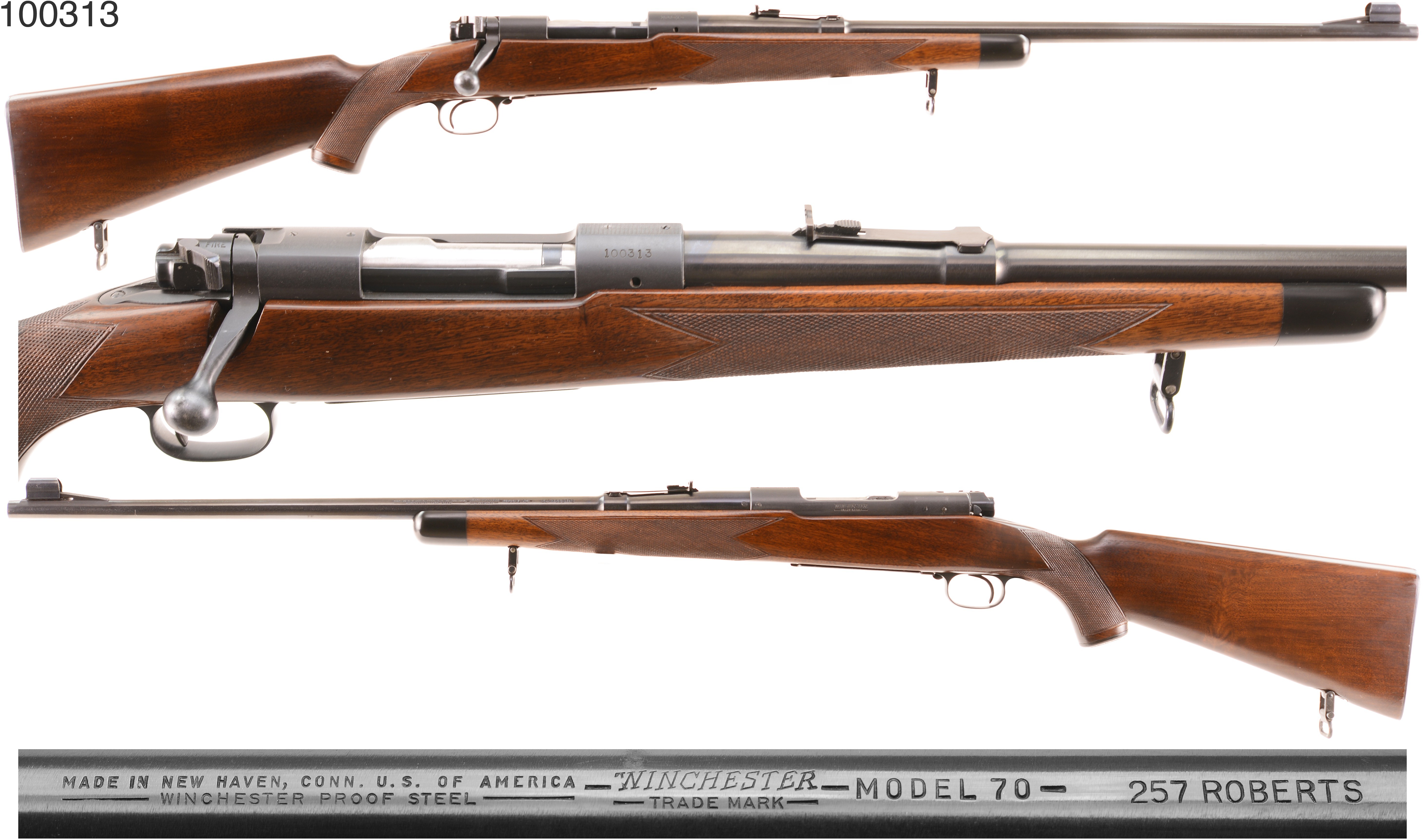
Who knew this was so complicated!!!  Here’s an oddball of mine… S/N 100313, a Type II-2 (cloverleaf tang + late dogleg safety) Super Grade in 257 ROBERTS (no surprise there) with a “no cheekpiece” Super Grade stock. The most common request of left handed shooters wanting a Model 70 Super Grade but not wanting to pay for a right side cheekpiece… Hmmm…
Just my take,
Lou
WACA 9519; Studying Pre-64 Model 70 Winchesters
April 3, 2018
Offline
Louis:
My “transition” rifle serial no. is 114177, and it came from Northern Nevada. I am not a real student of the Model 70, but very aware of what I admire in the pre-1963 rifles. Frank De Haas points out some of the areas that the early M 70 could have been improved in his “Bolt Action Rifles”: like a real Mauser-style bolt shroud along with an extra gas raceway or extra left side receiver ring gas port.
That said, the early Model 70 was of a quality that its steel quality was never questioned like in some Springfields or Mausers, while the fit and finish of the overall rifle along with its accuracy earned it the deserved title of “The Rifleman’s Rifle”.
Maybe that is why I keep “rescuing” them from pawn shops, sporting goods stores, and riflesmiths. My collection runs the gamut from 270 WCF through .375 Holland and Holland. Strange as my tastes allow are two re-chambered and re-rifled custom M 70s in 338-06 and 35 Whelen. One that kinda want back was a pre war heavy barreled Type 1 Super Grade 375 H&H in a wooden Winchester shipping box.
Lastly, a little different from O’Connor’s views-wish John Olin and the management of Winchester had decided to turn the pre-63 Model 70 into a custom shop rifle and just raised the price to compete with Weatherby, not Remington…along with some additional calibers and custom orders-all at extra cost, of course.
But I am just a hunter with good taste-what do I know about corporate costs and worn machinery. Regards;
Ridge Marriott
Lt Col-USA-Ret


2 Guest(s)
