

 Log In


April 15, 2005
 Offline


helidriver72 said
Ok reviving another old post here. I was just wondering how many are on the survey now and if any more evidence has came to light regarding the authenticity if these “hybrids”?
Thanks again for all the knowledge shared here.
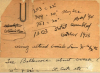
First, the Model 94/95 Hybrids are positively authentic. Based on this note card found in the factory files box in the McCrackin Research library (at the Buffalo Bill Historical Center of the West), there is extremely strong evidence that Winchester in fact assembled 1,303 Model 94 Carbines in October of the year 1928 using left over .30 caliber Model 95 barrels.

In my continuing survey, a total of (90) of the Model 95/95 hybrids have been documented thus far, with all of the serial numbers corresponding to the year 1928 (in the 1014894 – 1035596 range).

Bert
WACA Historian & Board of Director Member #6571L

June 26, 2013
Offline
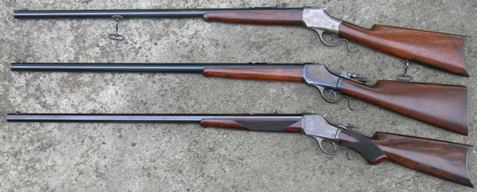
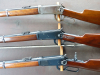
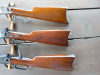
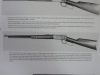
I found my first Model 94/95 about 13 years ago. Over the years, I’ve been on the hunt for an example of each of the three variations. One is featured in Kassab and Dunbar’s 1895 book as well as the Winchester Collector magazine. Another is pictured in Bob Renneberg’s 1894 book.
Don

March 31, 2009
Offline
How can you tell it’s a hybrid? What is the tell tale?
June 26, 2013
Offline
Chuck said
How can you tell it’s a hybrid? What is the tell tale?
The most notable difference is the rifle style magazine retainer rather than the standard barrel band. Barrels also have 1 in 10 rifling (like the 30-06) rather than the standard 1 in 12 twist for 30 WCF. The top carbine also has a 21.5″ barrel, which is a modified 1895 musket barrel. You may find these articles of interest. My carbine, serial number 1025460 is featured in both articles.
https://winchestercollector.org/magazines/202103/54/
https://winchestercollector.org/magazines/201206/10/
Don
December 9, 2024
Offline
Bert, Finding that note is pretty amazing! And pretty inspiring to know theres some more out there to be found, thanks again for all the great knowledge shared in this site!
Thanks for the pics Deerhunter👍
April 15, 2005
Offline
helidriver72 said
Bert, Finding that note is pretty amazing! And pretty inspiring to know theres some more out there to be found, thanks again for all the great knowledge shared in this site!
Thanks for the pics Deerhunter👍
I cannot take the credit for finding that note in the files at the museum (it was one of our other WACA members who found it and sent me a copy). Yes, it would appear that there are at least another 1,213 of them out there yet to be discovered. It is my belief that the majority of them will be found somewhere west of the Rocky Mountains.
Bert
WACA Historian & Board of Director Member #6571L
March 31, 2009
Offline
deerhunter said
Chuck said
How can you tell it’s a hybrid? What is the tell tale?
The most notable difference is the rifle style magazine retainer rather than the standard barrel band. Barrels also have 1 in 10 rifling (like the 30-06) rather than the standard 1 in 12 twist for 30 WCF. The top carbine also has a 21.5″ barrel, which is a modified 1895 musket barrel. You may find these articles of interest. My carbine, serial number 1025460 is featured in both articles.
https://winchestercollector.org/magazines/202103/54/
https://winchestercollector.org/magazines/201206/10/
Don
After looking at all of this I guess the easiest way to spot one is the front sight and the barrel band?
April 15, 2005
Offline
Chuck said
deerhunter said
Chuck said
How can you tell it’s a hybrid? What is the tell tale?
The most notable difference is the rifle style magazine retainer rather than the standard barrel band. Barrels also have 1 in 10 rifling (like the 30-06) rather than the standard 1 in 12 twist for 30 WCF. The top carbine also has a 21.5″ barrel, which is a modified 1895 musket barrel. You may find these articles of interest. My carbine, serial number 1025460 is featured in both articles.
https://winchestercollector.org/magazines/202103/54/
https://winchestercollector.org/magazines/201206/10/
Don
After looking at all of this I guess the easiest way to spot one is the front sight and the barrel band?
Yes, that is certainly one of the easy things to spot. Another clue is the mismatched barrel and magazine tube length on the (203) that were made with a 21.75″ barrel length (Type-3 and Type-4).
Bert
WACA Historian & Board of Director Member #6571L
August 25, 2009
 Online
Bert H. said
helidriver72 said
Bert, Finding that note is pretty amazing! And pretty inspiring to know theres some more out there to be found, thanks again for all the great knowledge shared in this site!
Thanks for the pics Deerhunter👍
I cannot take the credit for finding that note in the files at the museum (it was one of our other WACA members who found it and sent me a copy). Yes, it would appear that there are at least another 1,213 of them out there yet to be discovered. It is my belief that the majority of them will be found somewhere west of the Rocky Mountains.
Bert
Bert
Could you expound on your suspicion that most of them came to the western US.
Doug
April 15, 2005
Offline
DEEREHART said
Bert H. said
helidriver72 said
Bert, Finding that note is pretty amazing! And pretty inspiring to know theres some more out there to be found, thanks again for all the great knowledge shared in this site!
Thanks for the pics Deerhunter👍
I cannot take the credit for finding that note in the files at the museum (it was one of our other WACA members who found it and sent me a copy). Yes, it would appear that there are at least another 1,213 of them out there yet to be discovered. It is my belief that the majority of them will be found somewhere west of the Rocky Mountains.
Bert
Bert
Could you expound on your suspicion that most of them came to the western US.
Doug
It was Art Gogan who first brought them to light and began surveying them. At the time, Art was living in Oregon, and he was finding them there locally and at the western gun shows. In my continued research if them, the majority of them have been found on the west side of the Rocky Mountains.
WACA Historian & Board of Director Member #6571L
August 25, 2009
Online
Bert H. said
DEEREHART said
Bert H. said
helidriver72 said
Bert, Finding that note is pretty amazing! And pretty inspiring to know theres some more out there to be found, thanks again for all the great knowledge shared in this site!
Thanks for the pics Deerhunter👍
I cannot take the credit for finding that note in the files at the museum (it was one of our other WACA members who found it and sent me a copy). Yes, it would appear that there are at least another 1,213 of them out there yet to be discovered. It is my belief that the majority of them will be found somewhere west of the Rocky Mountains.
Bert
Bert
Could you expound on your suspicion that most of them came to the western US.
Doug
It was Art Gogan who first brought them to light and began surveying them. At the time, Art was living in Oregon, and he was finding them there locally and at the western gun shows. In my continued research of them, the majority of them have been found on the west side of the Rocky Mountains.
Bert
If Art G lived in Oregon and started to document these carbines and you being here in the NW are finding them here also, has anyone been watching for them in other parts of the country?
I am trying to come up with a logical theory as to why they would not be scattered across the country. Thus far we have found no special acknowledgment of them being different from Winchester other than the note in the McCracken files. If Winchester just shipped them as normal SRCs wouldn’t someone have noticed the difference. Do you suppose they could have been marketed as a “special” run of carbines? (we have no documents that support that other than a theory)
Not trying to be argumentative here. I do own three of the 4 variations. Just wondering how they could have been marketed.
Doug
April 15, 2005
Offline
In response to Doug’s last post, these are my thoughts & theories on the 94/95 Hybrids.
First, while Art’s survey was primarily confined to the western part of the U.S., my continued survey of them is not. I have the benefit of “www” (internet), and all of the many digital auction catalogs that I continually receive and comb through. Further, through this website and my known research efforts, I have collaborated with a substantial number of collectors spread across the county that routinely contact me with new information.
One of the primary reasons why I believe that most of the hybrids were shipped and sold in the western marketplace is the fact that all (100%) of the 94/95 hybrids found thus far are Saddle Ring Carbines. By the late 1920s (1927 and beyond), Winchester had begun routine production (batches) of what we refer to as “Eastern” carbines. By the year 1929, more than 50% of the total Model 94 carbine production was “Eastern” Carbines. The SRC variation was still being manufactured but they were primarily shipped and sold in the western part of the country. Simply stated, SRCs had fallen out of favor in the eastern & midwestern parts of the country.
As of today, the majority of the 94/95 hybrids have been located and documented in the western half of the U.S. Sure, there are some that have been discovered in the east, but they most likely migrated there through the activities of the collecting community and the auction houses.
Bert
WACA Historian & Board of Director Member #6571L


