

 Log In


August 29, 2026
 Offline

I had aways looked at pre-64 Model 70’s while in college in the 1970’s. I finally traded into one a few years ago.
It has some slight blue wear on the barrel where I suspect a 22K spring sight may have resided. Did my 1955 30-06 low comb come originally with a 22K for a rear sight? I believe it currently has a Lyman 16B installed but it also came with a Marbles 69 in a bag with a bad screw. The screw has been sourced and the Marbles is functional again.
In its current state is it worthy of having a 22K reinstalled if it originally came with one? I have a set of 4 screw Redfield high rings I could put the Leupold 2-7X scope in. Would Redfield high rings clear the 22K or would I need to go to something like a Lyman Alaskan scope?
Would a folding sight have been the Marbles or the Lyman 16B if it came with a folding sight? I want to avoid fixing something that may be correct?
https://i.imgur.com/nzqp7Za.jpeg?1
https://i.imgur.com/Die26mi.jpeg
https://i.imgur.com/ANcaV8g.jpeg
https://i.imgur.com/gXTB7KI.jpeg
https://i.imgur.com/H4MJBjv.jpeg
https://i.imgur.com/lVmK1Qp.jpeg
https://i.imgur.com/eAQ5MWE.jpeg?1
https://i.imgur.com/FEvYAZ0.jpeg
https://i.imgur.com/7XuCnah.jpeg
https://i.imgur.com/d84TEpN.jpeg
https://i.imgur.com/FQjIBY3.jpeg
https://i.imgur.com/3lxTmWX.jpeg

November 5, 2014
Offline
Hi TW56-
It looks like a nice honest gun to me… Congrats!
The issue of correct sights on a 1955 vintage low comb M70 may generate some (unnecessary) controversy, based on the fact that Roger Rules didn’t make clear what he meant by “22K”. There were TWO different height 22K sporting type rear sights used, one for standard barrels, the other for Featherweights. Neither is the double scallop pre-war 22K that kept getting pictured in Winchester parts catalogs into the late 1940s, despite being discontinued around the time F. Scott Fitzgerald wrote “The Great Gatsby”. Don’t blame ME or Roger, we didn’t name them!!!
This pic may explain it best. From left to right are the 22G, “low 22K” (used on standard barrels) and “high 22K” (used in Featherweights):
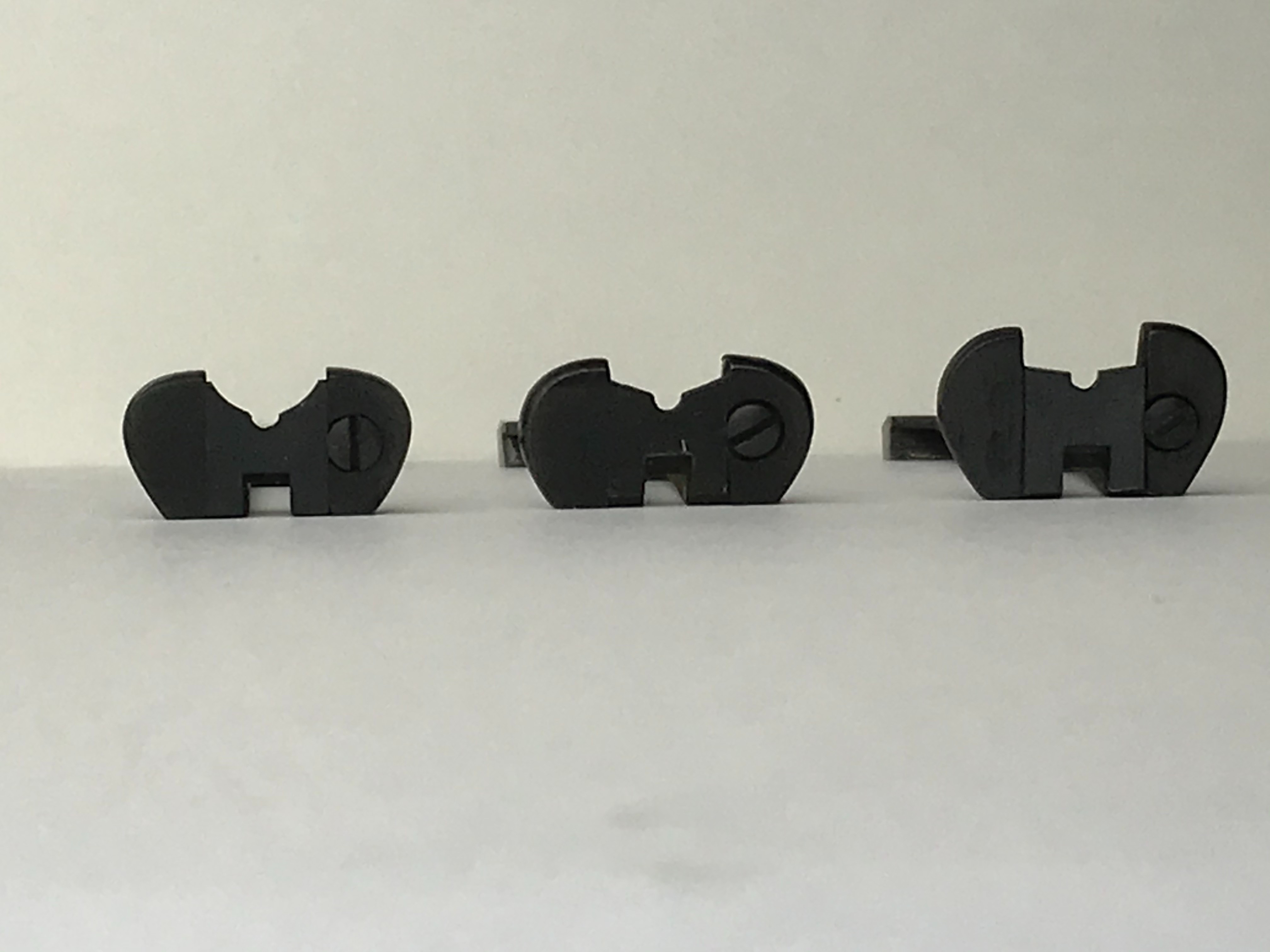
The ONLY difference between the 22G and the low 22K was the shape of the sheet metal slide. The shallow “V” of the low 22K gave a slightly higher line of sight, which Winchester wanted so they could use the same taller from sight (103E instead of 103C) on all barrels regardless of stock style. Confused yet??? It’s confusing…  But I do have copies of the 22G and low 22K blueprints that clearly state that the “base” (the whole sight except the slide) was the same on both.
The chronology of standard barrel contour rear sights and low comb stocks, as best I can tell, was that the 22G was used through 1953 paired with a 103C front sight (0.310″ tall). The low 22K was used from 1954-ish through 1957-ish paired with a 103E front sight (0.360″ tall). The tall 22K (which is pictured in Rule’s book) was used on low comb Featherweights from 1954-1957.
As for the Monte Carlo stocks, they all used the 103E front sight (beginning in 1952). Initially the rear sight was a Marbles 69 (which also came in two heights, a lower one used on standard barrels and a taller one used on Featherweight barrels). This was replaced by the Lyman 16B (on standard barrels) and 16A (on Featherweight barrels) beginning in 1954.
So if your rifle was a 1955 with Monte Carlo stock, the Lyman 16B would be most appropriate. As a low comb, the low height 22K would be the right one.
Just my take…
Lou
WACA 9519; Studying Pre-64 Model 70 Winchesters
July 3, 2020
Offline
Just learned something new from you “Louis”…. thank you my friend… Ben

January 20, 2023
Offline
To study the pre-64 Winchester Model 70 is to enter James Jesus Angleton’s “wilderness of mirrors.”
As an apostate who loves his 1950 Super Grade, may I suggest a Lyman 12S in the rear dovetail solves all problems, particularly for users of Buehler-style scope mounts who do not regard them as QC devices.
- Bill
WACA # 65205; life member, NRA; member, TGCA; member, TSRA; amateur preservationist
"I have seen wicked men and fools, a great many of both, and I believe they both get paid in the end, but the fools first." -- David Balfour, narrator and protagonist of the novel, Kidnapped, by Robert Louis Stevenson.
December 9, 2002
Offline
Zeb,
There’s definitely a lot to know and learn about the M-70, and Louis and a few others sure have helped us out here. Louis is a walking Encyclopedia, to say the least! IMHO! I wish I had his memory!
Ben,
I’m in agreement with you, as I also have learned some more from him. Every time he posts something, I have to re fresh my notes and memory bank, in the most pleasurable way!
Thanks Dr. Lou! 
Tony
November 5, 2014
Offline
Hi Tony-
The issue of M70 sights is messy… The factory rarely specified the sights they used or called out changes in their catalogs, especially when they were using “outsourced” sights from Lyman, Redfield or Marbles. For example, Winchester product catalogs only describe the Super Grade front sight as a “Redfield full gold bead”. They do not specify height. The notion that only the Redfield 255 (0.360″ tall) was used on M70s comes from Rule’s book (and possibly from a typo in one of the parts catalogs)… Loooong story…
The reality (based on the survey) is that Super Grade front sights were the same height as the contemporary Standard rifle front sights, which makes sense because the butt stock dimensions/barrel contour/rear sight of the Super Grade was the same as a Standard rifle. So from 1936-1952 the Super Grade front sight was 0.310″ tall (Redfield 254), same height as the Lyman 31W/Winchester 103C sights used on Standard rifles. The change to the Redfield 255 occurred with the advent of the MC stock in 1952, when the rear sight was changed to a Marbles 69 folding. The same thing happened on Standard rifles about the same time. MC stocked Standard rifles got the Marbles 69 paired with a 0.360″ tall Winchester 103E (replacing the 0.310″ tall 103C). LC stocked Standard rifles got the “low” 22K (pictured above) paired with the 103E, although the change was a little slower (I think) b/c the only reason to change the sights on a LC stock M70 was so they could use the same front sight (103E) on everything (standard and Featherweight barrels) regardless of stock type.
The issue I will encounter is that this information differs from what’s stated in Roger Rule’s book… Many M70 experts will therefore question my “unsupported claim” or at least my basic literacy skills…
Make of it what you will…
Lou
WACA 9519; Studying Pre-64 Model 70 Winchesters

August 27, 2014
 Online
Louis Luttrell said
Hi Tony-
The issue of M70 sights is messy… The factory rarely specified the sights they used or called out changes in their catalogs, especially when they were using “outsourced” sights from Lyman, Redfield or Marbles. For example, Winchester product catalogs only describe the Super Grade front sight as a “Redfield full gold bead”. They do not specify height. The notion that only the Redfield 255 (0.360″ tall) was used on M70s comes from Rule’s book (and possibly from a typo in one of the parts catalogs)… Loooong story…
The reality (based on the survey) is that Super Grade front sights were the same height as the contemporary Standard rifle front sights, which makes sense because the butt stock dimensions/barrel contour/rear sight of the Super Grade was the same as a Standard rifle. So from 1936-1952 the Super Grade front sight was 0.310″ tall (Redfield 254), same height as the Lyman 31W/Winchester 103C sights used on Standard rifles. The change to the Redfield 255 occurred with the advent of the MC stock in 1952, when the rear sight was changed to a Marbles 69 folding. The same thing happened on Standard rifles about the same time. MC stocked Standard rifles got the Marbles 69 paired with a 0.360″ tall Winchester 103E (replacing the 0.310″ tall 103C). LC stocked Standard rifles got the “low” 22K (pictured above) paired with the 103E, although the change was a little slower (I think) b/c the only reason to change the sights on a LC stock M70 was so they could use the same front sight (103E) on everything (standard and Featherweight barrels) regardless of stock type.
The issue I will encounter is that this information differs from what’s stated in Roger Rule’s book… Many M70 experts will therefore question my “unsupported claim” or at least my basic literacy skills…
Make of it what you will…
Lou
You have the DATA Lou
“If you can’t convince them, confuse them”
President Harry S. Truman

April 15, 2005
Online
Louis Luttrell said
The issue I will encounter is that this information differs from what’s stated in Roger Rule’s book… Many M70 experts will therefore question my “unsupported claim” or at least my basic literacy skills…
Make of it what you will…
Lou
Welcome to the Club! I have been dealing with that exact same issue for the past 25+ years concerning all of the non-factual information published in the past years by G.M.
Bert
WACA Historian & Board of Director Member #6571L

August 8, 2024
Offline
Interestingly all my Super Grades with the exception of the African that were made from 1955-1958 have the Redfield 254 front site that measures .310. These feature the Monte Carlo stock with a Lyman 16B rear site. The Super Grade Feather Weight has the same Redfield 254 front site, but has the taller Lyman 16A. Louis I concur with you thoughts that Roger’s information differs from what I have found. Keep up the good work!
November 5, 2014
Offline

Hi Bob-
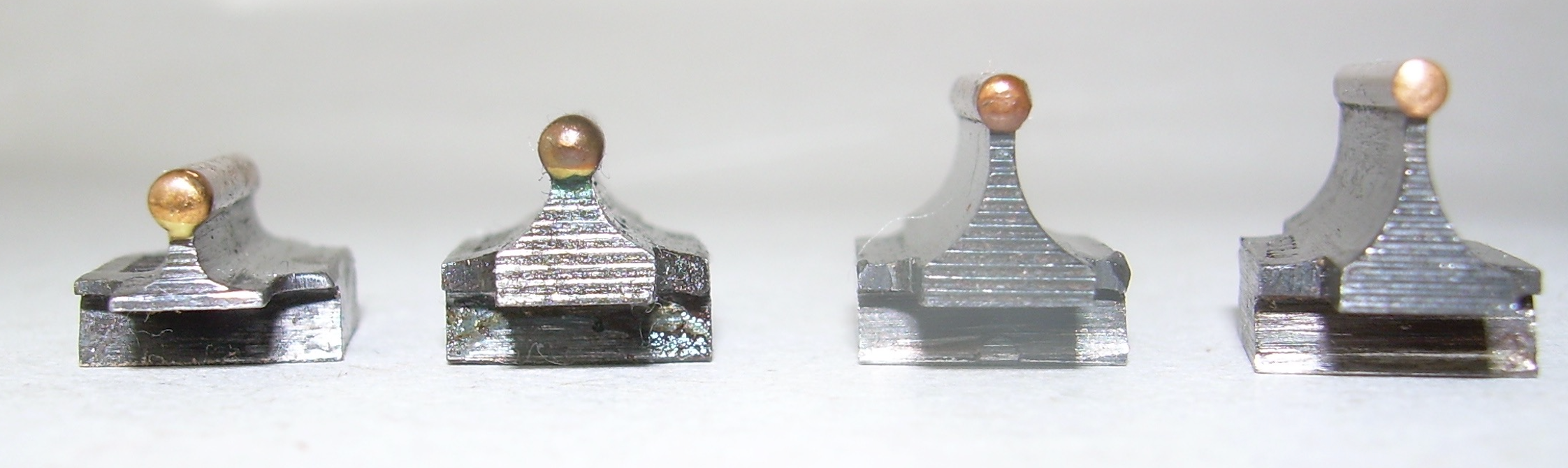
Are you sure about the front sight on your later (non-African) Super Grades? This could help the survey… Whenever possible, I usually count the number of horizontal striations on the rear surface of the sight b/c they’re hard to measure w/o knocking them out. Pic below shows (left to right) Redfield full gold sights of 0.260″ (used by Winchester only on the 375 MAGNUM 24-inch heavy barrel), 0.310″ (254), 0.360″ (255), and 0.390″ (256). The 256 was not used by Winchester on anything I’m aware of… I have better pics of the 254 than this photo, but this is the composite I have handy…
Hi Ted-
The problem with “data” from an “observational survey” is that I can only record what was there when I saw the gun (or on-line photos of the gun). This is a problem with LC M70s in general, since many (most???) people back in the day removed the original sight whenever they installed a scope, and many other people put the “wrong” sight back when trying to “restore” a gun for resale… The 22G versus “low” 22K thing is a mess… Since the “low” 22K blueprint I’ve mentioned is dated from 1948, it seems reasonable that any M70 made before 1948 with that sight is carrying a replacement. But when/if Winchester went from the 22G to “low” 22K on LC Standard and Super Grade M70s is far from definite. I know that the M43 rear sight was the “low” 22K and they started making them in 1948. But the “data” on M70s are still messy…
When it comes to what height front sight should be on a Super Grade, I tend to look at what was being used on Standard rifles at the time. I can think of no reason why a Super Grade would require a different height front sight than a Standard rifle that had the same stock dimensions/barrel contour/rear sight… Standard rifles are more common so there are more data…
Talk about “messy data”… Try charting M70 boxes/tags/manuals… That survey looks like a cat barfed on an Excel spreadsheet!!! There are way too many boxes out there that are either fakes/repros or are original boxes with altered/fake end labels. The only (possible) saving Grace is that Olin Corporation changed corporate names several times during the period that the pre-64 M70 was being made, and the boxes/tags/manuals (like the catalogs and print ads) followed suit… I had a nice chat with tionesta about this at the OGCA/WACA show. He’s got the right idea!!!
Best,
Lou
WACA 9519; Studying Pre-64 Model 70 Winchesters
August 8, 2024
Offline
Louis, This is a funny story! When I bought my first Super Grade in 1992 I measured the Front Redfield site. All the SuperGrades I bought after that had the same Redfield site. So, naturally I thought that they were the same type. I double checked them, because I wanted you to have accurate information for your book. Well, I must of measured the site wrong in 1992, and since then I never thought to measure them afterwards. Yes, they all are the Redfield 255 Gold Front sites!
November 5, 2014
Offline
Thanks Bob!!!
That would agree with both Rule’s book and what’s in the survey. It happens that my relatively few 1955 or later Super Grades (excepting the Africans, of course) have the Redfield 255. All my earlier Super Grades have the Redfield 254 except the 24-inch heavy barrel 375 Magnum. It has the 0.260″ tall Redfield full gold, which is the same height as the Lyman 31W gold bead found on (at least most) of the 375 Magnum Standard rifles with that barrel.
It’s hard to know what “should” be on a heavy straight taper 375 Magnum Super Grade (they aren’t too common), but I’ve got enough of the Standard rifles recorded to know that they used the lower Lyman 31W front sight with that heavy barrel.
Best,
Lou
WACA 9519; Studying Pre-64 Model 70 Winchesters


1 Guest(s)
