

 Log In


February 6, 2010
 Offline

Is anyone here using cast bullets for the 218 bee? if so has anyone found much load data for cast?
Steve

January 20, 2023
Offline
Steve, I have never owned a Bee but do own a Model 92 rifle chambered in 25/20. I’ve reloaded for it with cast lead in the past. As long as I’ve stayed below about 1500 fs – easy to do with 86 grain bullets, leading has not been a problem.
Because the Bee is just a necked down 25/20, I would suppose the same pistol powders – Unique worked for me– would serve.
However, if you were looking for Hornet or better velocities, I think leading would be an insurmountable problem, even with copper gas checks.
I would consult an older Speer manual to see if it doesn’t have a low velocity load for the Bee with lead. I’ll look myself.
- Bill
WACA # 65205; life member, NRA; member, TGCA; member, TSRA; amateur preservationist
"I have seen wicked men and fools, a great many of both, and I believe they both get paid in the end, but the fools first." -- David Balfour, narrator and protagonist of the novel, Kidnapped, by Robert Louis Stevenson.

April 15, 2005
Offline
The 218 Bee is not a cartridge that is amenable to cast lead bullets. When it was created in 1936, it was specifically designed to be a high velocity “varmint” cartridge and loaded with jacketed bullets. My recommendation is to purchase a batch of Hornady 40 or 45 grain V-Max bullets and a 1-lb bottle of Hodgdon Lil Gun powder.
Bert
WACA Historian & Board of Director Member #6571L
January 20, 2023
Offline
Agreed but I think perhaps Steve was looking for a “turkey load” as opposed to a “turkey soup load” – for which nothing would beat the V-Max.
Because centerfire rifles are legal in Texas (and I think in Washington, unless its beyond-description government has since banned it), we’ve been able to throttle back the Hornet to cast lead velocities using medium low burn pistol powders like Unique and a slightly heavier than ordinary weight bullet.
I can’t imagine that couldn’t be replicated in the slightly bigger case of the Bee.
The slowest recipe I could find for the Bee is in Speer’s #13 but I don’t have any of the Lyman cast lead volumes. 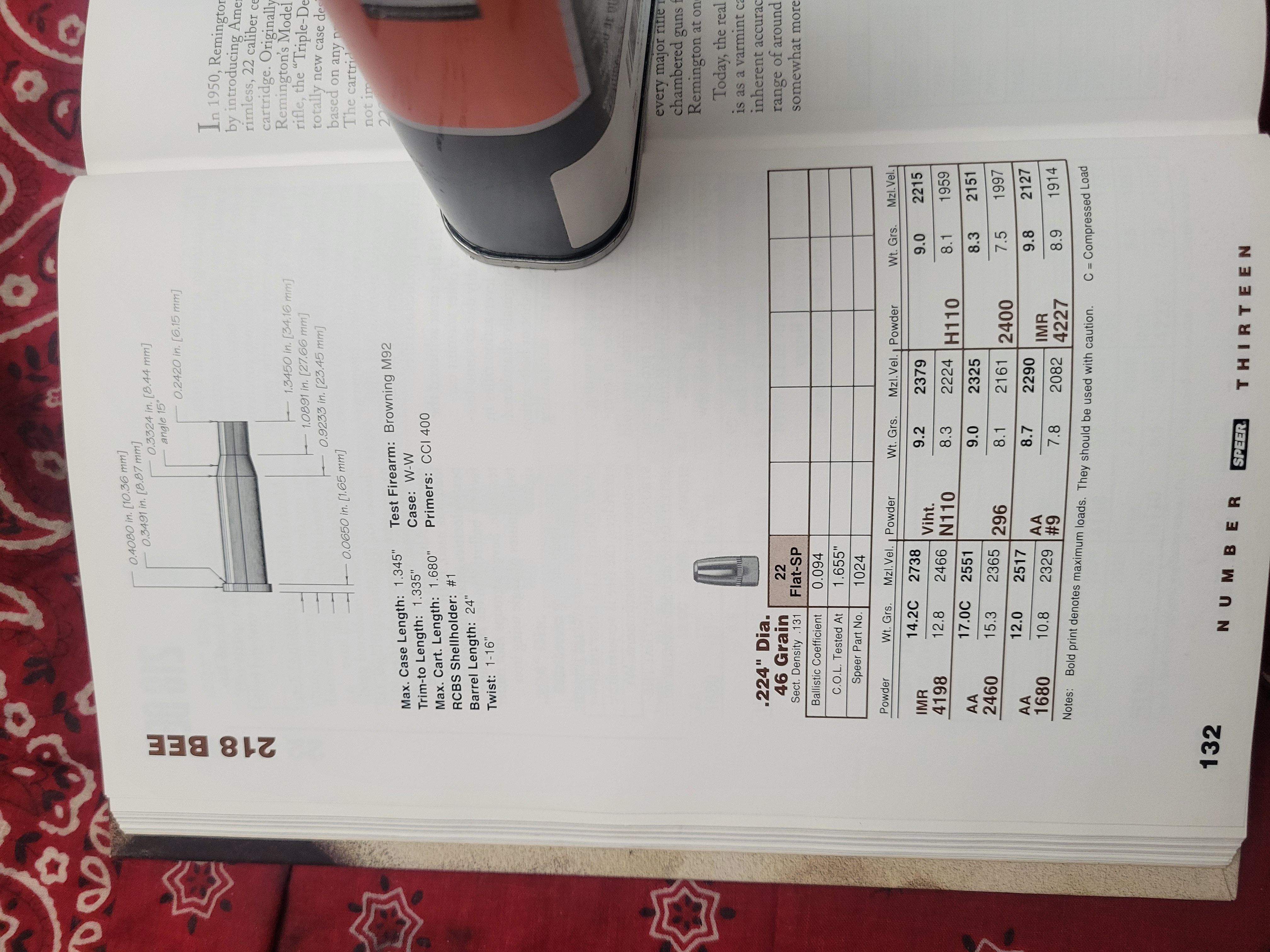
- Bill
WACA # 65205; life member, NRA; member, TGCA; member, TSRA; amateur preservationist
"I have seen wicked men and fools, a great many of both, and I believe they both get paid in the end, but the fools first." -- David Balfour, narrator and protagonist of the novel, Kidnapped, by Robert Louis Stevenson.
February 6, 2010
Offline
My reasoning for the 65gr cast question is that I have the 65 gr lyman 527420 mold that I cast with for my 25-20. Was just looking for a cheaper way to punch holes in paper than using the 65 gr speer jacketed projectiles.
Now if that is not safe then I will forget that idea. If the loads are too powerful for cast then I will just have to live with that and just use the store bought jacketed projectiles.
Steve
April 15, 2005
Offline
Zebulon said
Agreed but I think perhaps Steve was looking for a “turkey load” as opposed to a “turkey soup load” – for which nothing would beat the V-Max.
Because centerfire rifles are legal in Texas (and I think in Washington, unless its beyond-description government has since banned it), we’ve been able to throttle back the Hornet to cast lead velocities using medium low burn pistol powders like Unique and a slightly heavier than ordinary weight bullet.
I can’t imagine that couldn’t be replicated in the slightly bigger case of the Bee.
The slowest recipe I could find for the Bee is in Speer’s #13 but I don’t have any of the Lyman cast lead volumes.
The preferred method of dispatching Turkeys with either the 22 Hornet or 218 Bee is to shoot them in the head (decapitation). My 22 Hornets are capable of shooting the head off of a Turkey out to 100-yds. My preferred bullet/load choice is the 35-grain V-Max with 12-grains of Lil Gun powder. It chronographs @3,250 fps.
I will look through my old reloading manuals to see if any light 218 Bee loads are listed.
Bert
WACA Historian & Board of Director Member #6571L
February 6, 2010
Offline

I need to correct a statement I have made in my previous post. I got that 527420 mold confused with my 25-20. There is no way that projectile would fit in the 218 bee. Sorry for that confusion. I do have some load data in the lyman book for the 46 gr flat nose jacketed projectile from speer.
I may just have to live with store bought projectiles but if there is a cast projectile that works I would sure try.
I know in my original post I stated 65 gr but I really meant to say 46gr. Today is just not my day.
Steve
January 20, 2023
Offline
Bert H. said
Zebulon said
Agreed but I think perhaps Steve was looking for a “turkey load” as opposed to a “turkey soup load” – for which nothing would beat the V-Max.
Because centerfire rifles are legal in Texas (and I think in Washington, unless its beyond-description government has since banned it), we’ve been able to throttle back the Hornet to cast lead velocities using medium low burn pistol powders like Unique and a slightly heavier than ordinary weight bullet.
I can’t imagine that couldn’t be replicated in the slightly bigger case of the Bee.
The slowest recipe I could find for the Bee is in Speer’s #13 but I don’t have any of the Lyman cast lead volumes.
The preferred method of dispatching Turkeys with either the 22 Hornet or 218 Bee is to shoot them in the head (decapitation). My 22 Hornets are capable of shooting the head off of a Turkey out to 100-yds. My preferred bullet/load choice is the 35-grain V-Max with 12-grains of Lil Gun powder. It chronographs @3,250 fps.
I will look through my old reloading manuals to see if any light 218 Bee loads are listed.
Bert
In Texas it is considered bad manners to shoot our Río Grande gobblers at 100 yards, somewhat akin to shooting a Texas Ranger in the back. Proper etiquette is to call one in to your decoy set, which should be put out not further than 15 to 25 yards, depending on terrain. The shot is taken when he is fanning or strutting — and his head is never motionless. A rifle shot at a moving head is too likely to blow his beak off, upon which he will run into the brush and suffer until the coyotes get him. A 1500 fs 22 slug on the butte of a wing or the base of the neck is more sure and humane. I have done it with my S&W 27 loaded with 148 grain wadcutters at 750 fs, with no loss of edible meat.
- Bill
WACA # 65205; life member, NRA; member, TGCA; member, TSRA; amateur preservationist
"I have seen wicked men and fools, a great many of both, and I believe they both get paid in the end, but the fools first." -- David Balfour, narrator and protagonist of the novel, Kidnapped, by Robert Louis Stevenson.
August 25, 2009
Offline
Zebulon said
Bert H. said
Zebulon said
Agreed but I think perhaps Steve was looking for a “turkey load” as opposed to a “turkey soup load” – for which nothing would beat the V-Max.
Because centerfire rifles are legal in Texas (and I think in Washington, unless its beyond-description government has since banned it), we’ve been able to throttle back the Hornet to cast lead velocities using medium low burn pistol powders like Unique and a slightly heavier than ordinary weight bullet.
I can’t imagine that couldn’t be replicated in the slightly bigger case of the Bee.
The slowest recipe I could find for the Bee is in Speer’s #13 but I don’t have any of the Lyman cast lead volumes.
The preferred method of dispatching Turkeys with either the 22 Hornet or 218 Bee is to shoot them in the head (decapitation). My 22 Hornets are capable of shooting the head off of a Turkey out to 100-yds. My preferred bullet/load choice is the 35-grain V-Max with 12-grains of Lil Gun powder. It chronographs @3,250 fps.
I will look through my old reloading manuals to see if any light 218 Bee loads are listed.
Bert
In Texas it is considered bad manners to shoot our Río Grande gobblers at 100 yards, somewhat akin to shooting a Texas Ranger in the back. Proper etiquette is to call one in to your decoy set, which should be put out not further than 15 to 25 yards, depending on terrain. The shot is taken when he is fanning or strutting — and his head is never motionless. A rifle shot at a moving head is too likely to blow his beak off, upon which he will run into the brush and suffer until the coyotes get him. A 1500 fs 22 slug on the butte of a wing or the base of the neck is more sure and humane. I have done it with my S&W 27 loaded with 148 grain wadcutters at 750 fs, with no loss of edible meat.
Zeb I agree it is bad form to “snipe” turkeys at anywhere near 100 yards, some of us that really like our Hornets just want to have fun. 
January 20, 2023
Offline
Fun with a Hornet:
My hunting experience has been limited to deer, Rio Grande turkeys and other game birds, and hogs. Long but narrow.
Of all those hunts, the first time I actually called in a big [20+ lbs] longbeard and his harem late one afternoon, was the best in a lifetime. First came the hens, who trotted up to my decoy. Nothing for a couple of minutes. And then a long shadow, followed by Himself, passing by me not more than 10-15 feet away.
I had in my hands a scoped Anschutz Hornet. My plan had been to shoot when a bird was at the decoy I’d set up at the edge of a tank [pond] 25 yards away. I hadn’t thought about one coming from the other direction.
Even with the scope cranked down to 1.75X and him walking away from me with zero deflection, I couldn’t keep the crosshairs on that bobbling head.
Finally, when he stopped to bend over and fan, I gave up and gave him the Texas heart shot.
It didn’t touch the breast meat but it was the nastiest job of field dressing I ever had to do.
For a while I wanted one of those Colt/Sauer drillings with a Hornet or .222 underbarrel. Until I picked one up. It had the handling characteristics of a medicine ball.
The Anschutz has gone down the road but I won’t ever be without a Hornet, unless the Good Fairy gifts me with a Winchester Model 65 Bee. Until then a Ruger #1 Hornet will have to serve.
- Bill
WACA # 65205; life member, NRA; member, TGCA; member, TSRA; amateur preservationist
"I have seen wicked men and fools, a great many of both, and I believe they both get paid in the end, but the fools first." -- David Balfour, narrator and protagonist of the novel, Kidnapped, by Robert Louis Stevenson.
February 6, 2010
Offline
I had thought the same thing about acquiring a winchester 65 but had to finally settle for the Browning model 65 which is a fine replica of the winchester. With loading the speer 46 gr flat nose jacked bullets it is a tack driver at 50 yds. I can’t see much further than that using the factory sights but am thinking of getting a tang peep sight for it. That may help at further distances.
January 20, 2023
Offline
If you found a good Browning 65, Steve, you weren’t buying downmarket at all, except for the label. I never could find one, although I did eventually get a Model 53 32/20 I could kick myself for selling. I might add I had my best gunsmith carefully drill and tap the receiver for a Redfield 70. Told him I wanted it back with plug screws so I could see it looked like a factory job. It did and when I sold it nobody quibbled- all they saw was the burl walnut. I never sell my Redfield receiver sights. That one is now mounted on a Winchester brand Miroku 86 ELW.
Where Browning messed up was listening to some dim bulb when designing the gaudy Grade II versions. I had an 1895 30/06 that would consistently do 3-shot 1.25″ groups with factory 150 grain CoreLokt. And I dont shoot well with barrel mounted iron sights. But it was a Grade II and it hurt my eyes. My lease partners laughed at me. So I sold it.
By the time Browning built the 53, they’d gotten smarter and just upgraded the wood and added checkering and a good replica grip cap.
I still have two of the last Browning branded reproductions, a Model 12 20 gauge and a Model 42. They are permanent.
- Bill
WACA # 65205; life member, NRA; member, TGCA; member, TSRA; amateur preservationist
"I have seen wicked men and fools, a great many of both, and I believe they both get paid in the end, but the fools first." -- David Balfour, narrator and protagonist of the novel, Kidnapped, by Robert Louis Stevenson.
February 6, 2010
Offline
When I was looking an older guy on this site that is in his 90’s had a brand new Browning 65 still in the box never had been shot and offered it to me at a price I could not refuse and that was just last september.
He is one heck of a nice guy and he was very careful in double boxing it so the original box would not get messed up.
January 20, 2023
Offline
Yes. I have learned this is a good place to buy. Members take care of their stuff and don’t want to see it damaged in transit, either.
- Bill
WACA # 65205; life member, NRA; member, TGCA; member, TSRA; amateur preservationist
"I have seen wicked men and fools, a great many of both, and I believe they both get paid in the end, but the fools first." -- David Balfour, narrator and protagonist of the novel, Kidnapped, by Robert Louis Stevenson.
February 6, 2010
Offline
I found this link to be good info for the bullet that speer makes for the 218 bee especially for the lever action with tubular magazine.
https://reloadingdata.speer.com/downloads/speer/reloading-pdfs/rifle/218_Bee_46.pdf
November 7, 2015
Offline
Steve-
One of my favorite loading manuals is Lyman’s 4th Edition Cast Bullet Handbook. It lists loads for Lyman’s 225438 (44gr GC) and their 225415 (55gr GC) and notes that IMR4198 produced uniform results. Starting/accuracy load listed for the 44gr bullet is 11.7 grs IMR4198 @ 2003fps, 55gr pill is 10.8grs IMR4198 for 1810 fps. I have no experience with this cartridge so use this data at your own risk! I don’t cast anything smaller than 30 caliber and seldom load anything in 22 caliber. A properly sized and lubed GC bullet in a good or preferably excellent bore should be able to handle velocities over 2000 fps, the Lyman CB manual lists loads for this cartridge approaching 2300fps but the lower loads look like the best starting point.
Mike
February 6, 2010
Offline
I was able to pick up the lyman cast bullet book today. Not a lot of options for cast in 218 but i like it for a lot of the other calibers i cast for.
Actually I guess you can expect there to be lots of loads for it.
I use that same bullet mold 225438 for my 22 hornet loads. For some reason I have never been able to get good groups from a cast bullet in 22 hornet. I have a Rugger in 22 hornet that i can drive nails in with if i use the hornady varment bee jacketed bullet. The cast bullets to date have been quite disappointing for the hornet.
November 7, 2015
Offline
slk said
I was able to pick up the lyman cast bullet book today. Not a lot of options for cast in 218 but i like it for a lot of the other calibers i cast for.
Actually I guess you can expect there to be lots of loads for it.
I use that same bullet mold 225438 for my 22 hornet loads. For some reason I have never been able to get good groups from a cast bullet in 22 hornet. I have a Rugger in 22 hornet that i can drive nails in with if i use the hornady varment bee jacketed bullet. The cast bullets to date have been quite disappointing for the hornet.
As you probably know the first rule of cast bullets is know your bore size. An appropriate alloy for this velocity will likely not obturate to fill the bore so the bullet should be sized to bore size +.001 or .002″. Cast bullets in 22 caliber is a challenge best taken up by stubborn reloaders with very good casting skills and so far I haven’t ventured into that rabbit hole. I applaud your efforts but will likely observe your endeavor from the sidelines.
Mike
PS: There’s a lot of very good information in your new book. Take the time to read the opening chapters, I think some of them are MLV’s best work.
MH
February 6, 2010
Offline
Yes I run a slug down my barrels and check grove diameter. I uasually go 1-2 thousands over. I run all my cast through the lyman sizer dies and lube a gas check them if needed. I have had excellent success in 25-20 and up. I even do 500 gr for my sharps 45-70.
The small .224 diameters given me a fit. I mean 3-4 “ groups are not what i would call good. Hopefully the new lyman cast book will give me some new things to try.
Steve
November 7, 2015
Offline
Good luck to you, Steve. I suspect casting for the 22 caliber is a very unforgiving task and I understand the 218 Bee can be a bit of a challenge.
Mike


