

 Log In


February 6, 2010
 Offline


Hey guys is anything special I need to know about reloading for 44-40? I keep hearing nightmares about how thin the necks are and they tend to crumple.
I already do 25-20, 32-20, 22 hornet , 218bee. Never had any issues with them.
It looks like a fun cartridge to load.

January 20, 2023
Offline
I will be able to tell you shortly because I have a contemporary Sporting Rifle in 44/40 I’m going to start loading for.
However, I laid in a supply of brass from Starline and I don’t think it is any thinner that the 25/20 brass I load or the 32/20 I used to load.
All of these cases need to be treated with more respect than your average 38 Special case. If you overlube it, the chances are good it will collapse when sizing is attempted. You can’t get away with bumping the edge of the neck of a case misaligned in the shell holder. Nor can you seat a bullet into a grossly under-expanded case neck by brute force. Trying to speed up loading a big batch is usually the cause of the problem.
The “secret” to successfully loading these classic cartridges is 1. Patience and 2. Careful handling, which translates to 3. Taking your time.
- Bill
WACA # 65205; life member, NRA; member, TGCA; member, TSRA; amateur preservationist
"I have seen wicked men and fools, a great many of both, and I believe they both get paid in the end, but the fools first." -- David Balfour, narrator and protagonist of the novel, Kidnapped, by Robert Louis Stevenson.
November 7, 2015
Offline
If you’re loading 32-20 and 25-20 without issues I’ll bet you will do just fine with the 44-40! Just ease that case mouth into the sizing die (like you do with the 32-20 and 25-20) and be careful with flaring (with cast bullets), seating and crimping.
Mike

October 4, 2011
Offline
Biggest thing: pay attention to what your doing. Watch, feel, no rush. The rest is just frustrating, till you get your size of bullet correct, belling correct, seating correct. slug your bore. After all that, easy peazy. Still take your time. Not one I would use a progressive press with.

December 12, 2019
Offline
I load 44-40, 25-20, 32-20 and 22 Hornet. I’m more likely to crumple the 22 Hornet than any of the others.
As others have said, just take it easy and pay attention to the bullet seating operation, you’ll be fine.
Paul
Nevada Paul
Life Member NRA
January 20, 2023
Offline
Agreed. And Steve is right to say make sure of your bore. There is a large variance in dimensions in the old 44WCF barrels – and, particularly, Colt revolver bore, groove and chamber mouth dimensions.
Fortunately, Browning is very good about furnishing manufacturing specifications and Miroku uses highly advanced precision manufacturing techniques that result in dimensions that match those specifications with very small tolerances.
Browning has elected to adopt the modern 44 caliber dimensions to which the 44 Magnum adheres – including groove diameter of .429 plus or minus .001. A cast bullet of 200 grains sized to .430 is a good place to start, although slugging the barrel may show .431 is better.
This does mean that factory ammunition loaded with a .427 bullet may not shoot accurately.
Colt revolvers have been all over the map and an overlarge chamber mouth almost always guarantees poor accuracy, whatever the barrel. A 44 “Sheriff’s Model” SAA – correctly called a Storekeeper’s Model — with dual cylinders, 44 Winchester and 44 Special, may shoot one cartridge better than the other, or neither, depending on dimensions.
- Bill
WACA # 65205; life member, NRA; member, TGCA; member, TSRA; amateur preservationist
"I have seen wicked men and fools, a great many of both, and I believe they both get paid in the end, but the fools first." -- David Balfour, narrator and protagonist of the novel, Kidnapped, by Robert Louis Stevenson.
June 4, 2017
Offline

I have shot all of my old 1873s I have ever owned. The bores have varied from excellent to ugly and accuracy depended more on the individual barrel regardless of bore condition to some extent, ugly is ugly. The early five land rifling and later six land doesn’t seem to make much difference, but speed does. 1100-1200fps has worked the best for me. The best bullets for me have been Remington JSP 200gr .427″ or 200gr cast from a Winchester original mold not sized. The unsized cast bullet does work well for me, the jacketed 427 works better in the ugly. Because of the trajectory the speed of your strings must very no more than 30fps when using smokeless powder.
Not all Winchester 1873 barrels are equally straight. T/R
April 26, 2019
Offline
You have gotten some good advice
slk said
Hey guys is anything special I need to know about reloading for 44-40? I keep hearing nightmares about how thin the necks are and they tend to crumple.
I already do 25-20, 32-20, 22 hornet , 218bee. Never had any issues with them.
It looks like a fun cartridge to load.
I see you have had some good advice already.
I have two things to add. Number One, if you’re loading for a Model ’73 (or any other weak action type), be sure to use low-pressure loads. Check that your loading recipe is from a recognized source and is intended for your firearm’s action type. A load that is safe in a Model ’92 could wreck a ’73.
Number Two, at the charging stage, check that you haven’t accidentally double-charged a case. The .44-40 was designed for black powder and there’s room in the case for a double charge of smokeless. (It’s like the .45-70 that way.) Just place your charged cases in a tray and shine a flashlight in to check for powder level. An empty case or double-charge will be obvious to the eye.
Good luck,
Pete
February 6, 2010
Offline
All great advice. I sure appreciate it. Ya just never know when loading a new caliber.
Thank You
January 20, 2023
Offline
Everything Pete and Steve say. I believe Steve has already warned against loading the 44 Winchester on a progressive press and Pete has given the true dope on how to avoid double charges.
To those things I would only add:
○ Start with small batches. A first run of anything new is interesting but tiring. A perfect first batch of 10 cartridges allows me to concentrate on technique and avoids any pressure to hurry.
○ Don’t choose a too-hard cast bullet to avoid leading. Unlike vintage barrels roughened by corrosion, your new Miroku bore is very slick and I’d be surprised to see any sharp edges or tool marks. An alloy of about 12 should expand under the forces of ignition to fill the grooves and prevent gas cutting. As Pete says, you are not going to choose a high pressure, high temperature, progressive charge that would melt the base and require a gas check. At civilized, post Civil War velocities, a 200 grain 44 RNFP lead bullet will kill the biggest Whitetail deer that ever walked with a high lung shot at a hundred yards or less. And undoubtedly has been doing so ever since 1873.
I hope to add to that count before cashing in my chips.
- Bill
WACA # 65205; life member, NRA; member, TGCA; member, TSRA; amateur preservationist
"I have seen wicked men and fools, a great many of both, and I believe they both get paid in the end, but the fools first." -- David Balfour, narrator and protagonist of the novel, Kidnapped, by Robert Louis Stevenson.

April 15, 2005
Offline
I load both the 38 WCF and 44 WCF cartridges with a Lyman Ideal 310 hand tool. It is a very simple process and the dies are fully adjustable in the tool allowing you to resize only as much of the case as needed, bell the case mouth perfectly, and seat & crimp the bullet in the case to match your rifle’s chamber.
This is an example: LYMAN IDEAL 310 TOOL WITH DIES IN ORIGINAL BOX IN 32-20 CALIBER (gunsinternational.com)
Bert
WACA Historian & Board of Director Member #6571L
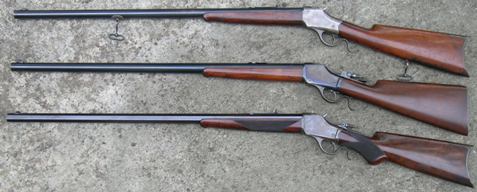
February 6, 2010
Offline
Ok I have another question about the 44-40. Somewhere along my life I have had this box of 44-40 ammo. Seams like forever and I do not ever remember having anything to shoot it out of. I as m assuming it may be factory ammo but not sure. The bullet is flat nosed lead but it is also a copper jacket. So my concern is did they make them in high velocity rounds for some other gun. Wish there was a way to tell?? Guess i could take one apart and weigh the bullet and the powder. Just trying to be careful.
April 15, 2005
Offline
slk said
Ok I have another question about the 44-40. Somewhere along my life I have had this box of 44-40 ammo. Seams like forever and I do not ever remember having anything to shoot it out of. I as m assuming it may be factory ammo but not sure. The bullet is flat nosed lead but it is also a copper jacket. So my concern is did they make them in high velocity rounds for some other gun. Wish there was a way to tell?? Guess i could take one apart and weigh the bullet and the powder. Just trying to be careful.
Yes, Winchester manufactured high velocity “W.H.V.” jacketed 44 WCF ammo (for the Model 1892 and Single Shot models).
Bert
WACA Historian & Board of Director Member #6571L
November 19, 2006
Offline
The brand of the brass can make a difference. Many prefer Starline and believe it is the strongest. There’s fair agreement that Winchester brass is the thinnest. Some prefer it for that very reason as they believe it seals the chamber better. Additionally thicker brass can be a problem with .429 or larger bullets.
Seems I’ve seen more negative comments about Remington .44-40 brass than I have other brands.
Your mileage can vary a good bit depending on your rifle, your bullets and your load. The choice of brand of brass can be a good variable to manipulate if things aren’t working out well.
April 15, 2005
Offline
steve004 said
The brand of the brass can make a difference. Many prefer Starline and believe it is the strongest. There’s fair agreement that Winchester brass is the thinnest. Some prefer it for that very reason as they believe it seals the chamber better. Additionally thicker brass can be a problem with .429 or larger bullets.
Seems I’ve seen more negative comments about Remington .44-40 brass than I have other brands.
Your mileage can vary a good bit depending on your rifle, your bullets and your load. The choice of brand of brass can be a good variable to manipulate if things aren’t working out well.
The original (older) Winchester brass is thin. The later production brass is heavier.
Bert
WACA Historian & Board of Director Member #6571L
November 19, 2006
Offline
Bert H. said
steve004 said
The brand of the brass can make a difference. Many prefer Starline and believe it is the strongest. There’s fair agreement that Winchester brass is the thinnest. Some prefer it for that very reason as they believe it seals the chamber better. Additionally thicker brass can be a problem with .429 or larger bullets.
Seems I’ve seen more negative comments about Remington .44-40 brass than I have other brands.
Your mileage can vary a good bit depending on your rifle, your bullets and your load. The choice of brand of brass can be a good variable to manipulate if things aren’t working out well.
The original (older) Winchester brass is thin. The later production brass is heavier.
Bert
Do you think the later production Winchester brass is as heavy as Starline?
April 15, 2005
Offline
steve004 said
Bert H. said
steve004 said
The brand of the brass can make a difference. Many prefer Starline and believe it is the strongest. There’s fair agreement that Winchester brass is the thinnest. Some prefer it for that very reason as they believe it seals the chamber better. Additionally thicker brass can be a problem with .429 or larger bullets.
Seems I’ve seen more negative comments about Remington .44-40 brass than I have other brands.
Your mileage can vary a good bit depending on your rifle, your bullets and your load. The choice of brand of brass can be a good variable to manipulate if things aren’t working out well.
The original (older) Winchester brass is thin. The later production brass is heavier.
Bert
Do you think the later production Winchester brass is as heavy as Starline?
I do not know… I do not have any Starline brass. All of mine is W-W (Winchester). It certainly did not feel “thin” when I loaded it.
Bert
WACA Historian & Board of Director Member #6571L
April 26, 2019
Offline
Bert H. said
I load both the 38 WCF and 44 WCF cartridges with a Lyman Ideal 310 hand tool. It is a very simple process and the dies are fully adjustable in the tool allowing you to resize only as much of the case as needed, bell the case mouth perfectly, and seat & crimp the bullet in the case to match your rifle’s chamber.
This is an example: LYMAN IDEAL 310 TOOL WITH DIES IN ORIGINAL BOX IN 32-20 CALIBER (gunsinternational.com)
Bert
Ah, Bert opened up an interesting topic: the Lyman/Ideal 310 nutcracker.
I’m a big fan. I have 310 tools in .25-20, 44-40 and a custom 310 in .50 Sharps. If you guys like shooting the old stuff, you might like loading with a 310.
One word of caution. The Lyman 310 does not full-length size the brass. It neck sizes only. That means you must use brass that was fired in your rifle. Brass from another firearm may not chamber in yours. Also, it works best in low-pressure rounds like the .44-40 where you can get away with just neck sizing.
I attached a link below to an excellent YouTube demo on the 310 tool that was done by Mike Beliveau of the Duelist Den channel. I regret to report that Mike died earlier this year. Mike was an excellent reporter on black powder guns and he had a nice manner on camera. He will be sadly missed. If you watch this video, you’ll see what I mean.
Pete
list=PLDbSDznoXMnOeBgxd2Z6FaTQ5A-0Jy1M1
April 15, 2005
Offline
I have Lyman Ideal 310 tools & dies for a total of (42) different cartridges (I collect the tools & die sets).
The predecessor to the No. 310 was the Ideal No. 3, No. 4, and No. 10.
I load 40-70 S.S. and 40-70 Ballard with an Ideal No. 3.
Bert
WACA Historian & Board of Director Member #6571L
November 7, 2015
Offline
I have a handful of Winchester reloading tools but have never used them. I use an old RCBS Reloader Special for all the old BP cartridges as loading them on my Dillon 550 seems sacrilegious and possibly a bit dangerous for my precious brass.
Mike


1 Guest(s)
