

 Log In


November 19, 2006
 Offline


… but maybe I’ve been selling them short?
https://www.gunbroker.com/item/1146043514
Buffalo bore also has an offering:

April 15, 2005
Offline
Those are “sissy man’s” loads!
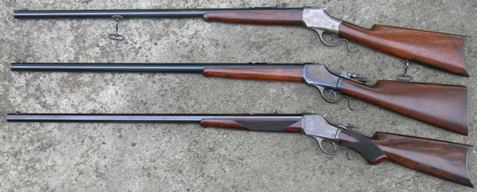
I recently loaded (reloaded) 50 rounds of 38 WCF for my 1918 production Single Shot high-wall rifle… 180-gr Hornady XTP bullets under 24.0 grains of A-2400 powder, WLR primer. I am anticipating 2,100 fps, and it will be a true “Bear” load.
Bert
WACA Historian & Board of Director Member #6571L
December 9, 2002
Offline
Bert,
Refresh our feeble minds on the load pressures of the S.S. rifles. With that how many PSI, are you putting out with you’re loads?
Tony
April 15, 2005
Offline
Anthony said
Bert,
Refresh our feeble minds on the load pressures of the S.S. rifles. With that how many PSI, are you putting out with you’re loads?
Tony
The Post-1900 production Single Shot high-wall center fire receiver frames were all heat treated and proofed for smokeless powder cartridges (e.g. the 30 US, 25-35 WCF, 30 WCF, 32 WS, 35 WCF, and 405 WCF). The 38 WCF load that I am shooting generates nowhere near the same pressure as what my slightly older Single Shot rifle in 405 WCF is subjected to.
Bert
WACA Historian & Board of Director Member #6571L
November 19, 2006
Offline
Bert H. said
Those are “sissy man’s” loads!
I recently loaded (reloaded) 50 rounds of 38 WCF for my 1918 production Single Shot high-wall rifle… 180-gr Hornady XTP bullets under 24.0 grains of A-2400 powder, WLR primer. I am anticipating 2,100 fps, and it will be a true “Bear” load.
Bert
Bert – how would you feel about these loads in a ’92 Winchester?
April 15, 2005
Offline
steve004 said
Bert H. said
Those are “sissy man’s” loads!
I recently loaded (reloaded) 50 rounds of 38 WCF for my 1918 production Single Shot high-wall rifle… 180-gr Hornady XTP bullets under 24.0 grains of A-2400 powder, WLR primer. I am anticipating 2,100 fps, and it will be a true “Bear” load.
Bert
Bert – how would you feel about these loads in a ’92 Winchester?
They would be perfectly fine in a Model 92.
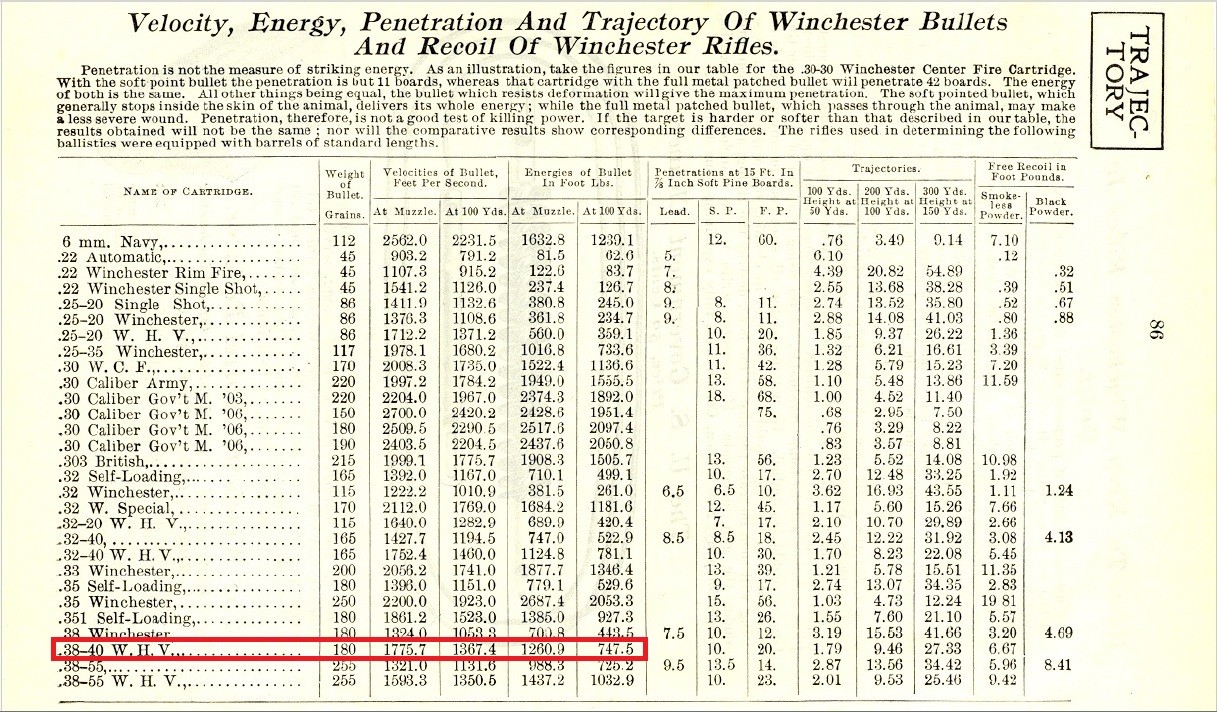
The attached picture is a scanned copy of the October 1911 Winchester Catalog No. 77. I have high-lighted the factory W.H.V. 38-40 load data. The ballistics information was derived using a Model 92 with a 24-inch barrel. My Single Shot high-wall has a much larger (30-inch No. 3 octagon barrel), and a much stronger action. My load does not begin to stress it.
Bert
WACA Historian & Board of Director Member #6571L
November 7, 2015
Offline
steve004 said
Bert H. said
Those are “sissy man’s” loads!
I recently loaded (reloaded) 50 rounds of 38 WCF for my 1918 production Single Shot high-wall rifle… 180-gr Hornady XTP bullets under 24.0 grains of A-2400 powder, WLR primer. I am anticipating 2,100 fps, and it will be a true “Bear” load.
Bert
Bert – how would you feel about these loads in a ’92 Winchester?
That’s quite a bit under what I load for my 1892 for plinking. MLV’s book shows my load has a velocity of 1325fps. Both look like cowboy loads to be. When did SASS start using bear targets?
Mike
April 15, 2005
Offline
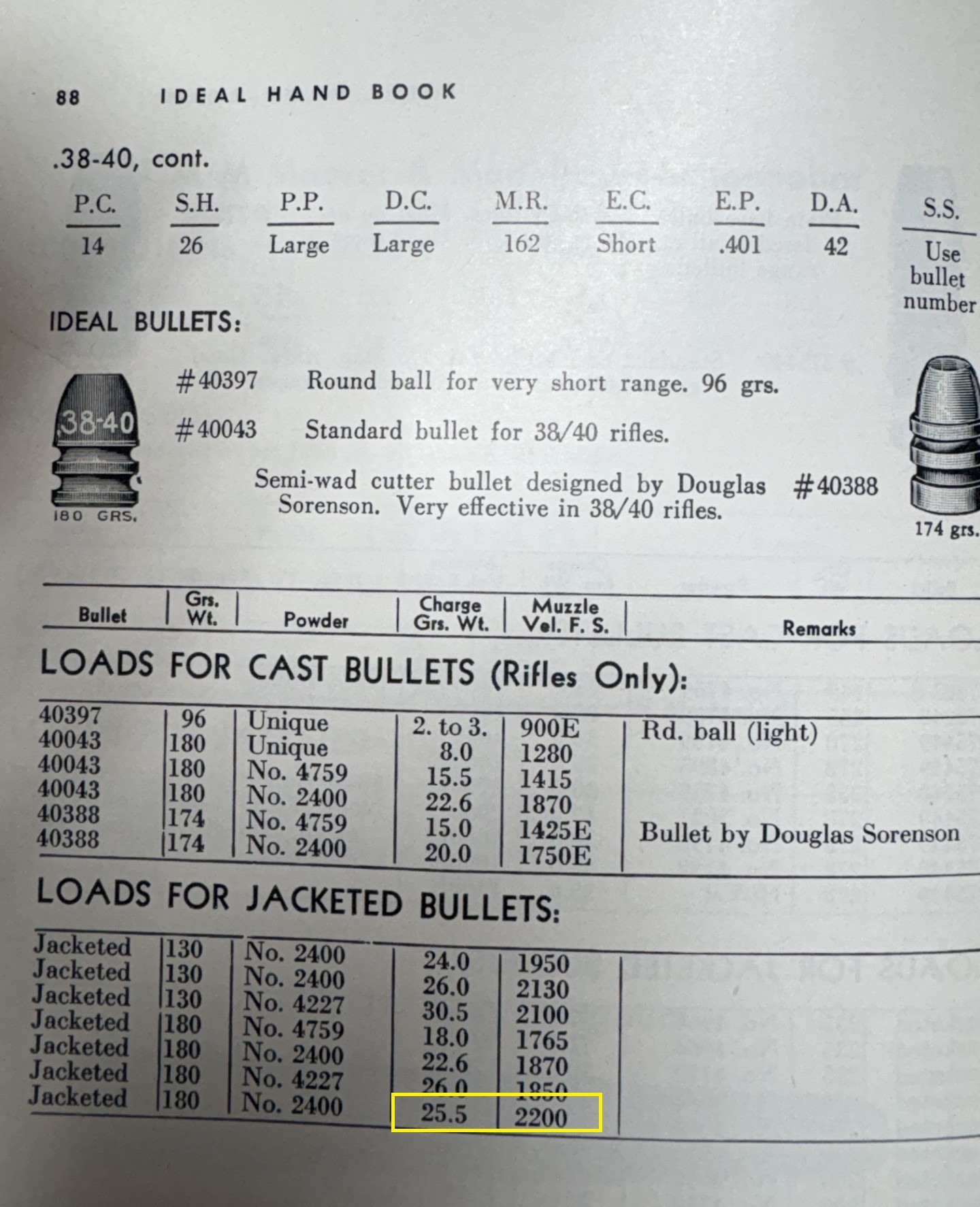
The load I am shooting is well below the maximum load as listed in the Ideal Hand Book… 25.5 grains of 2400.
Bert
WACA Historian & Board of Director Member #6571L
November 19, 2006
Offline
I really have a hankering to go out and shoot some of my .38-40’s. Too cold though.
April 15, 2005
Offline
steve004 said
I really have a hankering to go out and shoot some of my .38-40’s. Too cold though.
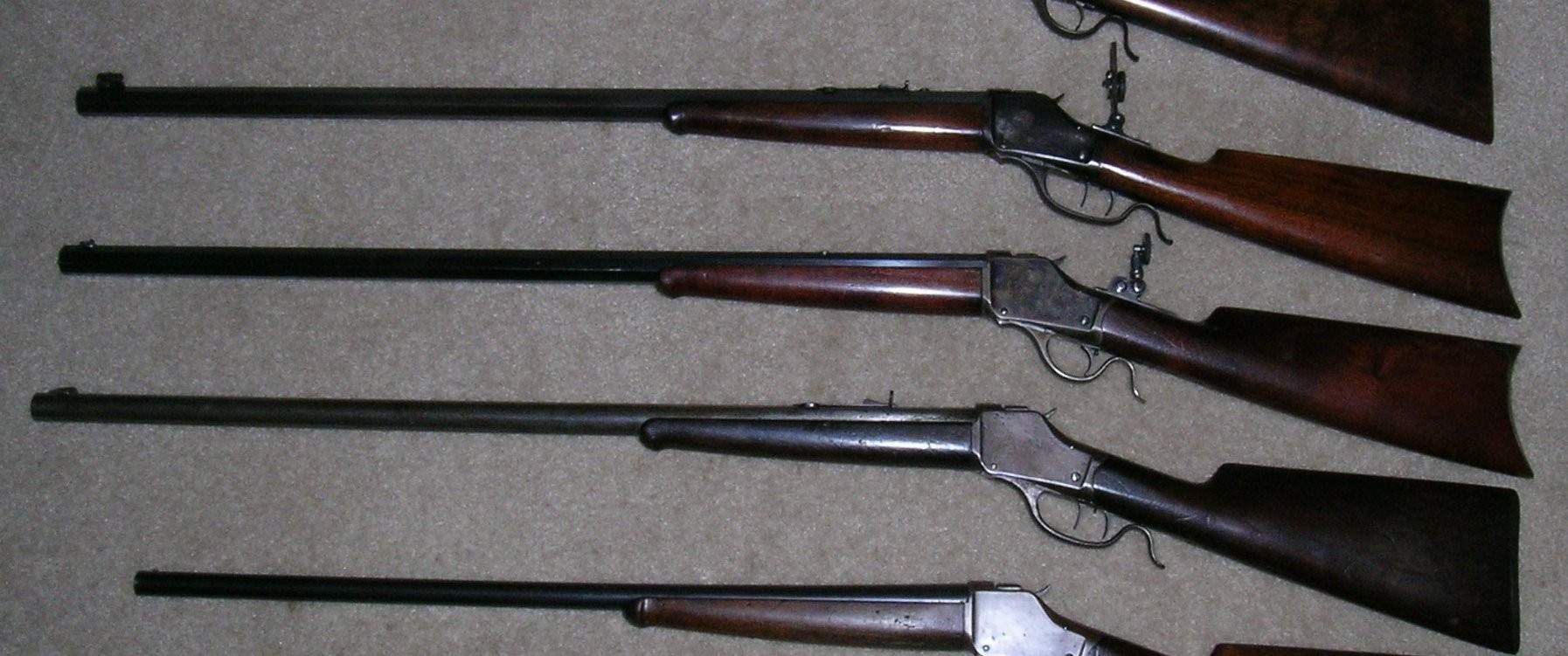
The W.H.V. load is a reasonably effective medium game load when shooting point blank out to 100-yds. I was very pleasantly surprised with accuracy of the 38 WCF cartridge in my Single Shot high-wall rifle… but it has a Winchester Globe front sight, Mid-range Vernier tang sight, and the Schuetzen double-set triggers. I was able to connect all the holes in a 3-shot group on multiple occasions. 
Sorry about the crappy picture, but the rifle in question is the top high-wall shown in this picture.
Bert
WACA Historian & Board of Director Member #6571L
December 9, 2002
Offline
Bert H. said
Anthony said
Bert,
Refresh our feeble minds on the load pressures of the S.S. rifles. With that how many PSI, are you putting out with you’re loads?
Tony
The Post-1900 production Single Shot high-wall center fire receiver frames were all heat treated and proofed for smokeless powder cartridges (e.g. the 30 US, 25-35 WCF, 30 WCF, 32 WS, 35 WCF, and 405 WCF). The 38 WCF load that I am shooting generates nowhere near same pressure as what my slightly older Single Shot rifle in 405 WCF is subjected to.
Bert
Bert,
I figured that you we’re well within the limits, as I know you better than that! I do like you’re load choice.
Tony
December 9, 2002
Offline
steve004 said
I really have a hankering to go out and shoot some of my .38-40’s. Too cold though.
Steve,
You could try some of Bert’s loads and warm up a bit! 
Tony

March 31, 2009
Offline
Anthony said
Bert,
Refresh our feeble minds on the load pressures of the S.S. rifles. With that how many PSI, are you putting out with you’re loads?
Tony
It is very difficulty to find a loading manual that gives chamber pressures. Some of the early manuals do but if that powder is still made today it is not as hot as the newest version.
November 7, 2015
Offline
Chuck said
Anthony said
Bert,
Refresh our feeble minds on the load pressures of the S.S. rifles. With that how many PSI, are you putting out with you’re loads?
Tony
It is very difficulty to find a loading manual that gives chamber pressures. Some of the early manuals do but if that powder is still made today it is not as hot as the newest version.
On top of that many of the old manuals use Copper Units of Pressure (crusher) numbers instead of the PSI numbers we like. They were also tested in special barrels that approximate actual rifles. I’m pretty certain JMB (over)built the SS, as was his habit, and it will withstand more than most modern actions. Certainly more than I want to shoot, anyway.
Mike
December 9, 2002
Offline
As usual, some great responses.
TXGunNut said
Chuck said
Anthony said
Bert,
Refresh our feeble minds on the load pressures of the S.S. rifles. With that how many PSI, are you putting out with you’re loads?
Tony
It is very difficulty to find a loading manual that gives chamber pressures. Some of the early manuals do but if that powder is still made today it is not as hot as the newest version.
On top of that many of the old manuals use Copper Units of Pressure (crusher) numbers instead of the PSI numbers we like. They were also tested in special barrels that approximate actual rifles. I’m pretty certain JMB (over)built the SS, as was his habit, and it will withstand more than most modern actions. Certainly more than I want to shoot, anyway.
Mike
Chuck,
I appreciate you’re follow up, and am also aware of that, the pressures I was referring to, would more likely be found in the actual weapon used for choice of loads made. One can never tell or know what chart or researched list he might have made up or show the Pressures, (PSI), of the Winchester Single Shots, he so expertly has advised us on.
Mike,
Ole JMB, certainly built his S.S. rifles to stand up to some heavy duty loads and shooting. My thought are without having the testing facilities Winchester had, being a larger company back in the day, he would cover his butt, for the re loaders of the day, as his buddy and well known, “Split Barlow”, who he sold one of his first S.S. rifles to, got his name from splitting his lip, probably shooting a S.S. rifle with a heavy loaded charge, of some kind!
Anthony
November 19, 2006
Offline
I am far from knowledgeable when it comes to the Winchester Single-Shot rifle.
It seems to me that .38-40 was more often chambered in the, “Low Wall” action vs. the, “High Wall” action?
Should greater caution be exercised in loading up the .38-40 for a Low Wall action?
I recall a discussion several years ago where there was a .38-56 available for sale in a Low Wall (a member here purchased it). I recall several here had concerns about the ability of a Low Wall to handle that cartridge. The .38-40 is a very different cartridge than the .38-56, but if we are talking about the top-end loads – any reason for concern?
Would the M1892 action be considered a stronger action than the Low Wall?
September 19, 2014
Offline
Folks, years ago John Linebaugh built a special revolver in .38-40 designed for monster pressures. It created a monster cartridge then that would stop anything short of a tyranosaurous, and maybe even that. Fellow who had it may still have it, although he tends to trade things off then wish he hadn’t. Loads like that would immediately take a model 1873 apart. Maybe take a model 1892 apart quickly as well. Single shots? I’ve no idea but can say the SAAMI specs were not adhered to! I was offered to shoot the revolver. I declined! Tim
November 19, 2006
Offline
tim tomlinson said
Folks, years ago John Linebaugh built a special revolver in .38-40 designed for monster pressures. It created a monster cartridge then that would stop anything short of a tyranosaurous, and maybe even that. Fellow who had it may still have it, although he tends to trade things off then wish he hadn’t. Loads like that would immediately take a model 1873 apart. Maybe take a model 1892 apart quickly as well. Single shots? I’ve no idea but can say the SAAMI specs were not adhered to! I was offered to shoot the revolver. I declined! Tim
Interesting. I wonder if John used standard .38-40 brass? I have concerns that standard .38-40 brass could be pushed that hard? Or rather, should be.
April 15, 2005
Offline
steve004 said
I am far from knowledgeable when it comes to the Winchester Single-Shot rifle.
It seems to me that .38-40 was more often chambered in the, “Low Wall” action vs. the, “High Wall” action?
Should greater caution be exercised in loading up the .38-40 for a Low Wall action?
I recall a discussion several years ago where there was a .38-56 available for sale in a Low Wall (a member here purchased it). I recall several here had concerns about the ability of a Low Wall to handle that cartridge. The .38-40 is a very different cartridge than the .38-56, but if we are talking about the top-end loads – any reason for concern?
Would the M1892 action be considered a stronger action than the Low Wall?
Steve,
In the early production years for the Single Shot, Winchester almost solely used the high-wall action for the 22 WCF, 32 WCF, 38 WCF, and 44 WCF cartridges. The low-wall actions were primarily used for the rim fire cartridges (e.g. 22 Short, 22 Long, 22 Extra Long, 32 Short and 32 Long). A few years into the production, Winchester did begin manufacturing low-wall rifles chambered for the 22 WCF, 25 WCF (25-20 SS), 32 WCF, 38 WCF, and 44 WCF, but they still used the high-wall action as standard for those cartridges. Then several years after the low-wall action was introduced, Winchester began using it as the standard for all of the rim fire cartridges and the aforementioned center fire cartridges, but also continued to use the high-wall action when so ordered (a heavy barrel, or for W.H.V. cartridges). Throughout the entire production run for the Single Shot, high-wall rifles can be found chambered for the smaller center fire cartridges, especially the 22 WCF, 25-20 S.S., and 32 WCF. My Single Shot high-wall rifle in 38 WCF was manufactured in late 1917 (serial number 120876).
In answer to your second question, Yes, greater caution should be exercised if reloading the 38 WCF for a Single Shot low-wall rifle. I personally would not exceed the listed factory W.H.V. load.
Winchester did very rarely (on special order only) manufacture a low-wall rifle chambered for the 32-40, 38-55, 38-56 WCF, and 40-65 WCF. In total less than (15) low-wall rifles were made in those cartridges.
When comparing the Single Shot low-wall rifle to a Model 1892 for strength of the action, you first have to understand which specific low-wall action you have. There were three distinctly different low-wall actions that were manufactured. I refer to them as 1st, 2nd, and 3rd variations (Winchester did not ever use any identifying nomenclature for them).
The 1st variation low-walls have the panel-sided frame with the full size (height) breech block. The upper and lower tangs are nearly the same dimensions as a high-wall. The first variation low-walls are nearly all found in the 2200 – 18500 serial number range, but they were used on later production rifles special ordered and chambered for the 32-40, 38-55, 38-56 WCF, and 40-65 WCF cartridges. While I do not have any empirical evidence, I am of the belief that the action is of equal strength to a Model 1892.
The 2nd variation low-wall is the vastly more common variant and made its first appearance in the 17200 serial range. This frame type was used through March of 1918 (122000 serial range). The frame and tangs on this variant are much lighter (thinner). Winchester did this to reduce the overall weight of the rifle. Again, while I do not have any empirical evidence, I am of the belief that the action is not quite as stout as a Model 1892.
The 3rd variation low-wall (used exclusively for the Model 87 Winder Muskets) is not truly a low-wall. Instead, it is a high-wall action that was remilled to make it look like a low-wall. The frame and tangs are full size & thickness. Winchester created the 3rd variation at the bequest of the U.S. Government (Army) to make it easier to load the 22 Short cartridges during its training use. The serial range is 120000 – 139000. I am of the firm belief that the 3rd variation action strength is more than equal to the Model 1892. Over the past many years, I have found numerous custom built varmint rifles (218 Bee, 22 Hornet, 22 K-Hornet, 22-3000 Lovell, 22 R2 Lovell, 219 Zipper, and even 225 Winchester) that used a 3rd variation action. I myself own a Model 87 Winder Musket that started life as U.S. Government contract 22 Short, then in later years was converted to shoot the 22 Hornet, and still later (during my ownership tenure) rechambered for the 22 K-Hornet. I have shot hundreds of hot K-Hornet loads in it for many years with no ill effects.
Bert
WACA Historian & Board of Director Member #6571L
November 19, 2006
Offline
Bert H. said
steve004 said
I am far from knowledgeable when it comes to the Winchester Single-Shot rifle.
It seems to me that .38-40 was more often chambered in the, “Low Wall” action vs. the, “High Wall” action?
Should greater caution be exercised in loading up the .38-40 for a Low Wall action?
I recall a discussion several years ago where there was a .38-56 available for sale in a Low Wall (a member here purchased it). I recall several here had concerns about the ability of a Low Wall to handle that cartridge. The .38-40 is a very different cartridge than the .38-56, but if we are talking about the top-end loads – any reason for concern?
Would the M1892 action be considered a stronger action than the Low Wall?
Steve,
In the early production years for the Single Shot, Winchester almost solely used the high-wall action for the 22 WCF, 32 WCF, 38 WCF, and 44 WCF cartridges. The low-wall actions were primarily used for the rim fire cartridges (e.g. 22 Short, 22 Long, 22 Extra Long, 32 Short and 32 Long). A few years into the production, Winchester did begin manufacturing low-wall rifles chambered for the 22 WCF, 25 WCF (25-20 SS), 32 WCF, 38 WCF, and 44 WCF, but they still used the high-wall action as standard for those cartridges. Then several years after the low-wall action was introduced, Winchester began using it as the standard for all of the rim fire cartridges and the aforementioned center fire cartridges, but also continued to use the high-wall action when so ordered (a heavy barrel, or for W.H.V. cartridges). Throughout the entire production run for the Single Shot, high-wall rifles can be found chambered for the smaller center fire cartridges, especially the 22 WCF, 25-20 S.S., and 32 WCF. My Single Shot high-wall rifle in 38 WCF was manufactured in late 1917 (serial number 120876).
In answer to your second question, Yes, greater caution should be exercised if reloading the 38 WCF for a Single Shot low-wall rifle. I personally would not exceed the listed factory W.H.V. load.
Winchester did very rarely (on special order only) manufacture a low-wall rifle chambered for the 32-40, 38-55, 38-56 WCF, and 40-65 WCF. In total less than (15) low-wall rifles were made in those cartridges.
When comparing the Single Shot low-wall rifle to a Model 1892 for strength of the action, you first have to understand which specific low-wall action you have. There were three distinctly different low-wall actions that were manufactured. I refer to them as 1st, 2nd, and 3rd variations (Winchester did not ever use any identifying nomenclature for them).
The 1st variation low-walls have the panel-sided frame with the sized breech block. The upper and lower tangs are nearly the same dimensions as a high-wall. The first variation low-walls are nearly all found in the 2200 – 18500 serial number range, but they were used on later production rifles special ordered and chambered for the 32-40, 38-55, 38-56 WCF, and 40-65 WCF cartridges. While I do not have any empirical evidence, I am of the belief that the action is of equal strength to a Model 1892.
The 2nd variation low-wall is the vastly more common variant and made its first appearance in the 17200 serial range. This frame type was used through March of 1918 (122000 serial range). The frame and tangs on this variant are much lighter (thinner). Winchester did this to reduce the overall weight of the rifle. Again, while I do not have any empirical evidence, I am of the belief that the action is not quite as stout as a Model 1892.
The 3rd variation low-wall (used exclusively for the Model 87 Winder Muskets) is not truly a low-wall. Instead, it is a high-wall action that was remilled to make it look like a low-wall. The frame and tangs are full size & thickness. Winchester created the 3rd variation at the bequest of the U.S. Government (Army) to make it easier to load the 22 Short cartridges during its training use. The serial range is 120000 – 139000. I am of the firm belief that the 3rd variation action strength is more than equal to the Model 1892. Over the past many years, I have found numerous custom built varmint rifles (218 Bee, 22 Hornet, 22 K-Hornet, 22-3000 Lovell, 22 R2 Lovell, 219 Zipper, and even 225 Winchester) that used a 3rd variation action. I myself own a Model 87 Winder Musket that started life as U.S. Government contract 22 Short, then in later years was converted to shoot the 22 Hornet, and still later (during my ownership tenure) rechambered for the 22 K-Hornet. I have shot hundreds of hot K-Hornet loads in it for many years with no ill effects.
Bert
Bert –
I appreciate the education on this topic. I learned a lot and thanks for taking the time to compose it. So… I’ve seen reference to a, “Low-Wall, Thick-Wall”.
Would this be the first variation of the Low Wall?


1 Guest(s)
