

 Log In


March 31, 2009
 Offline


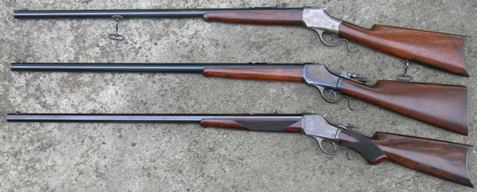
Some of you know I recently bought an 1885 Highwall in 40-110 EX 260. Well between the other 4 rifles I am working on I started messing with this one.
Last night I went through the brass I have and was a little let down that this one has to be squeezed just to get it into the chamber too. I can use the same brass I used for the 45 EX. I have around 30 empty 450 Nitro Express thick rim cases. I will use what I need for the 45 EX and the others for this project.
So without much thought I went out and started to squeeze one. Already had the hole drilled from the last project. It didn’t take long at all to get it to fit into the chamber. But I split the neck. I had forgotten the first step requires something from over squeezing and and in my case splitting the neck. The split is about an 8th of an inch but it will continue to split, so it is trash. I will cut off about a quarter inch of the case and keep the good part. My second attempt worked OK because I used something from letting it cave in and split.
I am not sure if I talked about the fix when doing the 38 EX? The first stage of squeezing I sat a bullet on the arbor press so when the case was being squeezed it was also over the bullet. For the 40 EX case I used a 30 cal to 40 cal sizer. I have too much else to get done but I will shoot the one case I have done on Tuesday.
After a lot of digging I found my bullets that I use for the 40-65 I shoot. They are the exact weight I need but the manuals says I need a .403″ bullet. These are .408″. Then I remembered that the 40 cals, like my 86, actually shoot the larger diameter. I slugged the barrel twice and found the .408″ bullets are what I need. The barrel slugged the firs time at .401″ and .407″ and the second time at .400″ and .407″. All the forming will be done with a 75% load of black powder. The Barnes manual says to use 32 grs. of 4198. I will start lower this time and work up.
I will post some pictures later.
March 31, 2009
Offline
I’m back. Here are the pictures of my slugging tools and the 2 slugs just into the bore. I like polished stainless rods with all the edges removed the best. Short, about a foot long, wooden dowels next. The shorter ones won’t bow when you use them. You will need a couple of sets for the different calibers. I forgot to take a picture of the brass hammer.
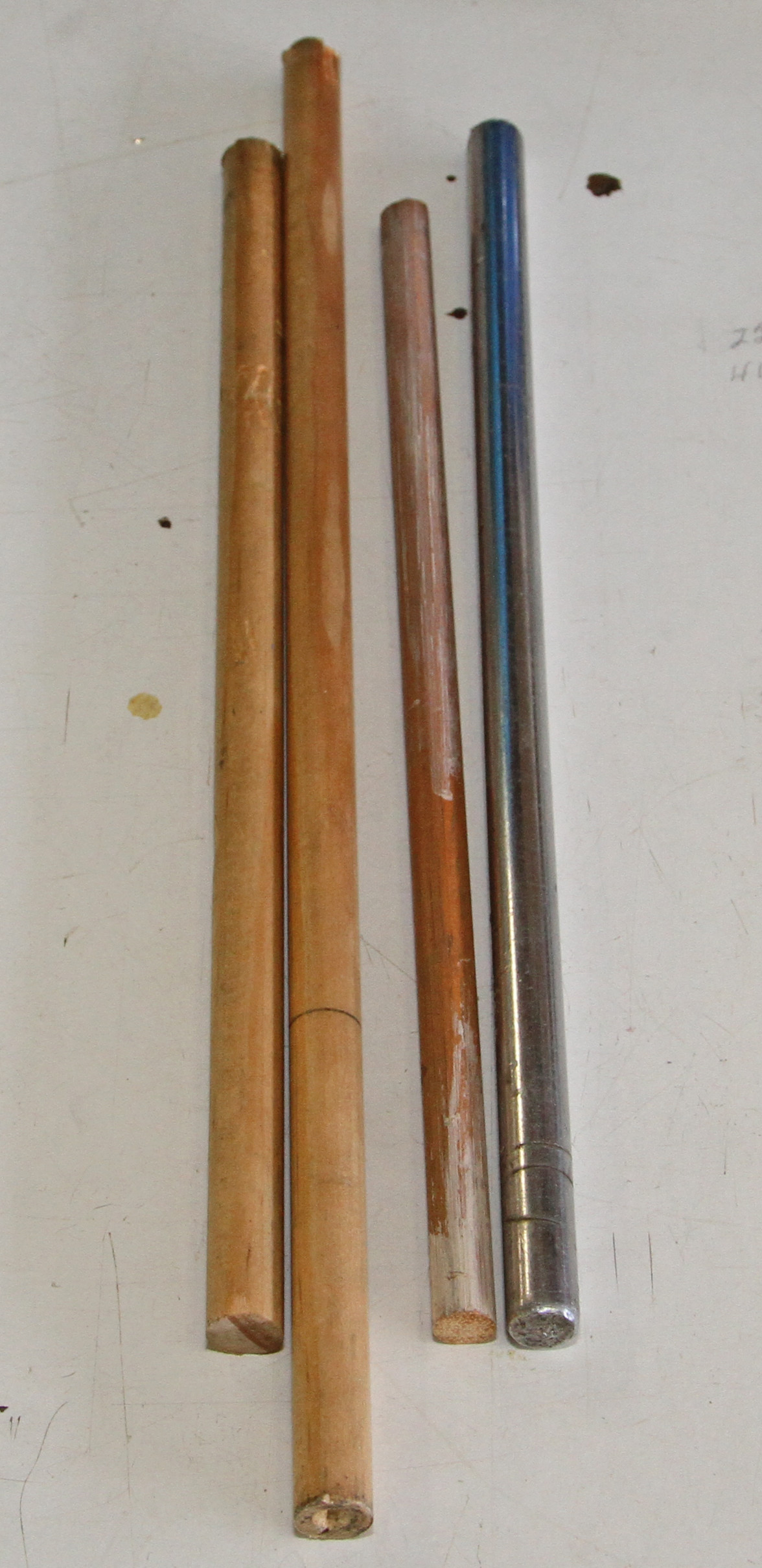
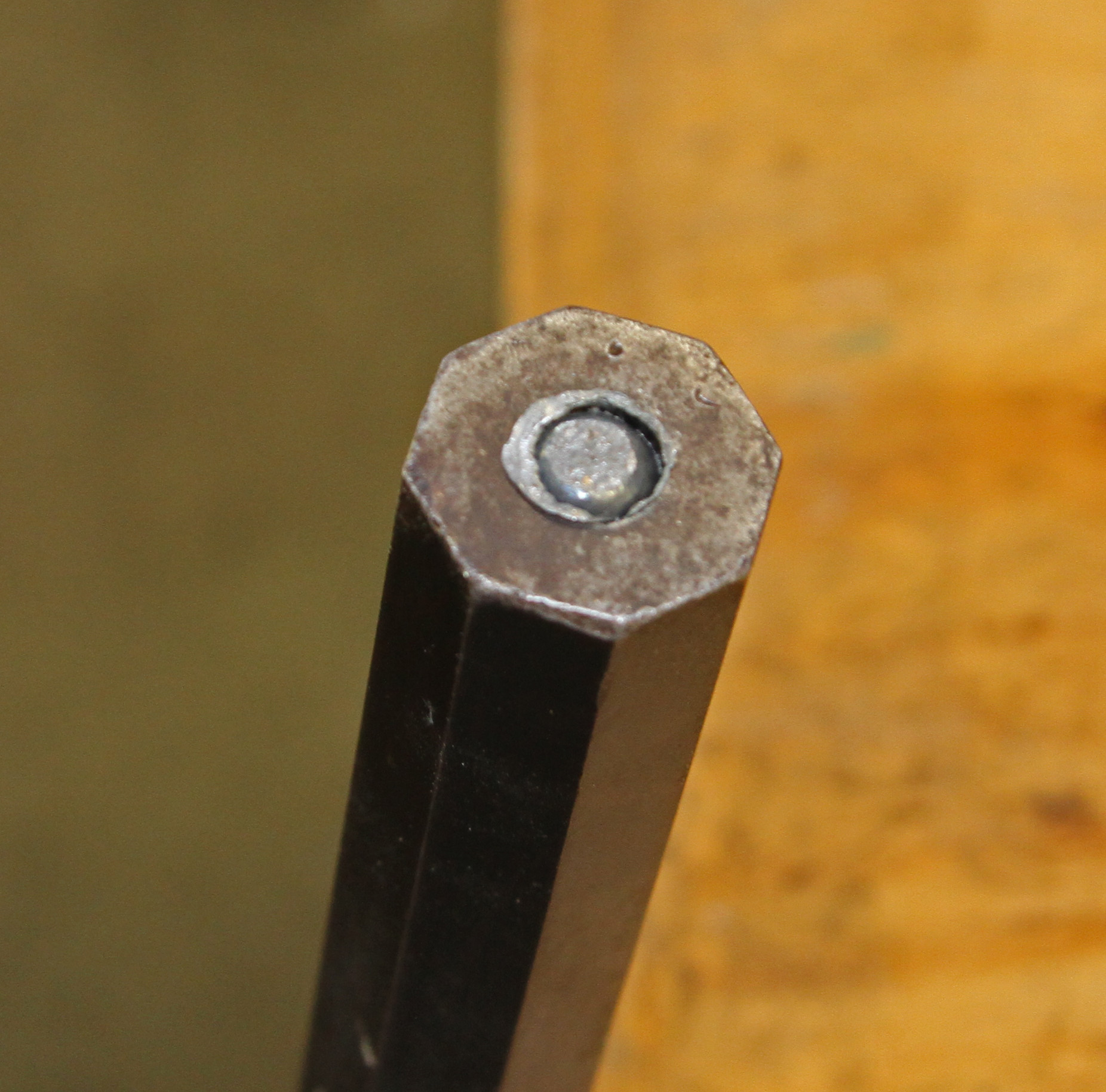
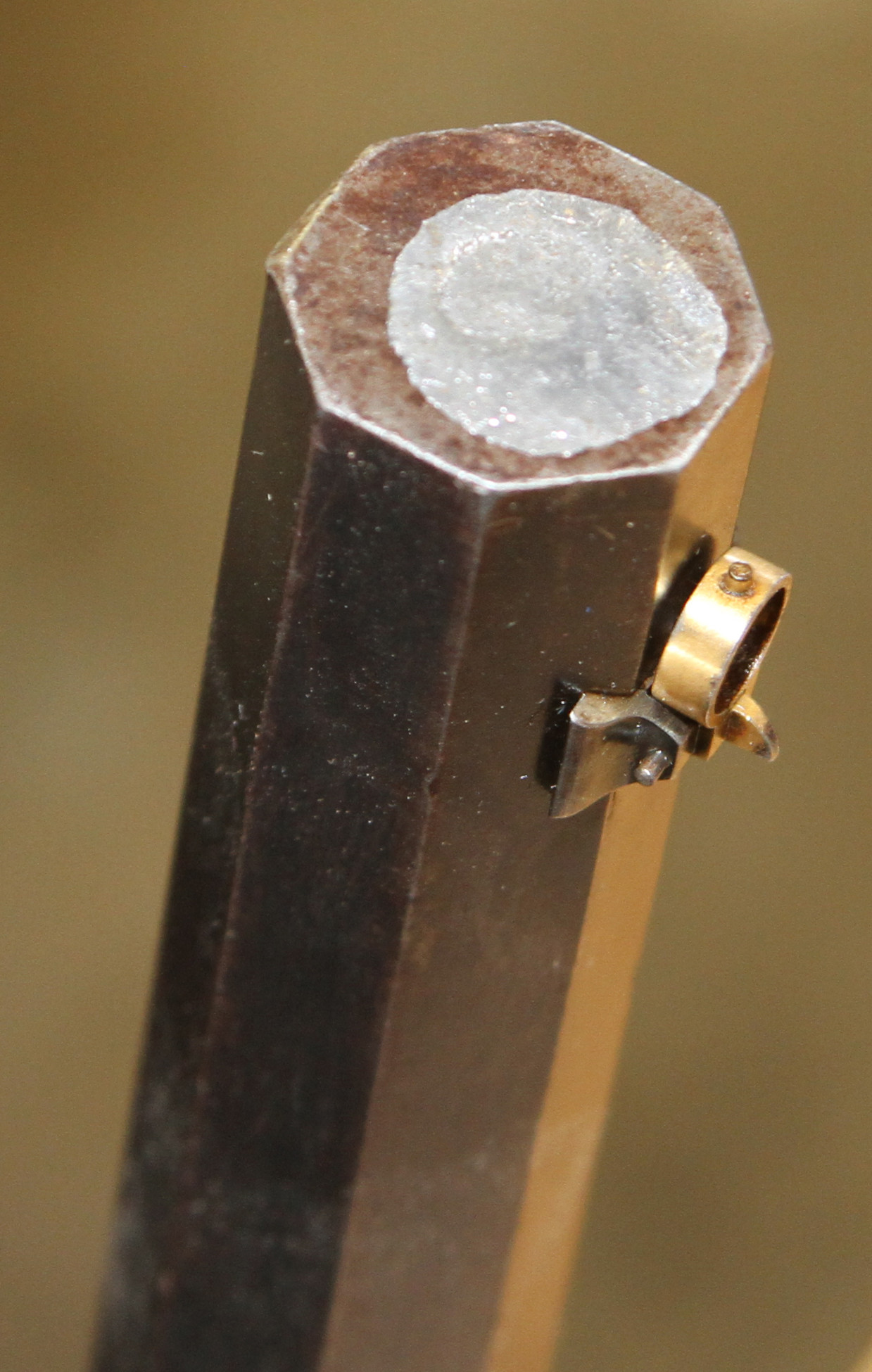
The 1st attempt at slugging I used a .424″ solid lead ball. The 2nd attempt I used a .457″ ball. The smaller ball was OK but the 2nd attempt with the larger ball is a lot better.
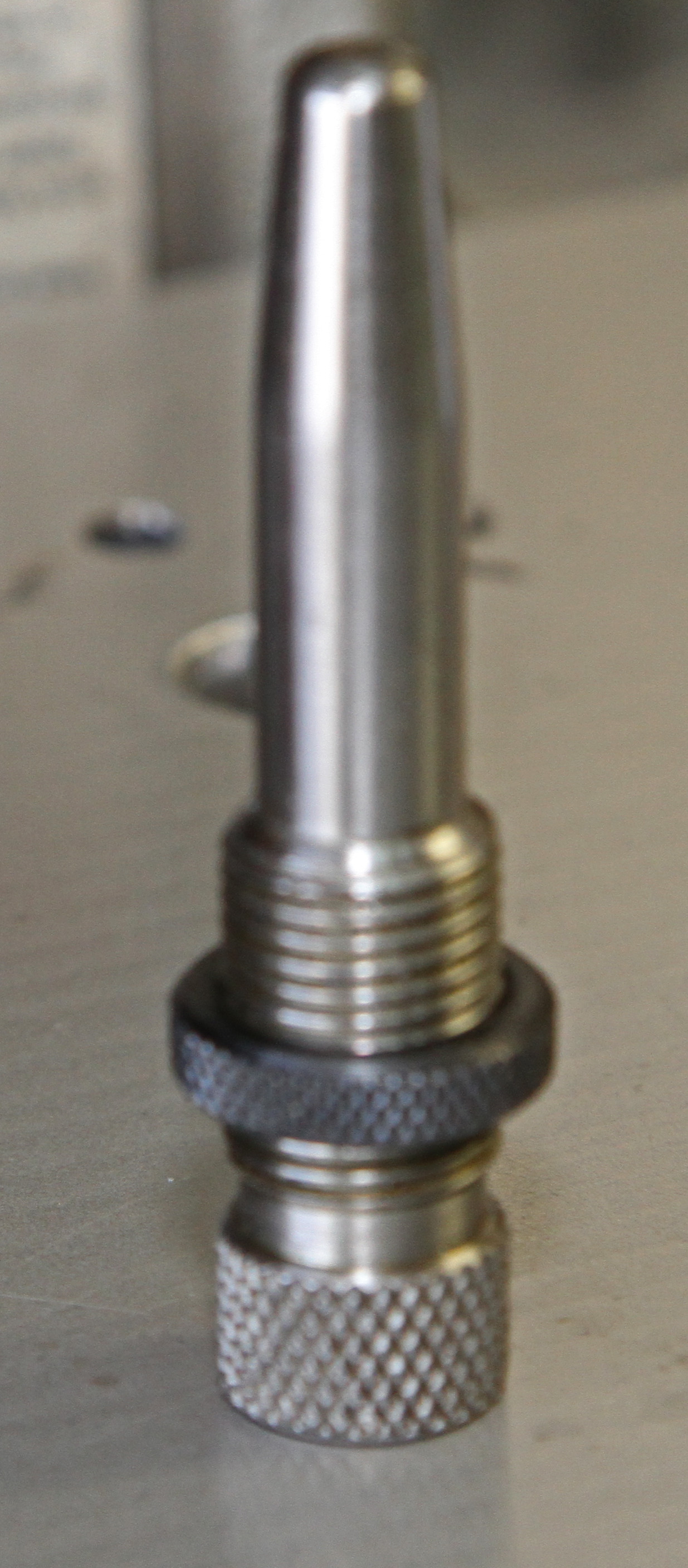
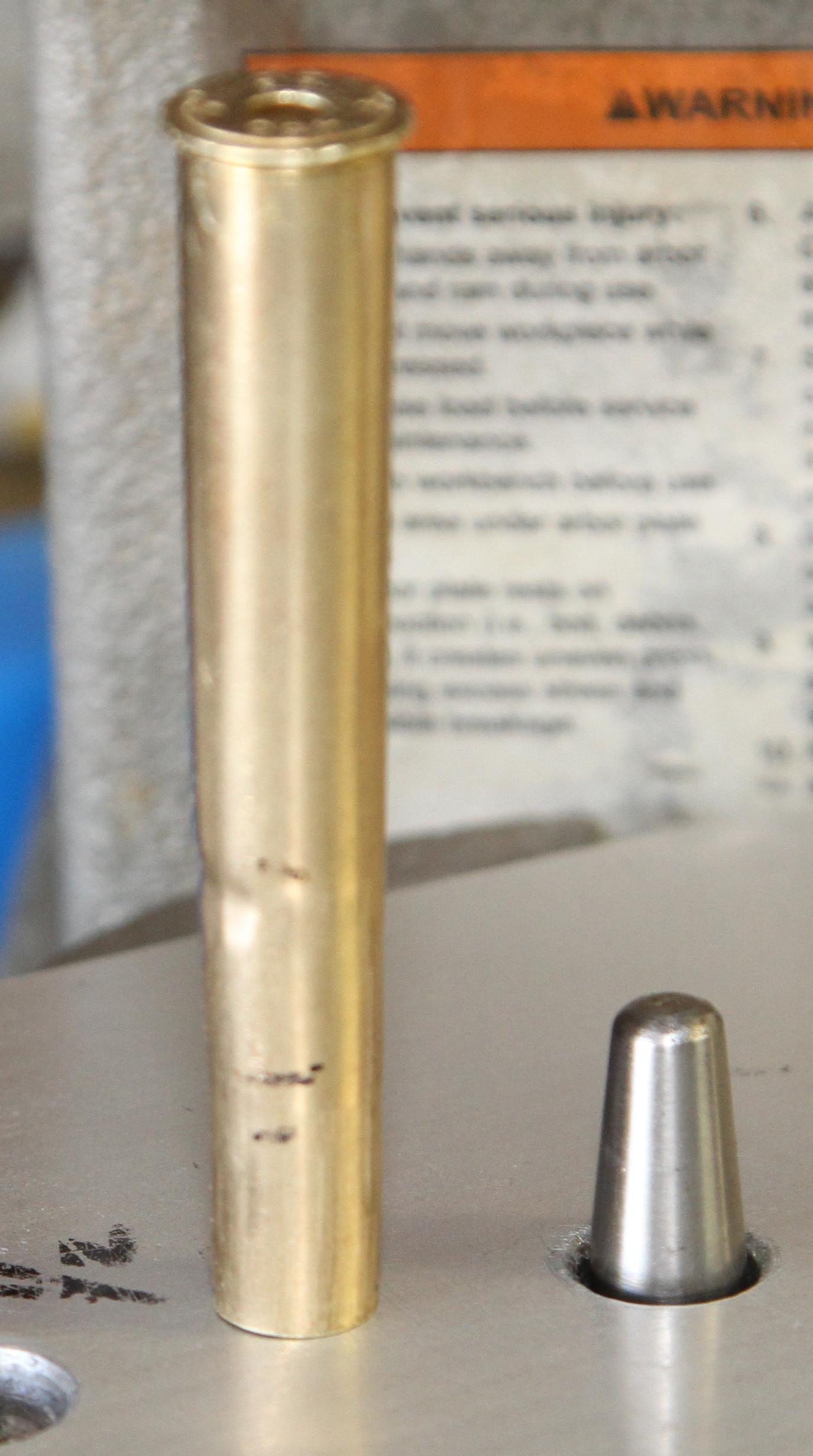
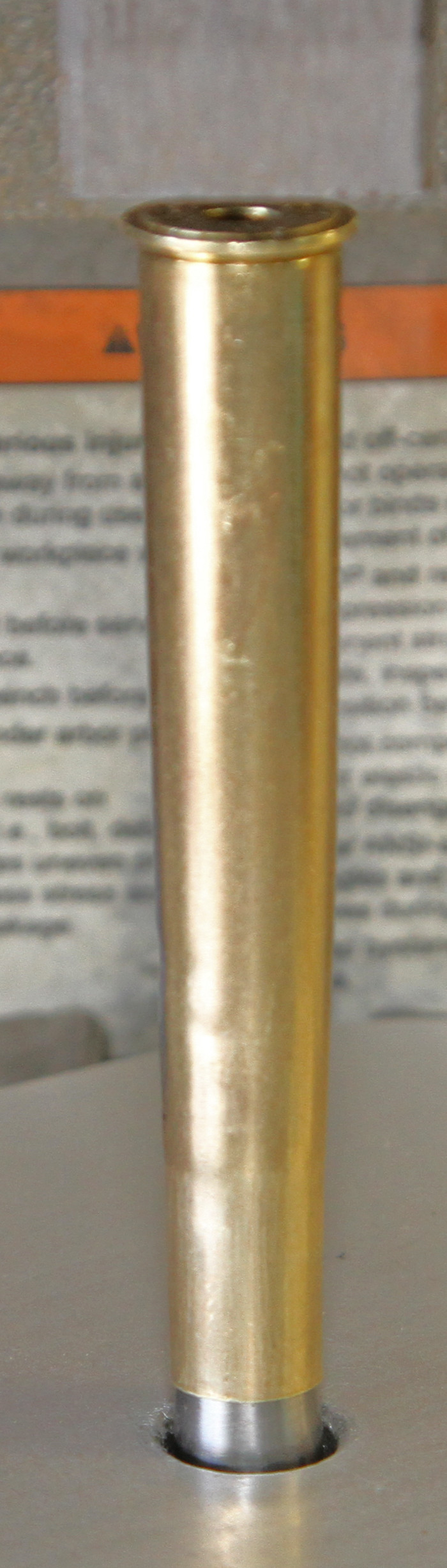
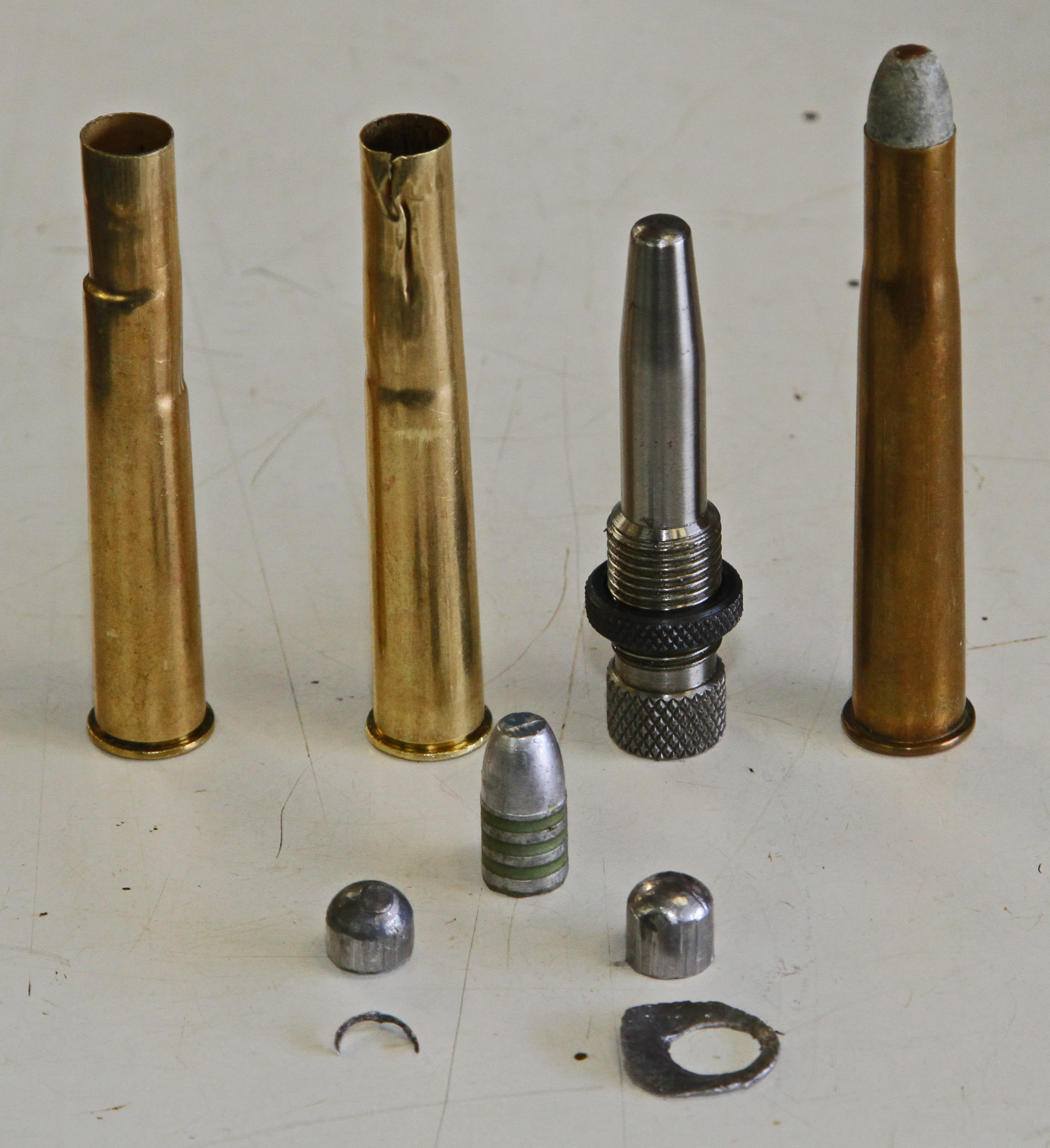
Next is the neck mandrel. This one goes from 30 Cal to 40 Cal. The mandrel sticking up through the plate then the case over the mandrel. The last pic shows the successful attempt to squeeze the case, the failure, the mandrel, an original cartridge. The bottom area you see the bullet I will use, the first slug and the second slug. See how the smaller ball creates a small round slug and the other ones is longer and easier to measure.

November 7, 2015
Offline
Big progress on the first day! Good that the bullets on hand are going to work for you. You’ll be an Express Expert before long.
Mike
March 31, 2009
Offline
I don’t know about expert, but I will have shot the 3 calibers that can be found. I wonder where the 2 50 EX’s are? It would be like finding a 50-105, or maybe worse.
December 9, 2002
Offline
Chuck,
I agree with Mike, as you’re making great progress, and especially on the first day. A very good detailed explanation, of the first day’s progress. It’s frustrating when the case starts to split, but that does go with the territory unfortunately, as you’re well aware of. A great job slugging the barrel, as I like you’re approach.
I do have to say that you’re teasing us with the picture of the end of the Octagon barrel, showing the flip down front sight. Is that a #3, or #4 barrel, on it?
(I went back to the .38 EX. post, and saw the letter, showing the #4 barrel).
I know that you’re busy with you’re load development, and will eventually post some pics, so with patience being a virtue, I’ll stay vigilant. LOL!
I did have a John Browning Original rifle, serial numbered below 200,(mfg. 1880-1883), with a thick, (1 1/4 inch at the muzzle), 30 inch Oct. barrel, in the .50 caliber, but I doubt that was an Express, as I know that you’re referring to the two, 50 EX. Caliber rifles in Bert’s survey. I think the 50 Ex. first became available in 1887, for the M-1886 rifle. So in all reality, the Browning Bros. rifle in .50 Cal. was not in the .50 Ex!
Keep it coming, and good luck with you’re progress!
Anthony
March 31, 2009
Offline
Anthony said
Chuck,
I agree with Mike, as you’re making great progress, and especially on the first day. A very good detailed explanation, of the first day’s progress. It’s frustrating when the case starts to split, but that does go with the territory unfortunately, as you’re well aware of. A great job slugging the barrel, as I like you’re approach.
I do have to say that you’re teasing us with the picture of the end of the Octagon barrel, showing the flip down front sight. Is that a #3, or #4 barrel, on it?
(I went back to the .38 EX. post, and saw the letter, showing the #4 barrel).
I know that you’re busy with you’re load development, and will eventually post some pics, so with patience being a virtue, I’ll stay vigilant. LOL!
I did have a John Browning Original rifle, serial numbered below 200,(mfg. 1880-1883), with a thick, (1 1/4 inch at the muzzle), 30 inch Oct. barrel, in the .50 caliber, but I doubt that was an Express, as I know that you’re referring to the two, 50 EX. Caliber rifles in Bert’s survey. I think the 50 Ex. first became available in 1887, for the M-1886 rifle. So in all reality, the Browning Bros. rifle in .50 Cal. was not in the .50 Ex!
Keep it coming, and good luck with you’re progress!
Anthony
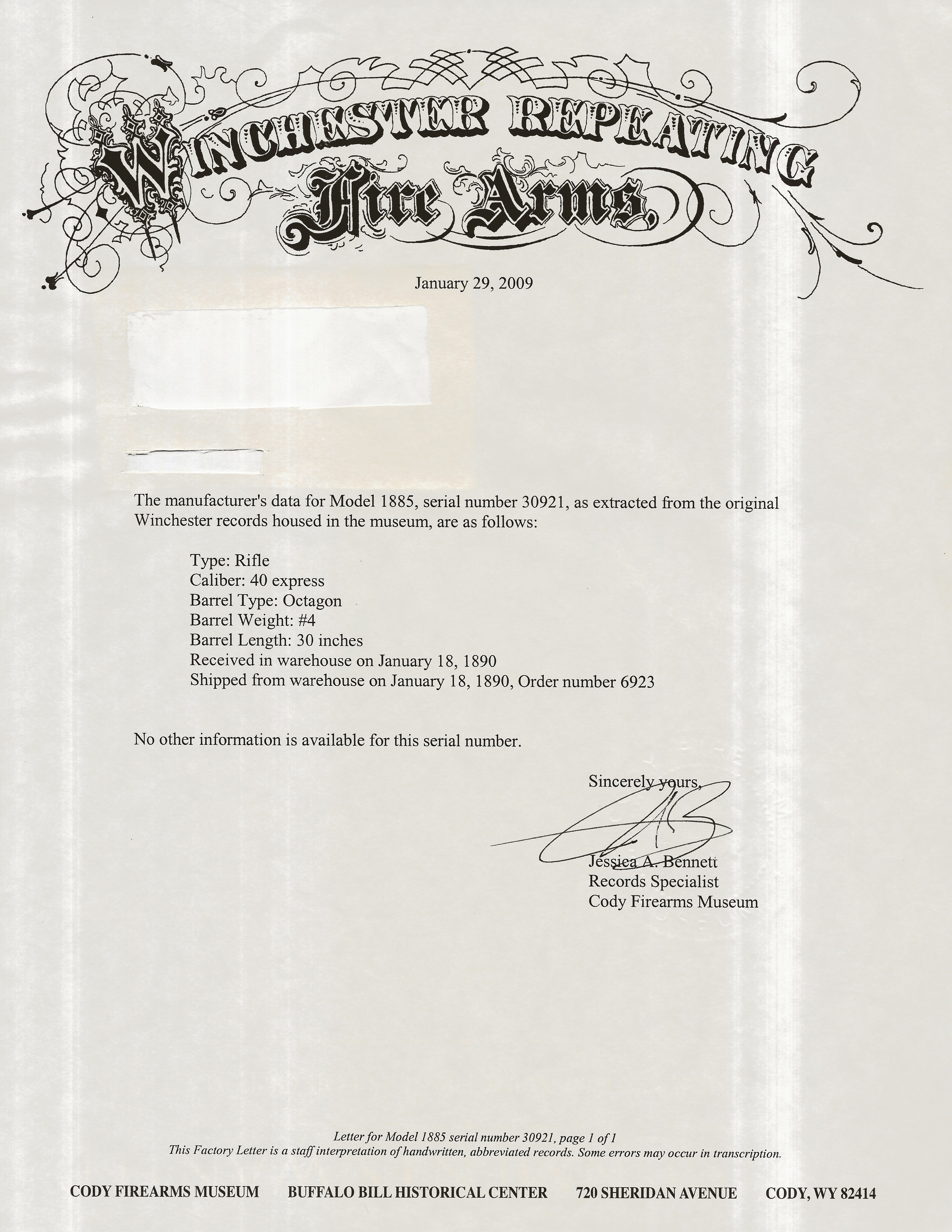
The 38, 40, 45 and 50 EX 3 1/4″ cartridges can only be shot in the 1885 highwalls. The 1886 50 cal cartridges are way shorter to be able to cycle. John Browning rifles were never chambered in any of these calibers. Bert will know the calibers.
I thought I posted a picture of the rifle in the 38 EX Forum?

December 9, 2002
Offline
Makes sense Chuck,
Thanks for adding that!
I didn’t see the pics in the .38 Ex. post!
Anthony
March 31, 2009
Offline
I loaded one round today and will shoot it Tuesday. Since I am fire forming the brass I used 75 grs of FFG and a filler so the bullet compresses the load. Some of the same issues as with the 38 EX. Shrinking the neck caused it to be too thick. It will go into the chamber but it is tight. The bullet doesn’t have a lot of neck tension. I am able to use the 40-65 FL die to squeeze the neck some but not quite enough.
March 31, 2009
Offline
I shot the one round today. Even with the low powder charge the primer backed out a small amount.
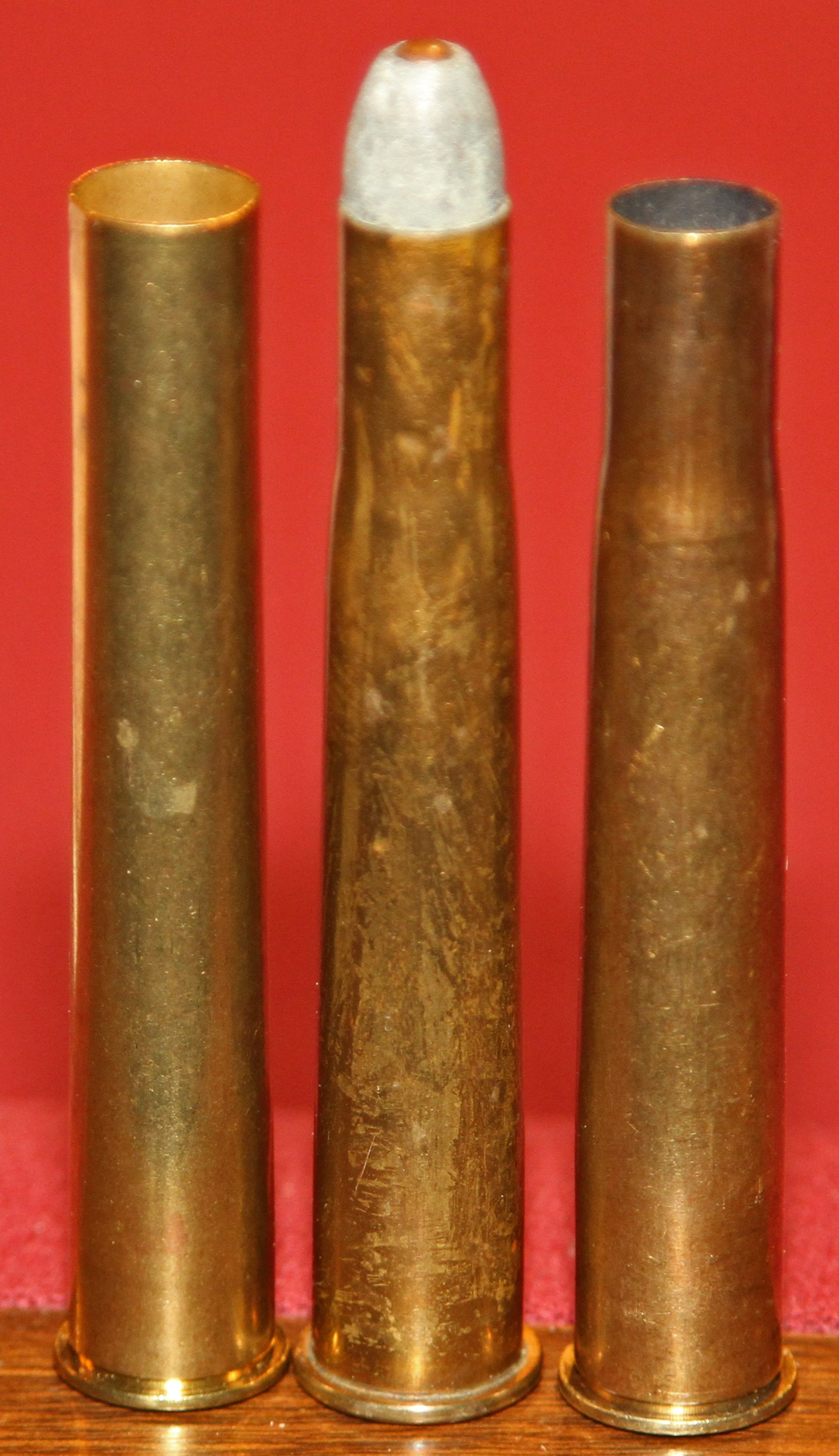
Her is a picture of the case before forming, an original cartridge and the fire formed case.

April 15, 2005
Offline
Chuck said
I shot the one round today. Even with the low powder charge the primer backed out a small amount.
Her is a picture of the case before forming, an original cartridge and the fire formed case.
Headspace issue?
WACA Historian & Board of Director Member #6571L
March 31, 2009
Offline
Bert H. said
Chuck said
I shot the one round today. Even with the low powder charge the primer backed out a small amount.
Her is a picture of the case before forming, an original cartridge and the fire formed case.
Headspace issue?
No, probably just trying to move so much brass. It will calm down after the forming. Believe me these cases are very tight and it takes effort to get the action closed against the case. Stupid me forgot to turn on the chronograph.
March 31, 2009
Offline
I formed 5 more cases yesterday. I then loaded all 6 cases with 70 grains of black powder. We’ll see what happens on Tuesday. Still trying to perfect my procedure. I did mess up 2 cases in the process. Luckily I have a good supply of the 450 Nitro Express thick rim brass and more is available at Buffalo Arms. I’m going to have to order some more bullets. The ones I’m shooting are the ones I use in m 86 40-65 too.
I got a lead on some Bell 45 basic brass and will check it out today. These are only 2 7/8″ long but are good to have in stock. I’m trying to buy a Sharps Model 74 from a collection. Having this brass allows me to be more flexible on the gun and cartridge I select. Sharps have a few cases up to this length.
March 31, 2009
Offline
Turned out the brass was 19 cases by Huntington Die Specialties in 45 2 7/8″ and 19 cases by RCBS in 45 3 1/4″. Huntington Die was owned by Fred Huntington the founder of RCBS.
Side note, Huntington designed a die in the 40’s called Rock Chuck Bullet Swage die, later shortened to RCBS. RCBS is currently owned by Hodgdon.
“In May of 2024, RCBS returned to family ownership when it was acquired by Hodgdon Powder Company, based in Shawnee, Kansas. Hodgdon and RCBS share a long history in the handloading industry. RCBS founder Fred T. Huntington knew Hodgdon Powder Co. founder Bruce Hodgdon. Along with other industry pioneers, the two men traveled the United States together in the 1960’s hosting reloading workshops to teach handloaders about their shared pursuit.”
March 31, 2009
Offline
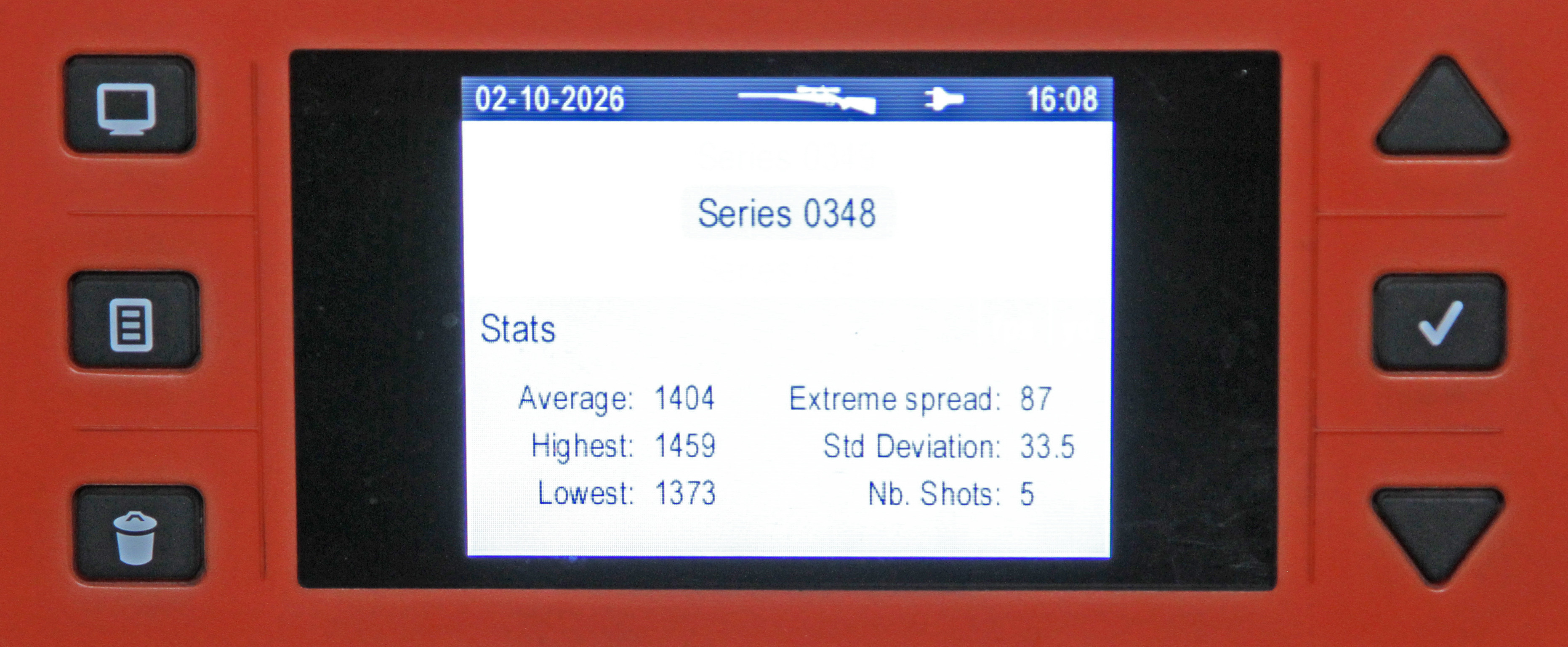
Fired the 5 cases. They were hard going in and 3 of the 5 had to be pushed out after firing. Hopefully this will get better now that the cases are almost completely formed.
November 7, 2015
Offline
Chuck-
Numbers look good to me. Progress!
Mike
March 31, 2009
Offline
TXGunNut said
Chuck-
Numbers look good to me. Progress!
Mike
Yes, some progress. I need to shoot these a couple more times and eventually shoot full loads of BP.
March 31, 2009
Offline
I just loaded the 6 rounds. I upped the powder to 75 grains. I had to crimp 5 of the 6 to get the bullet to stay put.
November 7, 2015
Offline
Chuck said
I just loaded the 6 rounds. I upped the powder to 75 grains. I had to crimp 5 of the 6 to get the bullet to stay put.
Are you using a drop tube?
Mike
March 31, 2009
Offline
TXGunNut said
Chuck said
I just loaded the 6 rounds. I upped the powder to 75 grains. I had to crimp 5 of the 6 to get the bullet to stay put.
Are you using a drop tube?
Mike
No. I have a 16″ drop tube but 75 grains doesn’t come close to filling this case that can hold 110 grains. I add the powder then a filler so the bullet will slightly compress the load. No air gaps. Never ever leave an air gap when using black powder.
March 31, 2009
Offline
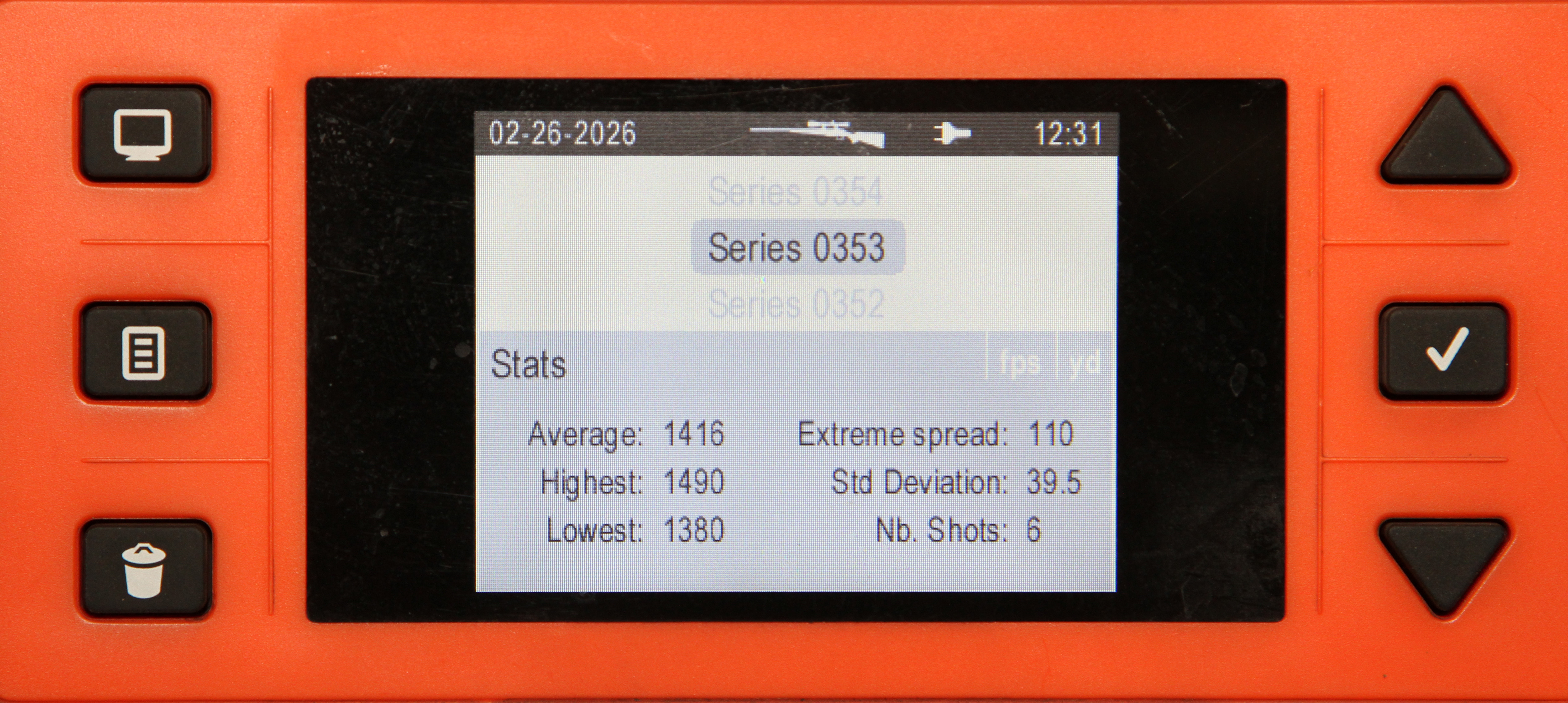
I was not able to shoot last week due to the rain. But I did shoot the 6 cartridges this week for the second firing. 4 of the 6 loaded easily and ejected just fine. The other 2 had to be pushed in and I had to use a cleaning rod to get them out. But that is a step forward. The metal for the first 1″ or so is still moving around. When you squeeze this much metal to just get it into the chamber it has to go somewhere. The neck gets thicker and longer.
I have no idea what the actual chamber length is. Usually you want to trim your brass about .020″ shorter than the chamber. Then the max length of the loaded cartridge has to be where it will cycle through the action. If you have a removable magazine the cartridge needs to be short enough to go in and out of the mag. If this were a normal cartridge a good loading manual would give you a trim length of the case and max OAL of the loaded cartridge. With normal cartridges you can buy a small piece to measure the chamber length. You size your brass then slip the piece in like you would a bullet but don’t push it in all the way. Using a light neck tension close the action and the piece will be forced into the case. It is flat on the end so it won’t go into the rifling. Then you can measure the OAL to get your chamber’s max length. Even today not all chambers are the same length. The SAAMI spec is a range not an exact measurement and reamers wear with use. I might make the piece myself out of a bullet. I could cut the bottom of the bullet perfectly flat and put it in the case backwards so the flat side goes into the chamber first but not into the rifling. All of this will get you the proper case trim length and max OAL of the cartridge but it does not tell you the best seating depth that your barrel likes.


1 Guest(s)
