

 Log In


July 7, 2026
 Offline

Hopefully this topic hasn’t been exhausted! I’ve been producing 32-40 brass from new 38-55 brass for a few months and generally it goes fairly well. However, this morning I did a batch and yielded about 50% success. What the heck? Then a light bulb came on and realized I had had not annealed the new brass. I have no great method for this. I simply run a propane torch on low and rotate the case in the main blue flame covering about the top 1/3 of the brass. I do it bare fingered and it takes 8-10 seconds. Much longer than that and my fingers get pretty dang warm. You’ll know if it’s too long. I have dropped the brass into water but I’m not sure that is necessary. I still get a dented case once in a while but I’d say less than 1 in 10.
Honest Jon

November 7, 2015
Offline
I’m trying to learn how to anneal. I ruined most of my first batch of 38-55 brass trying to get two torches and a simple tittle machine to work as a team. Seems one torch is defective and it’s too hot around here to try out the replacement. I made some 32-40 cases out of new 38-55 brass with fair results awhile back but I try very hard to use correct head stamp cases when possible. I don’t think water quenching is necessary or even helpful but a pile of freshly annealed brass takes awhile to cool off, at least that’s what my fingers thought!
Mike
June 4, 2017
 Online
I don’t do a lot of loading anymore but when I anneal I use a short lipped pan with less than 1/4″ of water in it. I heat the brass with a single propane torch with shell cases standing straight up, head in water. Then one at a time heat and knock over and roll. With a normal size brownie pan I can do 10 at a time before resetting another 10. The head stays hard, T/R
July 7, 2026
Offline
Here’s what mine look like after the KISS method. Eight to ten seconds rotated over a propane torch.
Jon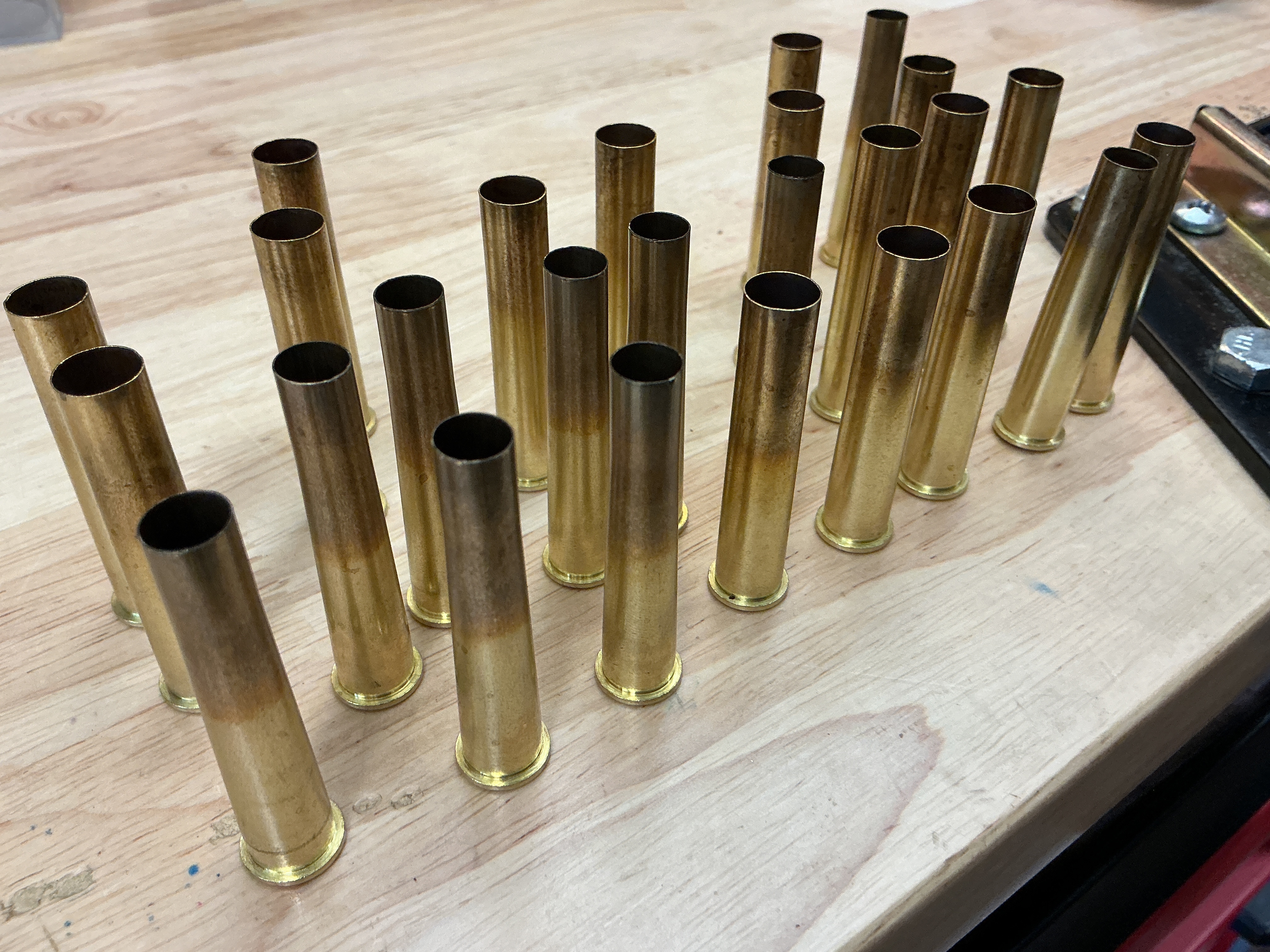
I have found 38-55 brass to be the worse brass to form 32-40 from. 32 special brass has worked best for me as the neck is already the correct diameter. I have never damaged a case and have never annealed a case. Yes, the formed brass is a few thousandths short but that is a plus as it allows you to use 32 special bullets and crimp at the cannelure.

October 4, 2011
Offline

I use a small rechargeable drill and proper size socket to anneal with. Hand held torch and a slow turn does the job nicely. With a pair of tweezer to remove the brass, set on a extra board or the like, cuz I found that sometime the brass head is hot enough to leave a mark on the table.
November 19, 2006
Offline
Keep the annealing techniques coming – I’m enjoying them. And taking notes.
November 7, 2015
Offline
I have the Anneal Rite kit, good videos on their site.
Mike
November 19, 2006
Offline
TXGunNut said
I’m trying to learn how to anneal. I ruined most of my first batch of 38-55 brass trying to get two torches and a simple tittle machine to work as a team. Seems one torch is defective and it’s too hot around here to try out the replacement. I made some 32-40 cases out of new 38-55 brass with fair results awhile back but I try very hard to use correct head stamp cases when possible. I don’t think water quenching is necessary or even helpful but a pile of freshly annealed brass takes awhile to cool off, at least that’s what my fingers thought!
Mike
Mike –
I also prefer correct headstamps. This is not always easy. I’ve never been able to do it when I load for my Marlin .25-36. On the Winchester Model 1886 chamberings, .45-70 and .45-90 are easy but the rest not so much. I recently loaded a batch of .38-72 for my Winchester ’95 and those cases are stretched .444 Marlin cases (which turned my ’95 into a single-shot as the cases will not feed through the magazine). When I loaded for my ’95 in .30-03, I never had correct headstamped cases. I have been able to find correct brass for all M1894 chamberings without much trouble.

March 31, 2009
Offline
You heat the brass just to the point where it turns orange or stars giving off an orange glow. DO NOT quench it. Quenching hardens the brass. Air dry only. Watch some of these videos.
July 7, 2026
Offline
King Medallion wrote:
I use a small rechargeable drill and proper size socket to anneal with. Hand held torch and a slow turn does the job nicely. With a pair of tweezer to remove the brass, set on a extra board or the like, cuz I found that sometime the brass head is hot enough to leave a mark on the table.
Excellent suggestion and I just tried it this morning. A more consistent heating and far easier on my bare fingers! Thank you.
Jon

January 20, 2023
Online
Chuck said
You heat the brass just to the point where it turns orange or stars giving off an orange glow. DO NOT quench it. Quenching hardens the brass. Air dry only. Watch some of these videos.
annealing brass – Search
I wondered about that. My knowledge of metals chemistry is very limited but I know a water quench renders metals hard and brittle, to some degree.
Since beginning to reload in the mid-Sixties, I’ve read about annealing techniques during which the heat is killed by knocking the cases over into the pan of water used to protect the heads. I think people do it to speed up the process and make room for more cases
My Dad was trained to work metal as a machinist and welder. He thought the annealed portion of the cases should air cool to stay dead soft.
- Bill
WACA # 65205; life member, NRA; member, TGCA; member, TSRA; amateur preservationist
"I have seen wicked men and fools, a great many of both, and I believe they both get paid in the end, but the fools first." -- David Balfour, narrator and protagonist of the novel, Kidnapped, by Robert Louis Stevenson.
March 31, 2009
Offline
I anneal almost weekly with a modern annealer. You can’t find a modern video using modern equipment that shows the brass being quenched. My cases drop into a stainless bowl to cool. Some of the annealers use induction coils instead o a flame.


1 Guest(s)
