

 Log In


January 26, 2011
 Offline

LeverGunner said
Bert H. said
LeverGunner said
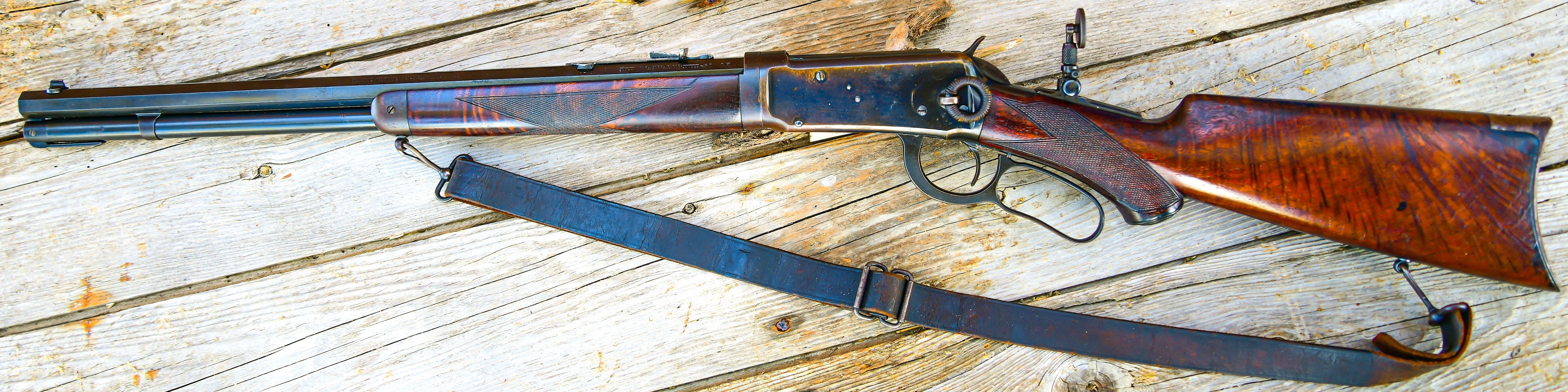
Can I ask you a peripheral question, what is up with the saddle ring? It appears to be wire wrapped.
My bet is that it is leather wrapped, which was relatively common back in the day to cut down on noise when in the field hunting, and wear to the receiver frame from metal rubbing on metal.
Bert
After seeing the more close up pictures, I think you’re right. That would be some fine leather work.
Correct gentlemen. I think someone else referred to it as leather string. It looks like it’s been on there a heck of a long time.
~Gary~
November 1, 2013
Offline

pdog72 said
I think someone else referred to it as leather string. It looks like it’s been on there a heck of a long time.
Resembles the leather lacing used in decorating saddles, billfolds, belts, etc, except that it looks thicker; lacing has to be thin enough to attach to a leather needle. I wonder how the two ends were secured. Saddle makers also use a heavy waxed brown linen thread that I used to wrap a ring because it pulls very tight & the coils stick to each other & the ring; end result very similar to this.
January 27, 1992
Offline
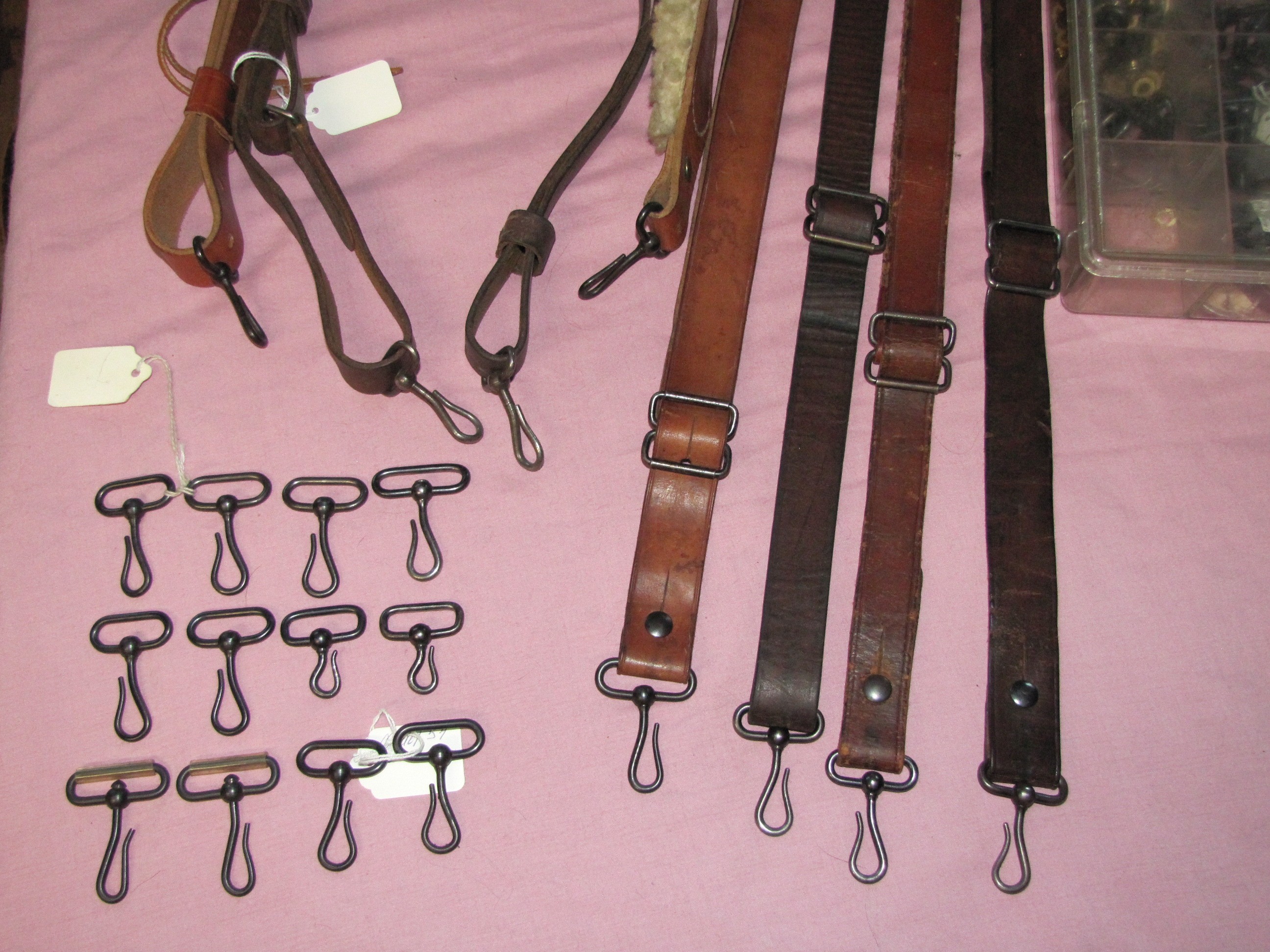
Sorry for the slow reply for additional pictures. I had some difficulty in finding the photos. RDB

July 17, 2012
Offline
Roger, nice selection! Thanks for the photo.
Best Regards,
WACA Life Member #6284 - Specializing in Pre-64 Winchester .22 Rimfire
November 1, 2013
Offline
rogertherelic said
Sorry for the slow reply for additional pictures. I had some difficulty in finding the photos. RDB
Now I know why I’ve never been able to find one of these offered for sale–Roger has beat me to them!

November 10, 2023
Offline
Thank you for sharing Roger, those are awesome! I’ve never seen another set of the short sling swivels. How rare are those?
November 10, 2023
Offline
I appreciate all the great information and pictures that is shared here.
How tight are the hooks supposed to be when installing them on the eyes? Are they supposed to be loose, such that they could accidentally fall off? Or is there supposed to be some friction against they eye when installing the hooks?
January 27, 1992
Offline
The sling hooks I have require some effort to slip into the eyelets. Some are eaiser than others. I would surmise wear and/or usage contribute to the differance in resistance when hooking the swivel to the eye. Just my view. RDB
November 10, 2023
Offline
Does anyone know if late model Winchester slings had a stamped buckle instead of the one with rollers?
I saw a sling that appears to be a Winchester sling.
These are screen shots of the sling.







March 15, 2020
Offline
I have been searching for a sling with the proper roller slide adjuster but the ultimate would be the sling made of webbing as per page 28 catalog 83. Has anyone ever seen one ? Don
March 15, 2020
Offline
Also just found in stroebels book page 291 a photo of Winchester Gunsights-1902 catalog a photo of THE WINCHESTER SLING STRAP.
This is an interesting subject to research. Don
November 2, 2009
Offline
I’ve made several “close” reproductions of this sling. As some of you know, I’ve been reproducing holsters and cartridge belts of the 1849 to 1900 period for almost 48 years and I am a stickler for authenticity. The problem with this sling is the hardware. Brass or steel buttons are easy; the fishhook is also fairly easy to find, but expensive. The hard one is the steel piece the leather slides through for adjustment. This is called a “tri-slide”. Many companies make tr-slides, but the one used on this sling is completely different in design. What appears to be a “roller” is a shield crimped to the wire loop and it will not roll. This is the piece with the patent date on it. Tri-slides today, do not have a crimped sleeve of any kind and are simply pressed out of flat sheet steel or brass. They will work, but they are not at all the same as the original and I don’t like using them. I’ve worked with saddlery hardware companies across the country for decades. They can get just about anything made “China”, but in most cases it is cost prohibitive. Minimum start-up fees, minimum orders of 5000 pieces, etc. I couldn’t sell enough of these in a lifetime to make it profitable. If anyone has an idea of where these tri-slides could be found, let me know, because I can make the 1″ sling, provided I have the correct hardware.
November 10, 2023
Offline
win4575 said
I’ve made several “close” reproductions of this sling. As some of you know, I’ve been reproducing holsters and cartridge belts of the 1849 to 1900 period for almost 48 years and I am a stickler for authenticity. The problem with this sling is the hardware. Brass or steel buttons are easy; the fishhook is also fairly easy to find, but expensive. The hard one is the steel piece the leather slides through for adjustment. This is called a “tri-slide”. Many companies make tr-slides, but the one used on this sling is completely different in design. What appears to be a “roller” is a shield crimped to the wire loop and it will not roll. This is the piece with the patent date on it. Tri-slides today, do not have a crimped sleeve of any kind and are simply pressed out of flat sheet steel or brass. They will work, but they are not at all the same as the original and I don’t like using them. I’ve worked with saddlery hardware companies across the country for decades. They can get just about anything made “China”, but in most cases it is cost prohibitive. Minimum start-up fees, minimum orders of 5000 pieces, etc. I couldn’t sell enough of these in a lifetime to make it profitable. If anyone has an idea of where these tri-slides could be found, let me know, because I can make the 1″ sling, provided I have the correct hardware.
Thank you for the information. Yes, I see the difference in the tri-slide. Do you know if Winchester ever used one without rollers? My understanding is that they offered slings until the 1980s. So I am wondering if the one pictured could be a late model sling.
November 2, 2009
Offline
In post #23, Roger shows four slings all with the crimped sleeve having the patent date marking. In my opinion, these are all original Winchester. I have never seen this tri-slide with patent date, used on ANY other sling by any other company other than Winchester. The one you show in the #29 post photo, may be a Winchester sling of a more modern era. The slide is not made in the same way and the leather appears to be VERY heavy, compared to the ones I have and those in post #23.
November 10, 2023
Offline
win4575 said
In post #23, Roger shows four slings all with the crimped sleeve having the patent date marking. In my opinion, these are all original Winchester. I have never seen this tri-slide with patent date, used on ANY other sling by any other company other than Winchester. The one you show in the #29 post photo, may be a Winchester sling of a more modern era. The slide is not made in the same way and the leather appears to be VERY heavy, compared to the ones I have and those in post #23.
Thanks.


