

 Log In


February 6, 2010
 Offline

I just acquired a winchester 62 that had a lyman tang sight on it. I have never used one before and I wondering just how to use it? What exactly do you look for in the site window? I look through a small hole and see the front sight but how do you aim. I can see the entire front sight.

May 2, 2009
Offline
You center the post of your front sight in the opening of the tang sight. If your seeing too much of the front sight you might be able to change the hole size of the tang sight depending on the model.
Bob
WACA Life Member---
NRA Life Member----
Cody Firearms member since 1991
Researching the Winchester 1873's
Email: [email protected]

January 20, 2023
Offline
1873man said
You center the post of your front sight in the opening of the tang sight. If your seeing too much of the front sight you might be able to change the hole size of the tang sight depending on the model.
Bob
Bob, you don’t have to consciously try to put the front sight in the center of the aperture. All you have to do is look through the aperture and put the front sight on the target. You only have to line up two things, not three.
The human eye automatically focuses in the brightest part of the aperture, which is the optical center. It is so easy and simple people used to using barrel mounted rear sights resist using it properly. You don’t look at the aperture, you just look through it as if it were a scope.
The field of view is supposed to be large. You should see the entire front sight (unless the rear iron is still in the sight seat and blocks your view. )
Try this experiment. Unscrew the aperture and just use the big hole. Look through the hole and put the tip or bead of the front sight on a hundred yard target. Shoot a group. You will be surprised.
- Bill
WACA # 65205; life member, NRA; member, TGCA; member, TSRA; amateur preservationist
"I have seen wicked men and fools, a great many of both, and I believe they both get paid in the end, but the fools first." -- David Balfour, narrator and protagonist of the novel, Kidnapped, by Robert Louis Stevenson.
January 20, 2023
Offline
slk said
I just acquired a winchester 62 that had a lyman tang sight on it. I have never used one before and I wondering just how to use it? What exactly do you look for in the site window? I look through a small hole and see the front sight but how do you aim. I can see the entire front sight.
Look THROUGH the aperture, put the bead or tip of the front sight on the target. Don’t try to use the aperture as a rear sight. Your eye automatically centers itself. You line up two things, not three. I suggest you unscrew the aperture and just use the hole.
Look through the aperture and ignore it — like you Look through a scope.
Put the bead of the front sight on the target and pull the trigger.
It is so much easier than a barrel mounted iron sight people can’t believe it until they learn how to use it.
In case you still have doubts, go find Jim Carmichael’s Book of the Rifle and Look in its index for “aperture sight”. Jim lays out how it works and why those unfamiliar with it have trouble until they understand how it works. Receiver sights and tang sights are both aperture sights.
- Bill
WACA # 65205; life member, NRA; member, TGCA; member, TSRA; amateur preservationist
"I have seen wicked men and fools, a great many of both, and I believe they both get paid in the end, but the fools first." -- David Balfour, narrator and protagonist of the novel, Kidnapped, by Robert Louis Stevenson.
February 6, 2010
Offline
I will give that a try. I was just like you were saying trying to use the rear hole as a sight like you would a buckhorn. Trying to get the tip of the front blade in the center of the sight hole.
Thanks much
Steve
February 6, 2010
Offline
The sight I have is I believe a Lyman #2 ws. I only have the one aperture with it. It is the small diameter over all size. I see there is a larger 5/8” diameter one that appears to have smaller hole in it than the one I have. I have no idea which one is best. I am assuming the threads are the same for the apertures??
Steve
January 20, 2023
Offline
Steve, to get the hang of shooting with an aperture sight, don’t use any aperture at all. Unscrew the one now in the hole.
At the range, shoot a group using only the bare frame. Then do the same at 50 yards and a hundred yards.
I think you will be surprised at the targets you make with the bare frame.
The large disks with tiny holes are for target shooters, not hunters. They require time and lots of bright light. They are not fast.
I will send you a chart of hole diameter ranges but first convince yourself by trying the bare frame hole. At dusk, you will find this useful on a deer stand.
Williams will sell you a set of aperture disks that will fit the Lyman threads. I believe Williams, Lyman and Redfield aperture disk threads are all the same.
A good set of drill bits is useful for measuring and enlarging aperture holes.
Don’t hobble yourself with target apertures. Try the bare frame before you do anything else. The late, great Jack O’Connor recommended this repeatedly in his books.
- Bill
WACA # 65205; life member, NRA; member, TGCA; member, TSRA; amateur preservationist
"I have seen wicked men and fools, a great many of both, and I believe they both get paid in the end, but the fools first." -- David Balfour, narrator and protagonist of the novel, Kidnapped, by Robert Louis Stevenson.
January 20, 2023
Offline
I believe the shank thread is 7/32 – 40tpi for all three makers.
The two hole diameters I find most useful are 0.90 and 0.125 and I prefer the latter with a white 3/32 bead. A squirrel.hunter might prefer something smaller but the average deer hunter at dusk and dawn would find it very useful.
- Bill
WACA # 65205; life member, NRA; member, TGCA; member, TSRA; amateur preservationist
"I have seen wicked men and fools, a great many of both, and I believe they both get paid in the end, but the fools first." -- David Balfour, narrator and protagonist of the novel, Kidnapped, by Robert Louis Stevenson.
February 6, 2010
Offline
It is funny all these years training your eyes to believe one thing with open sights and now making them think it is just a hole to look through and just concentrate on the front blade and target. Hard to wrap my mind around that. I think I am over thinking the reasoning behind it working.
I just have to get to the range now.
January 20, 2023
Offline

Once you’ve tried them properly and see the difference, you’ll never go back to barrel mounted irons.
With experience, the target apertures are useable for making tiny groups at long ranges – even 500 yards or more for experts who can read wind and know their load’s trajectory like a book.
But the advantage of aperture sights for us – the users of top ejecting, scopeless Winchesters.– lies in getting away from having to align 3 objects, particularly with aging eyes. My shooting eye has seen more than eighty Winters but in last shooting light it can focus on the front sight and let the deer’s shoulder blur. The bigger the aperture the better.
A second benefit is a much more accurate way of adjusting elevation, to get sighted in.
Although it drives some Collectors [note the capitalized “C”] crazy, later Winchester lever actions’ receiver sidewalls are tapped for micrometer receiver sights. Lyman 56, 66, Redfield 70 and 80. Attached see the newly installed Redfield 80 on my rice-powered 1886 45/90. If you care about factory issue originality, don’t ever try a Redfield 80 or you will be publicly drawn and quartered for tapping your vintage 94! They are that good.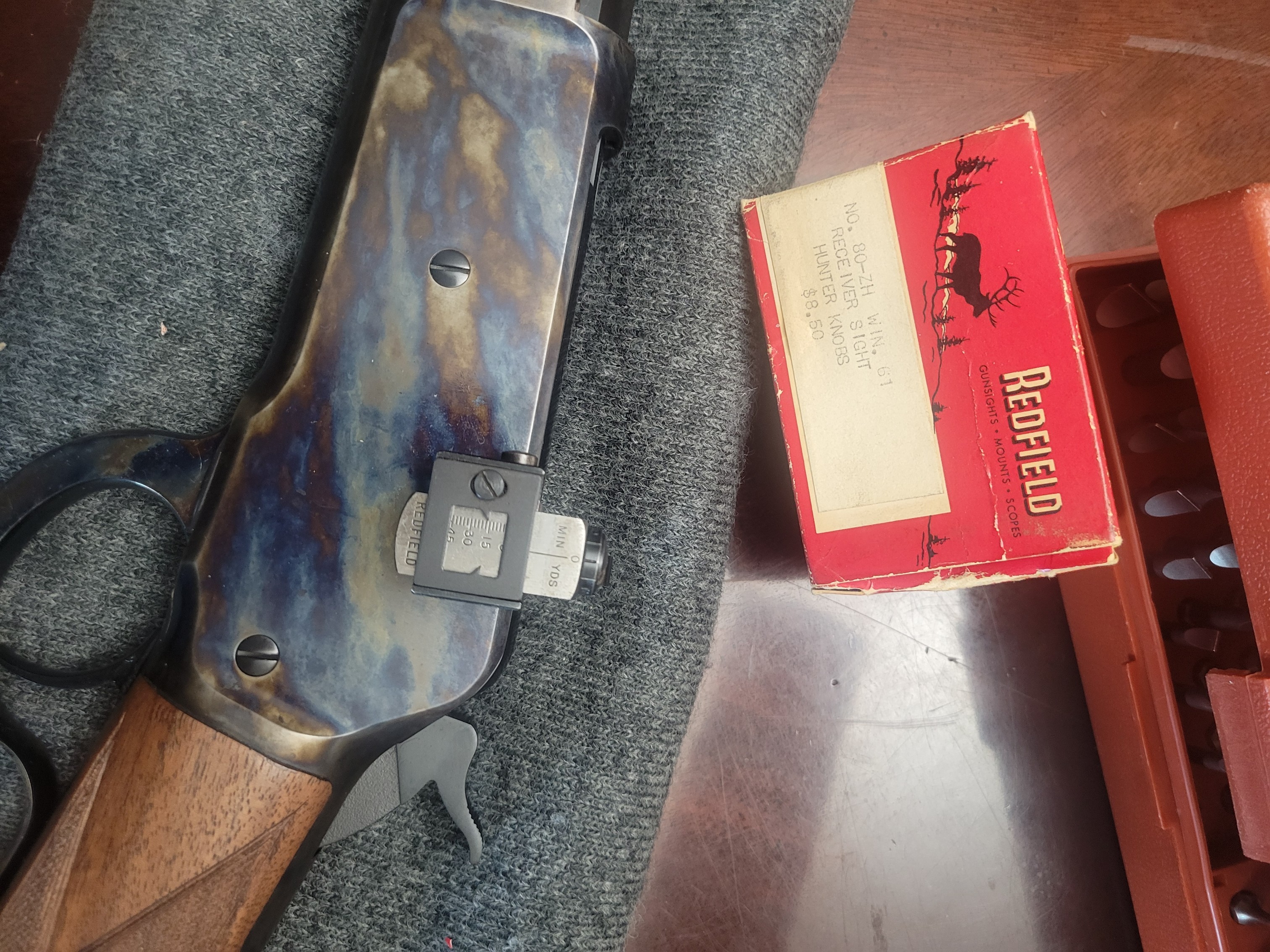
- Bill
WACA # 65205; life member, NRA; member, TGCA; member, TSRA; amateur preservationist
"I have seen wicked men and fools, a great many of both, and I believe they both get paid in the end, but the fools first." -- David Balfour, narrator and protagonist of the novel, Kidnapped, by Robert Louis Stevenson.
January 20, 2023
Offline
Steve, here is a chart Gemini made up for me about aperture sizes. If your aperture disk is a vintage Lyman, I would not drill it out. Nor would I pay a silly eBay price for vintage original disks. Williams disks are excellent and made of easy-to-drill Aluminum. A good, voluminous [in increments of .001″] set of SAE drill bits serves a dual purpose: making clean holes and measuring hole diameters. The unspiraled ends are the true diameter as each is marked. Use them as a GO/NO GO gauge, start large and poke until one slips in.
But do shoot first with the “ghost ring” to build confidence. It’s much more relaxing to start with lots of light and narrow down if you still want, than to start too narrow and get frustrated.
|
Diameter |
Classification |
Primary Use Case |
|---|---|---|
|
.030″ – .040″ |
Ultra-Fine Target |
Max Precision: Best for benchrest or long-range target shooting in extremely bright sunlight. |
|
.050″ – .060″ |
Standard Target |
Competition: The “Goldilocks” size for crisp focus and adequate light on overcast days. |
|
.093″ |
Medium / Hunting |
General Purpose: Standard for Williams/Lyman sights; ideal for informal range use and fair-light hunting. |
|
.125″ |
Large / Twilight |
Low Light: Maximum light transmission for dawn/dusk; sacrifices some depth-of-field focus. |
|
None |
Ghost Ring |
Speed: Removing the disk allows for the fastest target acquisition in thick brush or on moving targets. |
- Bill
WACA # 65205; life member, NRA; member, TGCA; member, TSRA; amateur preservationist
"I have seen wicked men and fools, a great many of both, and I believe they both get paid in the end, but the fools first." -- David Balfour, narrator and protagonist of the novel, Kidnapped, by Robert Louis Stevenson.


1 Guest(s)
