

 Log In


January 20, 2023
 Offline

Michael, i agree. The fissure was there all along and I never noticed it ( or maybe confused it with the scattered grain pattern) until i looked at the same image at several diameters of magnification.
I need to educate myself on the names of the various double shotgun components, in order to appreciate the information you and my other WACA friends are giving me. I’m very interested to understand the change in location of certain forearm components you describe. as soon as I have a grip on what those parts are called, i would like to discuss it futher with you. And with my gunsmith.
Chuck, as above with Michael, my ignorance of nomenclature is holding me back. Tell me what the forearm cap looks like? Is it the steel escutcheon inletted into the long axis of the convex external surface of the forearm, that houses the forearm latch release? If so, my answer is I don’t know because I did not attempt to disassemble any part of the forearm.
To my mind, the recoil force, a rearward vector, is trasmitted though the barrel attachment hook to the mating steel bracket and escutcheon in the forearm, thence to the wood of the forearm at every mating wood-to-steel junction.
If the steel escutcheon in the forearm is not held immobile by close ineletting, almost the entire force of recoil would eventually be borne by one or more attachment screws, I would think. Again, i need to learn the forearm architecture.
- Bill
WACA # 65205; life member, NRA; member, TGCA; member, TSRA; amateur preservationist
"I have seen wicked men and fools, a great many of both, and I believe they both get paid in the end, but the fools first." -- David Balfour, narrator and protagonist of the novel, Kidnapped, by Robert Louis Stevenson.

March 31, 2009
Offline
The forearm has a cap on one end where the cracks go up against. Can the piece of metal be easily removed to see the end of the wood? Nomenclature what nomenclature?
January 20, 2023
Offline
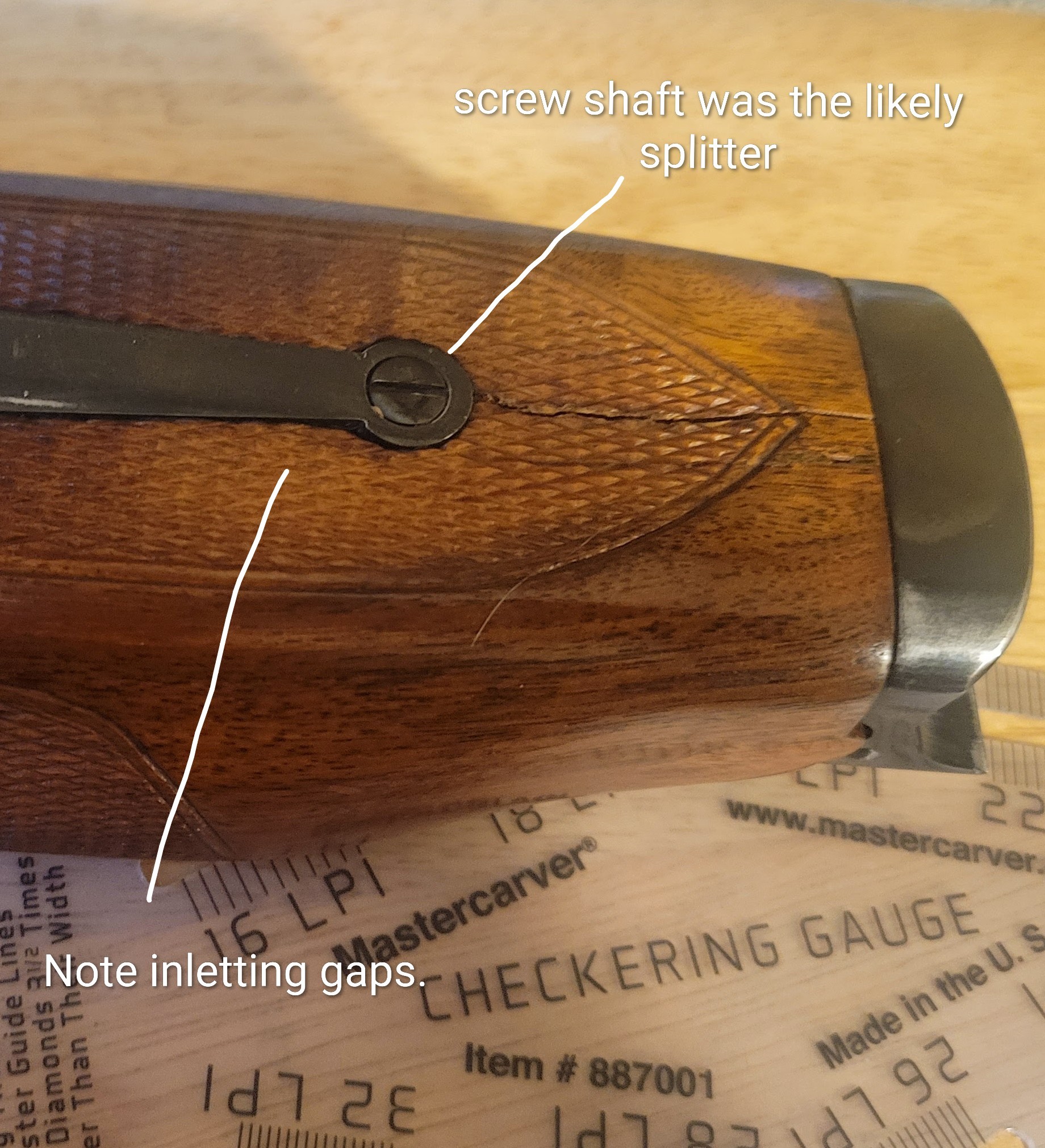 O.K. you mean the steel piece at the end. From the second photo showing the inletted side of the forearm, the cap appears to be of a single piece with the long steel housing containing the latch assembly. That entire part is going to be removed and eventually re-bedded in glass reinforced epoxy. Ron will remove additional wood, probably cutting channels and drilling holes to be filled with Acragel (or whatever he uses), perhaps with powdered aluminum for added strength. I don’t know how he plans to close the visible line of the crack. I would guess with a slow-set epoxy adhesive and elastic bands to close the line. Whether he will add any reinforcing metal or not, i leave to his judgment. From repairs i have seen to very heavily recoiling rifles, the craftsmen seemed to prefer cured bands and columns of glass filled epoxy to additional metal parts that could themselves become problems if they became unbonded.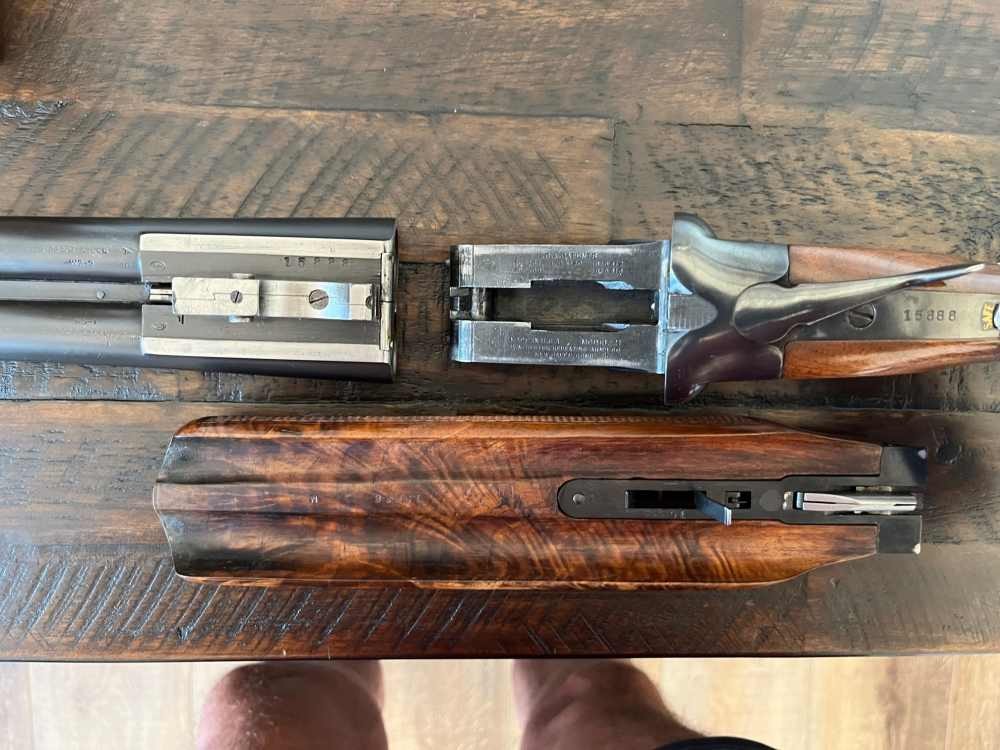
- Bill
WACA # 65205; life member, NRA; member, TGCA; member, TSRA; amateur preservationist
"I have seen wicked men and fools, a great many of both, and I believe they both get paid in the end, but the fools first." -- David Balfour, narrator and protagonist of the novel, Kidnapped, by Robert Louis Stevenson.
March 31, 2009
Offline
Now that I see these 2 pictures there is a lot more involved than I thought.
He is an expert and I am not but I’d use wood working glue and force as much as I could into the crack. If there was an area that would be covered up and I could get at the crack I’d pry it open a little to get more glue in. Then use padded clamps if I could. If not elastic like you said. The reason I like wood glue is that any excess can easily be removed without leaving a mark. Super glues and epoxies are hard to get off.
January 20, 2023
Offline
Yes, i would open the interior of the crack, too. I expect he will probably do so along its line, on the interior side. I’ve seen it done with a lining tool or fine chisel to give the adhesive more bite and add strength to the joint. Probably cross-lined as well.
I think the reason there is a preference for epoxy is to avoid a conflict between adhesives. Wood glue is water based, one reason it is easier to remove even when cured. (I am a Believer in Titebond III for almost everything and can testify that an unreinforced Titebond III glue joint will not fail before the 6/4 White oak itself does. It is waterproof after curing except for very extended continuous immersion..Great stuff.)
In the case of glass reinforced epoxy, the solution to squeeze-out is a pre-clamp application of release agent plus taping the visible surface shut. There are probably other tricks I’m unfamiliar with. I’ve heard a smear of Vaseline will keep the compound from adhering.
I do not know, but would guess a small line of compound in a checkering groove might even be carv-able to repair damaged diamonds, then sealed with an artist’s brush and thinned clear epoxy.
That is in the realm of black magic I don’t want to know about.
- Bill
WACA # 65205; life member, NRA; member, TGCA; member, TSRA; amateur preservationist
"I have seen wicked men and fools, a great many of both, and I believe they both get paid in the end, but the fools first." -- David Balfour, narrator and protagonist of the novel, Kidnapped, by Robert Louis Stevenson.

January 27, 2018
Offline
Zeb,
See page 117 of Mr Schwing’s book The Model 21 for a view of the difference between pre 1950 and post 1950 forearms.
Michael
March 31, 2009
Offline

Zebulon said
Yes, i would open the interior of the crack, too. I expect he will probably do so along its line, on the interior side. I’ve seen it done with a lining tool or fine chisel to give the adhesive more bite and add strength to the joint. Probably cross-lined as well.
I think the reason there is a preference for epoxy is to avoid a conflict between adhesives. Wood glue is water based, one reason it is easier to remove even when cured. (I am a Believer in Titebond III for almost everything and can testify that an unreinforced Titebond III glue joint will not fail before the 6/4 White oak itself does. It is waterproof after curing except for very extended continuous immersion..Great stuff.)
In the case of glass reinforced epoxy, the solution to squeeze-out is a pre-clamp application of release agent plus taping the visible surface shut. There are probably other tricks I’m unfamiliar with. I’ve heard a smear of Vaseline will keep the compound from adhering.
I do not know, but would guess a small line of compound in a checkering groove might even be carv-able to repair damaged diamonds, then sealed with an artist’s brush and thinned clear epoxy.
That is in the realm of black magic I don’t want to know about.
I use Titebond II. III is designed for stuff like outdoor furniture. Your guns will never need III. Well, unless you store them outside in the rain. Even III can be cleaned up with water.
January 20, 2023
Offline
Chuck,
For me, a major benefit of III, indoor or out, is it kicks over slower than II on a warm day. I favor multiple dowel construction for cabinetry (ever since I got a DowelMax) and glueups can get too frantic with II. It’s bad enough the damned dowels start swelling when the wet glue hits them!
- Bill
WACA # 65205; life member, NRA; member, TGCA; member, TSRA; amateur preservationist
"I have seen wicked men and fools, a great many of both, and I believe they both get paid in the end, but the fools first." -- David Balfour, narrator and protagonist of the novel, Kidnapped, by Robert Louis Stevenson.
March 31, 2009
Offline
Zebulon said
Chuck,
For me, a major benefit of III, indoor or out, is it kicks over slower than II on a warm day. I favor multiple dowel construction for cabinetry (ever since I got a DowelMax) and glueups can get too frantic with II. It’s bad enough the damned dowels start swelling when the wet glue hits them!
Zeb, I have made cabinets with just my table saw using tongue and groove joints, a dowel jig, a dovetail jig, a box joint jig, biscuit joiner and a pocket hole jig but my favorite for raised panels is a 6 piece router bit set. Each time I got a new tool I would build something with it to figure out how to use it.
November 7, 2015
Offline
Chuck said
Zebulon said
Chuck,
For me, a major benefit of III, indoor or out, is it kicks over slower than II on a warm day. I favor multiple dowel construction for cabinetry (ever since I got a DowelMax) and glueups can get too frantic with II. It’s bad enough the damned dowels start swelling when the wet glue hits them!
Zeb, I have made cabinets with just my table saw using tongue and groove joints, a dowel jig, a dovetail jig, a box joint jig, biscuit joiner and a pocket hole jig but my favorite for raised panels is a 6 piece router bit set. Each time I got a new tool I would build something with it to figure out how to use it.
https://sommerfeldtools.com/sommerfeld-06008-six-piece-ogee-cabinetmaking-set-with-new-patented-chip-free-ogee-rail-stile-1-2-inch-shank/?searchid=0&search_query=cabinet+making+set
Impressive! I think I’ll stick with the occasional raised garden planter boxes and the occasional knife handle.
Mike
March 31, 2009
Offline
TXGunNut said
Chuck said
Zebulon said
Chuck,
For me, a major benefit of III, indoor or out, is it kicks over slower than II on a warm day. I favor multiple dowel construction for cabinetry (ever since I got a DowelMax) and glueups can get too frantic with II. It’s bad enough the damned dowels start swelling when the wet glue hits them!
Zeb, I have made cabinets with just my table saw using tongue and groove joints, a dowel jig, a dovetail jig, a box joint jig, biscuit joiner and a pocket hole jig but my favorite for raised panels is a 6 piece router bit set. Each time I got a new tool I would build something with it to figure out how to use it.
https://sommerfeldtools.com/sommerfeld-06008-six-piece-ogee-cabinetmaking-set-with-new-patented-chip-free-ogee-rail-stile-1-2-inch-shank/?searchid=0&search_query=cabinet+making+set
Impressive! I think I’ll stick with the occasional raised garden planter boxes and the occasional knife handle.
Mike
Impressive, Not really. I’ve been building furniture for over 60 years and have collected a lot of tools.
January 20, 2023
Offline
Chuck, you’ve got me on dovetails..I tried it once and gave up. I use pocket screw joinery for utility cabinets like a rolling cart for my suitcase planer but I’ve not been able to achieve precision with it for finer work. I got a biscuit jointer tool decades ago but gave it up.for dowel joinery.
I’d tried to use a hardware store dowel jig a long time ago and gave up because it was incapable of indexing mating holes with the requisite accuracy. It wasn’t until I read up on Jim Lindsay’s invention and watched a couple of his videos that I gave DowelMax a try. Jim is a Scot.who emigrated to Canada to run their ferry system. A professional marine engineer, he served as chief engineering officer on QE2 for Cunard. Lives in BC and is a very helpful and likeable man. His tool system just flat works and it makes frame and panel work a relaxed process.
My garage shop is not state of the art and lacks working room, particularly for breaking down plywood panels. I have an old Model 10 Delta table saw i got in 1982 that is a sort of hybrid- cast iron trunnions and top but an open stand. It’s accurate enough but the 1.5 hp motor can bog down on thick hardwoods if you don’t baby it. A polymer link belt I put in really smoothed it out. It’s no Unisaw but it works. I finally jarred loose for a track saw a couple years ago and break plywood down on the adjacent patio – to my wife’s irritation.
- Bill
WACA # 65205; life member, NRA; member, TGCA; member, TSRA; amateur preservationist
"I have seen wicked men and fools, a great many of both, and I believe they both get paid in the end, but the fools first." -- David Balfour, narrator and protagonist of the novel, Kidnapped, by Robert Louis Stevenson.
November 7, 2015
Offline
Impressive, Not really. I’ve been building furniture for over 60 years and have collected a lot of tools. -Chuck
Well, I think so. I only have basic carpentry repair skills meaning I can do small to medium repairs if I study on it awhile. I replaced a stud, siding, windows and built a new door for my shed last year but that was at the ragged edge of my ability. Thank goodness for latex caulk and paint! I put together a knife kit now and then but they are very simple designs. I made a mess of some raised garden boxes recently but thankfully dirt covers most of my primitive joinery. I know just enough about this kind of work to recognize quality and enjoy a video now and then.
Mike
March 31, 2009
Offline
Zebulon said
Chuck, you’ve got me on dovetails..I tried it once and gave up. I use pocket screw joinery for utility cabinets like a rolling cart for my suitcase planer but I’ve not been able to achieve precision with it for finer work. I got a biscuit jointer tool decades ago but gave it up.for dowel joinery.
I’d tried to use a hardware store dowel jig a long time ago and gave up because it was incapable of indexing mating holes with the requisite accuracy. It wasn’t until I read up on Jim Lindsay’s invention and watched a couple of his videos that I gave DowelMax a try. Jim is a Scot.who emigrated to Canada to run their ferry system. A professional marine engineer, he served as chief engineering officer on QE2 for Cunard. Lives in BC and is a very helpful and likeable man. His tool system just flat works and it makes frame and panel work a relaxed process.
My garage shop is not state of the art and lacks working room, particularly for breaking down plywood panels. I have an old Model 10 Delta table saw i got in 1982 that is a sort of hybrid- cast iron trunnions and top but an open stand. It’s accurate enough but the 1.5 hp motor can bog down on thick hardwoods if you don’t baby it. A polymer link belt I put in really smoothed it out. It’s no Unisaw but it works. I finally jarred loose for a track saw a couple years ago and break plywood down on the adjacent patio – to my wife’s irritation.
The 2 things my garage is missing is a panel saw and a good vacuum system. I have no room for either. The vac would have to go in a shed attached to the garage. When my wife had her business we went through a lot of 1/2″ baltic birch plywood. It comes in 5′ x 5′ sheets. The panel saw would have been great for cutting these up. She ordered her wood straight from the rail yard and had it delivered to our driveway. My table saw looks like this one but it has a shelf under the right side and a different fence. The whole unit sets on a roller stand. It has an out feed table and we have a lot of roller stands.
January 20, 2023
Offline
You can’t beat a Unisaw. I was actually given a nineteen Seventies model in partial payment of a fee. It had been used on a manufacturing floor only to cut circuit boards from stock that outgassed some form of salt that left a fine layer of rust on the table. I took it home in pieces and eventually restored the top. After I got it set up and running, I took a hard look at those triple belts on the optional 5 horse Baldor. My shop is wired for 220 so that wasnt an issue but I’m not really comfortable with, nor do I need, that much torque. The fence was missing. After I priced out a Biesemeyer and thought about it, I let a favorite nephew, a much more advanced woodworker who could use it, have the saw.
I love to work with Baltic Birch, metric though it is. Stable, flat, and durable. My track saw is metric as well and sometimes its just easier to design in mils.
The best floor tool I have is a 6″ Powermatic jointer with helical head and long tables. It replaced a small Jet with blades that were evermore getting out of level. No jackscrews so you were on your own with a magnet and screwdriver. I strained for the Powermatic but it saved so much stomach acid the first month I used it, even my wife thought it was a bargain.
- Bill
WACA # 65205; life member, NRA; member, TGCA; member, TSRA; amateur preservationist
"I have seen wicked men and fools, a great many of both, and I believe they both get paid in the end, but the fools first." -- David Balfour, narrator and protagonist of the novel, Kidnapped, by Robert Louis Stevenson.
January 20, 2023
Offline
Michael B. said
Zeb,
See page 117 of Mr Schwing’s book The Model 21 for a view of the difference between pre 1950 and post 1950 forearms.
Michael
Michael, For some reason I overlooked this post, for which my apologies. Your cite to the illustrations in Schwing are illuminating and most helpful. I did see and take note of your earlier post that Winchester had made a change in the forearm architecture after my gun was built but didn’t fully appreciate your point until studying page 117.
Thanks very much for taking your time to give me the citation.
Let us hope Ron’s glass bedding the iron will solve the problem. I plan to do my part by refraining from any more high velocity loads in this gun (or any other, at my age.)
Not being a waterfowler and, for most of my life a 16 and 20 gauge upland hunter, I neglected to educate myself on what the newer velocity labels meant, in dram equivalent terms. I own and use several 12 gauge guns but have typically shot 2.75 DE one ounce shells and was unbothered.
My downfall was in buying a case of Winchester one ounce, 1350 fs shells and using them in a Browning Gold gas gun — which lulled me into trying them in the M21, which I didn’t consider all that light. It tore the gun from my aged hands and cut my middle finger, in addition to finishing the forearm split. I had also hunted doves with these in my Auto 5 Light 12, a heavier gun that spreads the recoil out a bit, so it really surprised me.
I may have to take up shotshell reloading again, after many years, to produce some 7/8 ounce loads, if an ounce of nines at 1150 won’t solve the problem.
It’s a hard job but somebody has to do it
Best regards,
Bill
- Bill
WACA # 65205; life member, NRA; member, TGCA; member, TSRA; amateur preservationist
"I have seen wicked men and fools, a great many of both, and I believe they both get paid in the end, but the fools first." -- David Balfour, narrator and protagonist of the novel, Kidnapped, by Robert Louis Stevenson.
January 20, 2023
Offline
For the benefit of the Membership, here is what Schwing disclosed about the Model 21 forearm cracking problem. 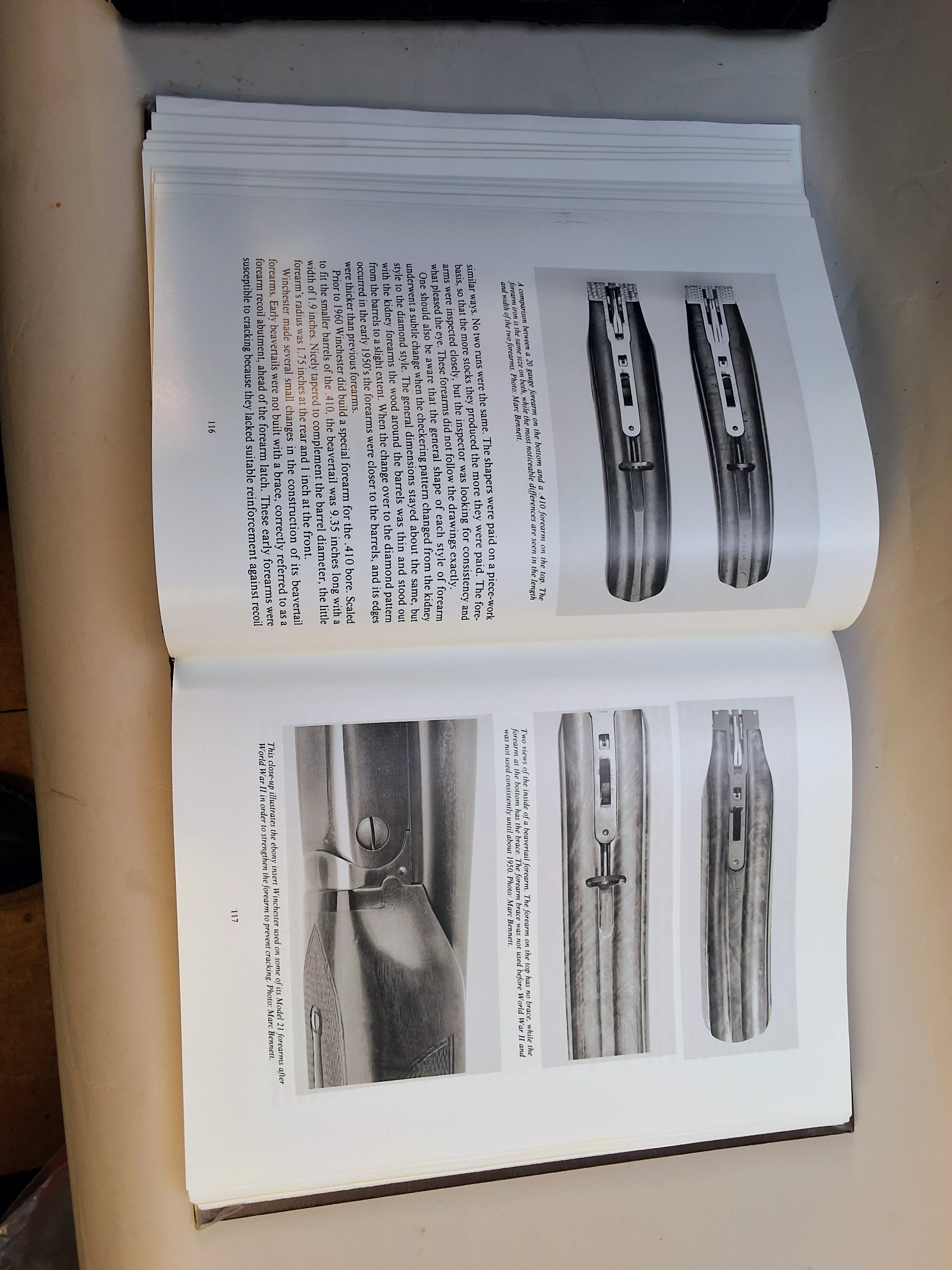
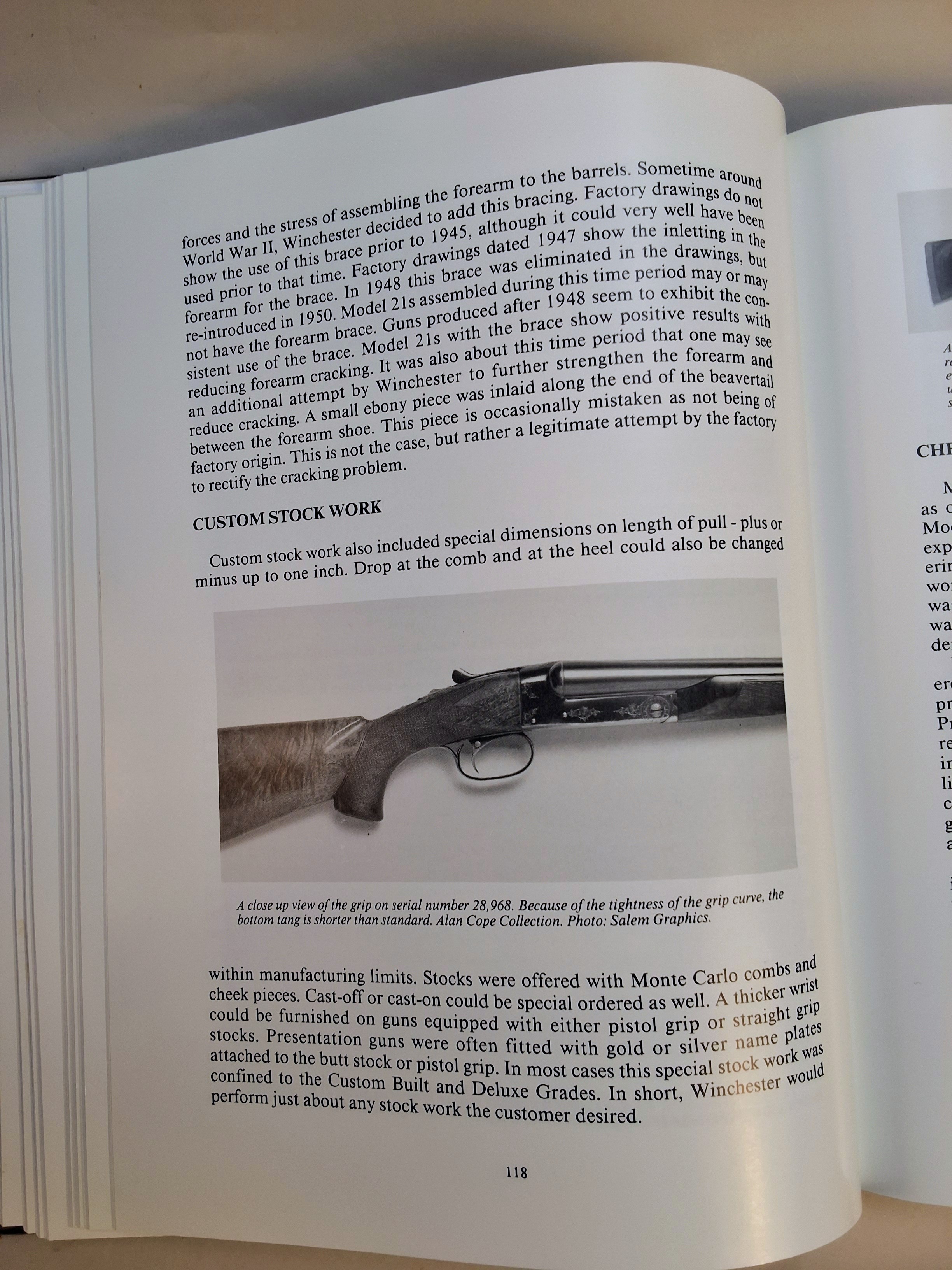
Again, my thanks to Member Michael B. for pointing out what I should have discovered for myself.
As you can see, it was something Winchester struggled with for a while.
- Bill
WACA # 65205; life member, NRA; member, TGCA; member, TSRA; amateur preservationist
"I have seen wicked men and fools, a great many of both, and I believe they both get paid in the end, but the fools first." -- David Balfour, narrator and protagonist of the novel, Kidnapped, by Robert Louis Stevenson.

April 30, 2023
Offline
Interesting note about that being an issue with the 21s. I would’ve figured Winchester would have worked pretty hard on that model to eliminate that quickly. Good to know!
….and great, another book to hunt down! 
March 31, 2009
Offline
Sorry, it got compressed and now you can’t read it.

January 20, 2023
Offline
Chuck said
Sorry, it got compressed and now you can’t read it.
Chuck, wait one and I will put up a link to my Photos album. That should fix it.
- Bill
WACA # 65205; life member, NRA; member, TGCA; member, TSRA; amateur preservationist
"I have seen wicked men and fools, a great many of both, and I believe they both get paid in the end, but the fools first." -- David Balfour, narrator and protagonist of the novel, Kidnapped, by Robert Louis Stevenson.


