

 Log In


January 20, 2023
 Offline


According to Schwing, the standard checkering pattern on Model 21 stocks and forearms was diminished in 1946 from 20 LPI to 18 LPI.
The D.O.M. of my Skeet Gun is 1947, according to its Cody letter. Curious, I ordered a checkering gauge and both wrist and beavertail forearm are checkered at 22 lines per inch. Obviously, the employees who made the 21 had considerable leeway. I also suspect this gun’s furniture may have been done before Pearl Harbor. Again according to Schwing, a 1947 Skeet Model should have 28″ barrels and this one has the pre-1946 26″ set.
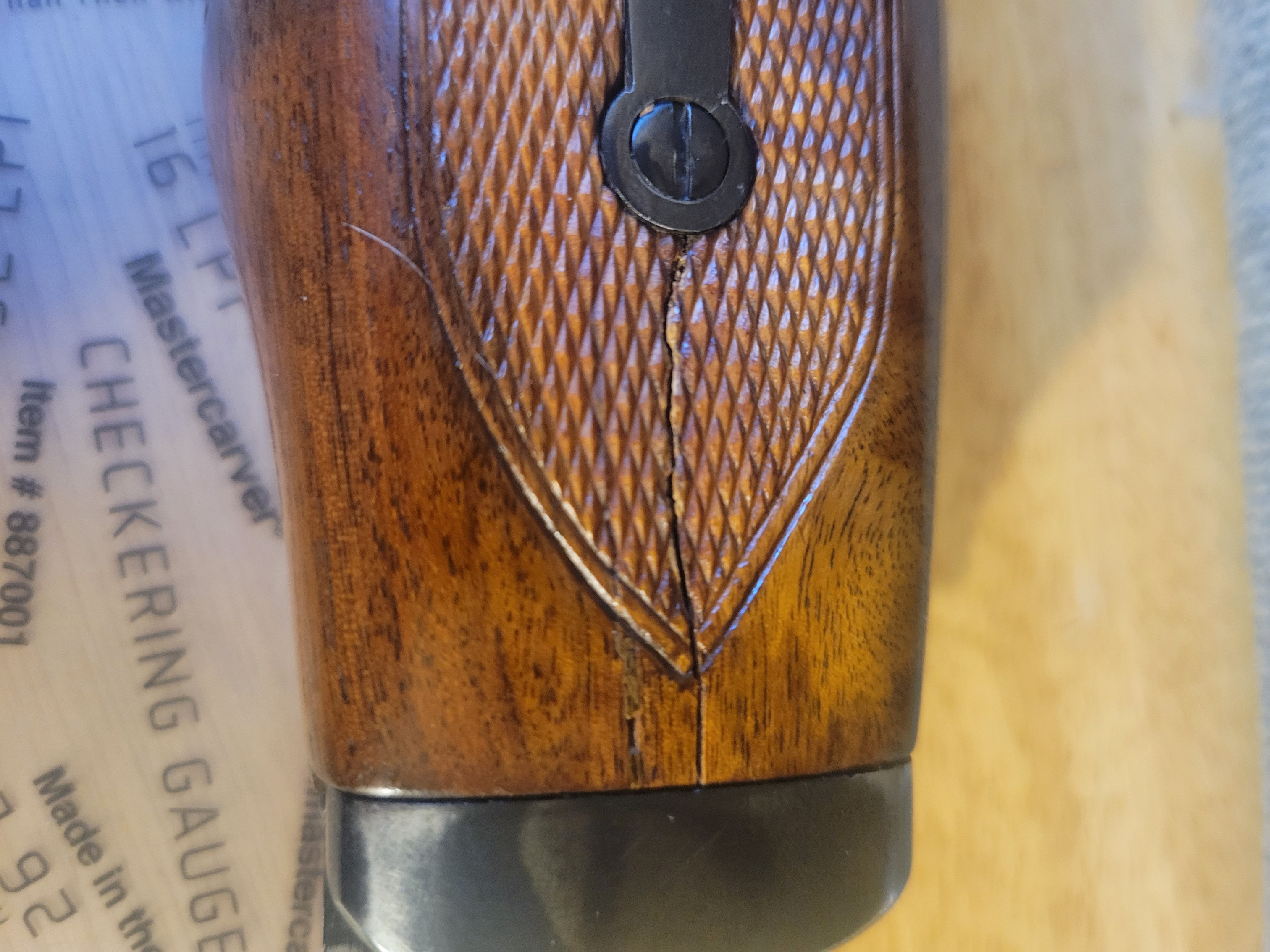
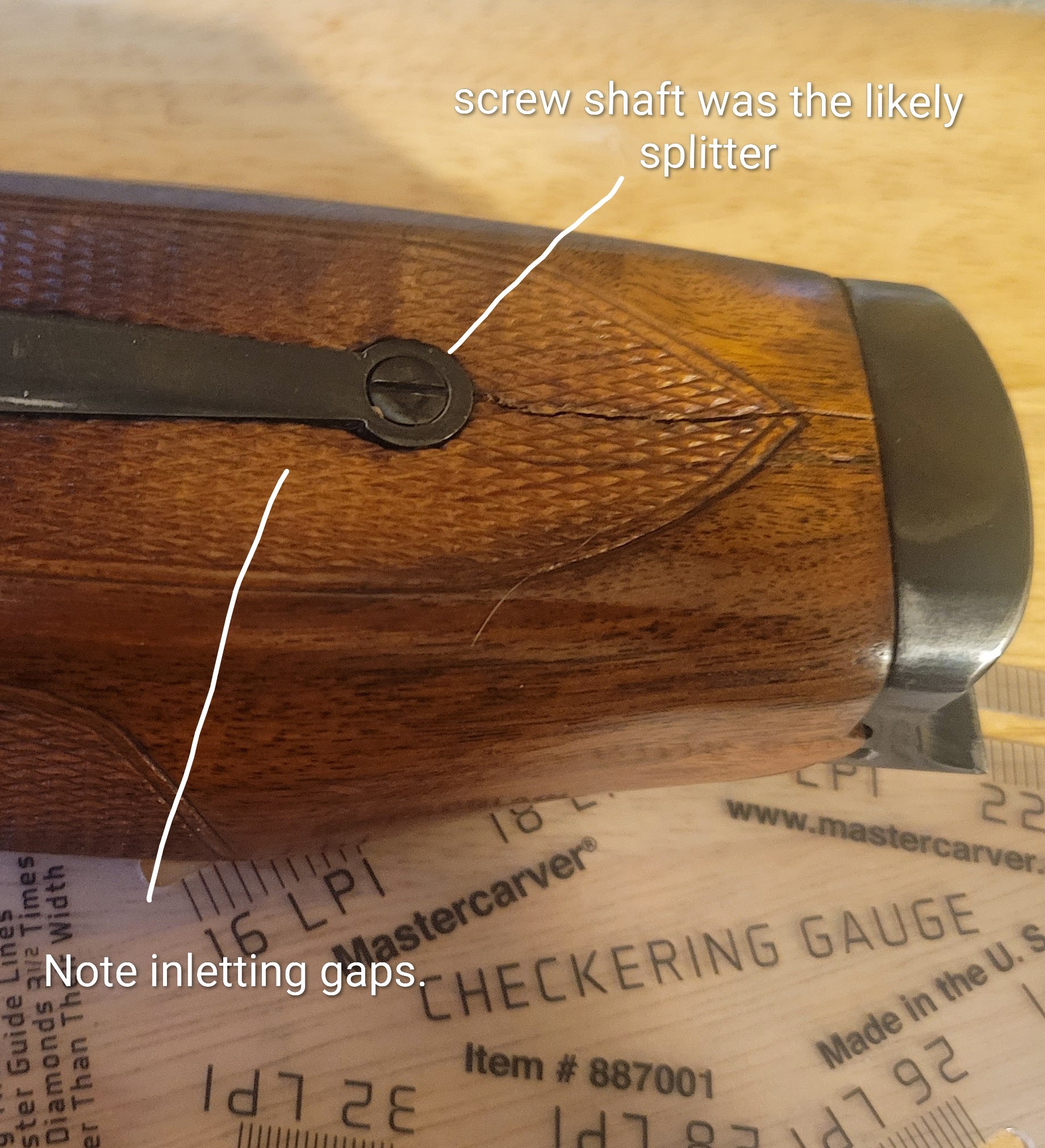
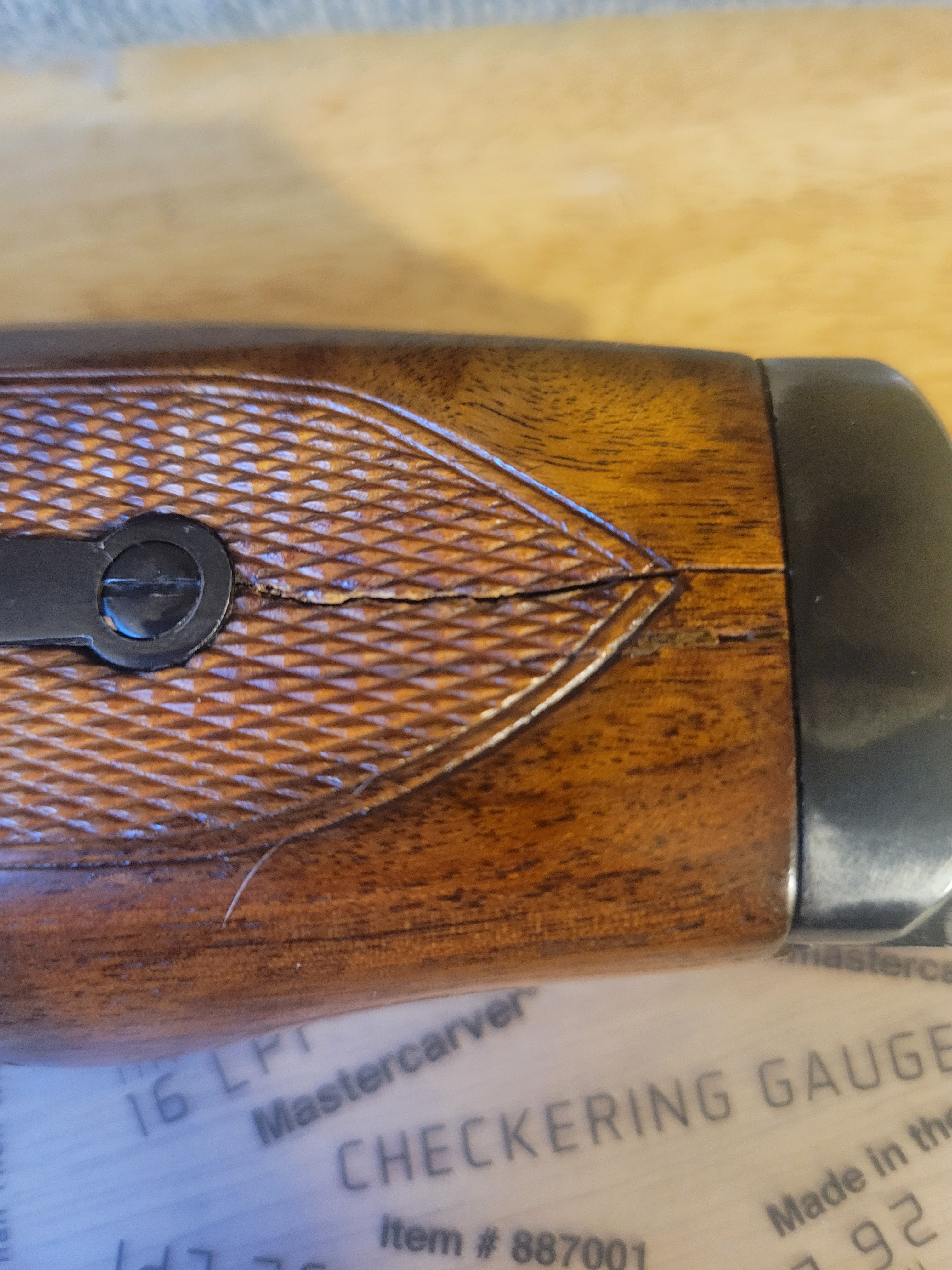
Now the bad news. When I unsafed the gun to measure its checkering, I saw the crack in the forearm wood emanating from the rear forearm iron mounting screw hole. This is new; wasn’t there when I bought the gun last year.
I suspect this occurred the first and only time I shot it. The very first shot left the forearm wood in my left hand and the gun high in recoil. My guess is I hadn’t secured the latch properly and the screw shaft was forced into the wood.
So, off to my gunsmith it goes. While it’s there, I’m going to have him disassemble the lockwork, check, clean and lube it as needed. Against the possibility that hasn’t been done for 79 years. My gunsmith works on Hollands and Purdeys, so I trust him to do the work.
Lou, its just like Roseann said….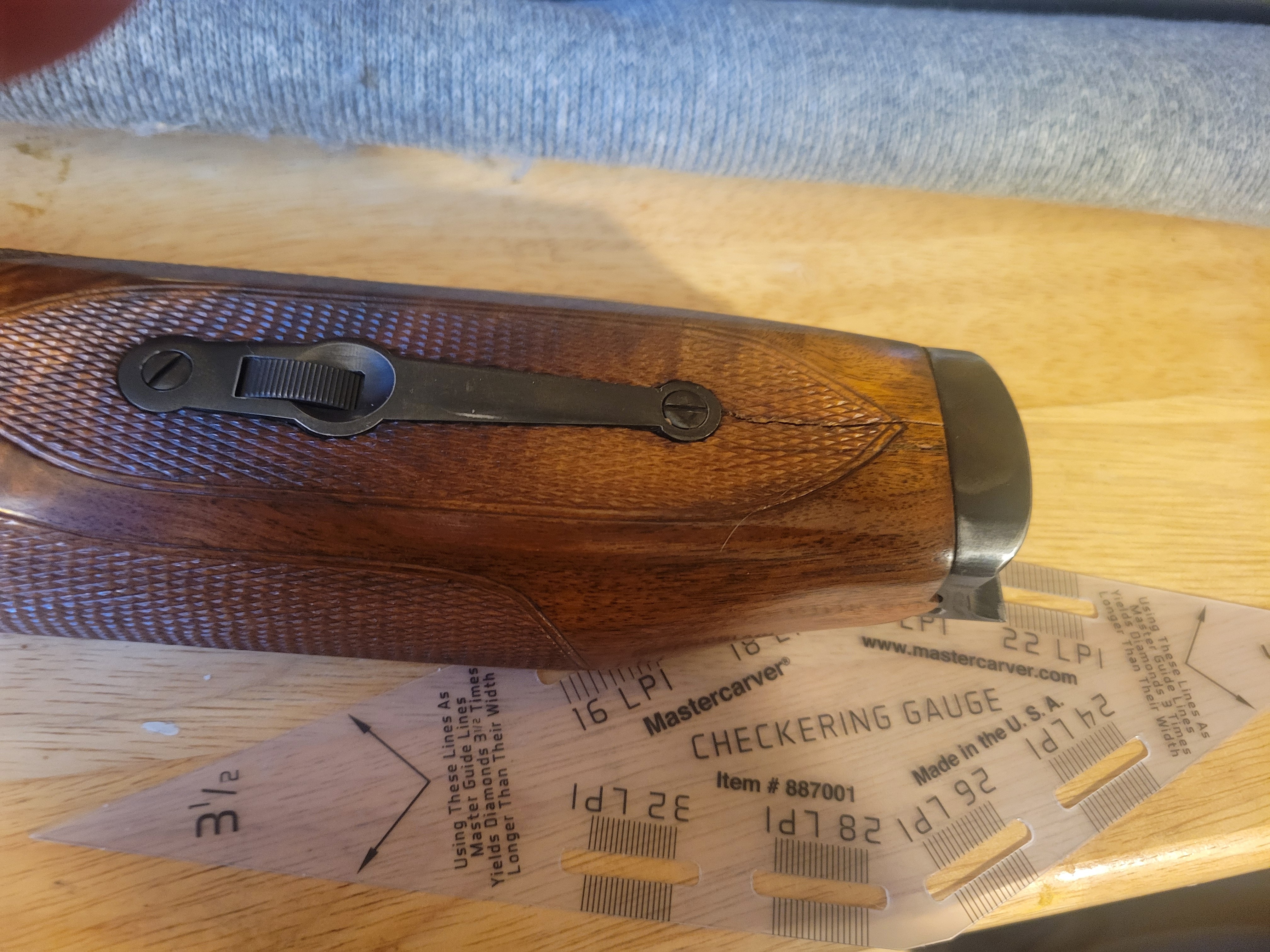
- Bill
WACA # 65205; life member, NRA; member, TGCA; member, TSRA; amateur preservationist
"I have seen wicked men and fools, a great many of both, and I believe they both get paid in the end, but the fools first." -- David Balfour, narrator and protagonist of the novel, Kidnapped, by Robert Louis Stevenson.

March 31, 2009
Offline
Zebulon said
According to Schwing, the standard checkering pattern on Model 21 stocks and forearms was diminished in 1946 from 20 LPI to 18 LPI.
The D.O.M. of my Skeet Gun is 1947, according to its Cody letter. Curious, I ordered a checkering gauge and both wrist and beavertail forearm are checkered at 22 lines per inch. Obviously, the employees who made the 21 had considerable leeway. I also suspect this gun’s furniture may have been done before Pearl Harbor. Again according to Schwing, a 1947 Skeet Model should have 28″ barrels and this one has the pre-1946 26″ set.
Now the bad news. When I unsafed the gun to measure its checkering, I saw the crack in the forearm wood emanating from the rear forearm iron mounting screw hole. This is new; wasn’t there when I bought the gun last year.
I suspect this occurred the first and only time I shot it. The very first shot left the forearm wood in my left hand and the gun high in recoil. My guess is I hadn’t secured the latch properly and the screw shaft was forced into the wood.
So, off to my gunsmith it goes. While it’s there, I’m going to have him disassemble the lockwork, check, clean and lube it as needed. Against the possibility that hasn’t been done for 79 years. My gunsmith works on Hollands and Purdeys, so I trust him to do the work.
Lou, its just like Roseann said….
Wood glue and a clamp, all done.
January 20, 2023
Offline
Chuck,
Yeah, and I’ve done a lot of glueups but somebody has to disassemble this piece first and then know how much clamp pressure will close the gap and not crack the piece into two pieces…. and then spot refinish and reassemble without buggering the screws.
I don’t mind admitting I paid more for this gun than for any other I own. Pass.
I’ll post pics of the repair when I get it back. And that’s the last 3.25 dram ammunition it will get fed during my custody. The gun would easily handle it but it counts on me to hang onto it.
Bill
- Bill
WACA # 65205; life member, NRA; member, TGCA; member, TSRA; amateur preservationist
"I have seen wicked men and fools, a great many of both, and I believe they both get paid in the end, but the fools first." -- David Balfour, narrator and protagonist of the novel, Kidnapped, by Robert Louis Stevenson.

November 7, 2015
Offline
Good call. Only a few ways to fix it right and a dozen ways to wreck it.
Mike
March 31, 2009
Offline
Zebulon said
Chuck,
Yeah, and I’ve done a lot of glueups but somebody has to disassemble this piece first and then know how much clamp pressure will close the gap and not crack the piece into two pieces…. and then spot refinish and reassemble without buggering the screws.
I don’t mind admitting I paid more for this gun than for any other I own. Pass.
I’ll post pics of the repair when I get it back. And that’s the last 3.25 dram ammunition it will get fed during my custody. The gun would easily handle it but it counts on me to hang onto it.
Bill
I was just talking about the forearm. How much has to come apart to get some glue into the crack?
January 20, 2023
Offline
Chuck, I don’t know the names of all the steel pieces in the forearm that are in inletted into the wood but I would want to make certain before I applied pressure to the edge of what is a fairly thin, highly figured piece of stump Walnut, that nothing i cant see is going to be forced into the wood that would act as a fulcrum or a splitter.
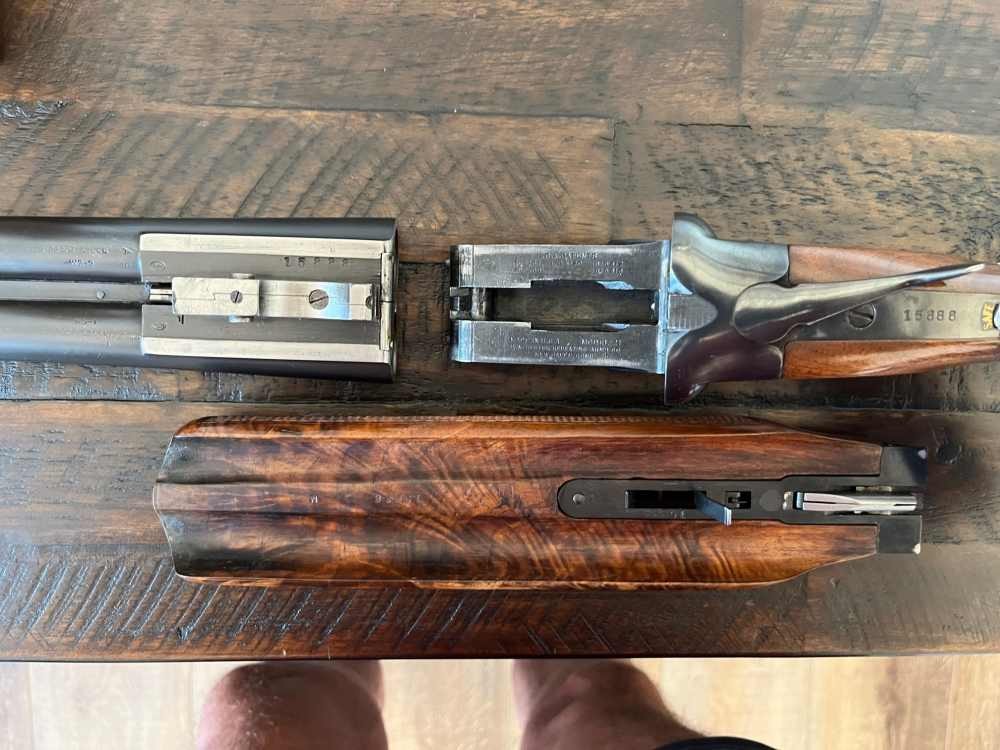
The method of forearm attachment is different than any Ive ever seen. The latch thumbpiece not only depresses but rolls forward. It is under tension from a flat spring that protrudes from the forearm vertically. The tip of the spring must engage a crevice in the steel hook of the barrel block.
I’ve since read the forearm can be cracked by incorrect assembly and I may have done just that.
In any event, I want to know what caused the crack and how to avoid repeating it. Ron will know the answers. He also has the skill to minimize the crack through checkering. Ive done that work on a Sweet 16 forearm but this job is well above my pay grade.
- Bill
WACA # 65205; life member, NRA; member, TGCA; member, TSRA; amateur preservationist
"I have seen wicked men and fools, a great many of both, and I believe they both get paid in the end, but the fools first." -- David Balfour, narrator and protagonist of the novel, Kidnapped, by Robert Louis Stevenson.
March 31, 2009
Offline
I have never picked up a Model 21 let alone messed with one. When I work on guns I try to stabilize the problem but try not to do any restoration. I would never mess with checkering.

April 30, 2023
Offline
Dang! I’m sorry that it cracked, that sucks…probably good that she’s going for some love anyways. Can’t wait to see the finished product!

August 8, 2024
Offline
Zebulon, There are plenty of examples of Winchesters made in 1947 assembled with Pre War parts.
January 20, 2023
Offline
Good evening, Bo. Thanks. I figured that was probably the case.
I’ve wondered if, as the War was winding down but Winchester was still under War Department restriction, the factory didn’t have idle hands that could quietly be kept busy building inventory for when VJ Day would come. The company had a lot of friends in the War Department.
After Germany fell but before Hiroshima, the AAC didn’t know what to do with my dad, an expert on heavy bomber electrical systems and loaned him out to various civilian, non-aviation-related businesses that needed somebody with mechanical skills. Mother was almighty grateful he wasn’t aircrew flying missions in the Pacific. I probably wouldn’t be here if he’d gotten what he wanted.
- Bill
WACA # 65205; life member, NRA; member, TGCA; member, TSRA; amateur preservationist
"I have seen wicked men and fools, a great many of both, and I believe they both get paid in the end, but the fools first." -- David Balfour, narrator and protagonist of the novel, Kidnapped, by Robert Louis Stevenson.
January 20, 2023
Offline
Zebulon said: …….. Now the bad news. When I unsafed the gun to measure its checkering, I saw the crack in the forearm wood emanating from the rear forearm iron mounting screw hole. This is new; wasn’t there when I bought the gun last year.
I suspect this occurred the first and only time I shot it. The very first shot left the forearm wood in my left hand and the gun high in recoil. My guess is I hadn’t secured the latch properly and the screw shaft was forced into the wood.
So, off to my gunsmith it goes. ………..
FEBRUARY 19, 2026 UPDATE
I took the Model 21 to Ron Gervase this morning. It took Ron all of about 15 seconds to diagnose the problem. He put an educated finger on the iron inside the inletting and traced the joint line of the iron with the Walnut, all around. The iron was badly inletted at the factory in such a way that, under repeated recoil, the iron would eventually gain running room and then eventually cause a split in the wood, which it did.
It was a relief to realize I had not improperly assembled the forearm to the barrels, which I’d worried I’d done. Ron confirmed I’d fitted the tip of the flat tensioning spring into the correct angle of the barrel hook.
Because my first shot separated the barrels from the forearm, I’d thought I’d not properly attached it. I now believe the separation was caused by the impact of the moving iron on the forward wood face of its inletting, under recoil.
I don’t know the round count of the gun or whether it was used in competition. From the condition of its bluing and checkering, I doubt it and believe it was more likely somebody’s lightly used quail gun, as many Skeet models were. As evidence it had been carried a lot more than shot, the only bluing wear is at the carry point.
Perhaps my use of 3.25 dram equivalent, 1500 f/s shells was the straw that broke the camel’s back. But it would eventually have happened anyway.
SOLUTION AND CONCLUSION
I’m surprised Winchester’s stock fitter messed up the inletting — there can be no question about it, once you see it. He did not achieve enough contact between the rear end edge of the iron with the mating face of the wood to stand up to repeated impact; the wood surface that was in contact was insufficient and eventually crushed, allowing a gap that became a channel for the iron end to batter the backset inletting face and split the wood.
Repairing the crack would not have solved the underlying problem, which would have recurred. The solution is to glass bed the iron and then repair the crack, which will solve the problem permanently. That will entail undercutting and removing additional wood below the visible surface of the forearm, to allow sufficient thickness of glass reinforced epoxy to which the iron can be bolted and immobilized in place.
All in all, it could have been a lot worse. The forearm is a really magnificent piece of colorful, flame-grained American Walnut. I shudder to think what it would cost to have a stockmaker match it.
I suppose an argument could be made that I should display the gun only rather than alter the flawed artistry of the “factory original” work. However, Schwing made the point that even collectors buy the Model 21 to shoot because it is so robust. If Winchester Repeating Arms Company still existed as a division of Olin Industries, I’d ask them to fix the gun and even pay them if they refused to admit faulty workmanship. However, the gun has outlived its maker.
Ron has repaired so many high-end English, Belgian and Italian doubles for enough Dallas hardgrabbers for long enough without getting shot or Infamous, that I trust him to do better than whoever at New Haven couldn’t find his [toolbox] with both hands.
I will display Ron’s work when I get the gun back. It will be awhile.
- Bill
WACA # 65205; life member, NRA; member, TGCA; member, TSRA; amateur preservationist
"I have seen wicked men and fools, a great many of both, and I believe they both get paid in the end, but the fools first." -- David Balfour, narrator and protagonist of the novel, Kidnapped, by Robert Louis Stevenson.
March 31, 2009
Offline
I’d be curious to know how he fixed the crack and the checkering.
January 20, 2023
Offline
I will show you the work as soon as I get it back and, as usual with Ron, he and I will have gone over materials and technique when he shows me the finished forearm.
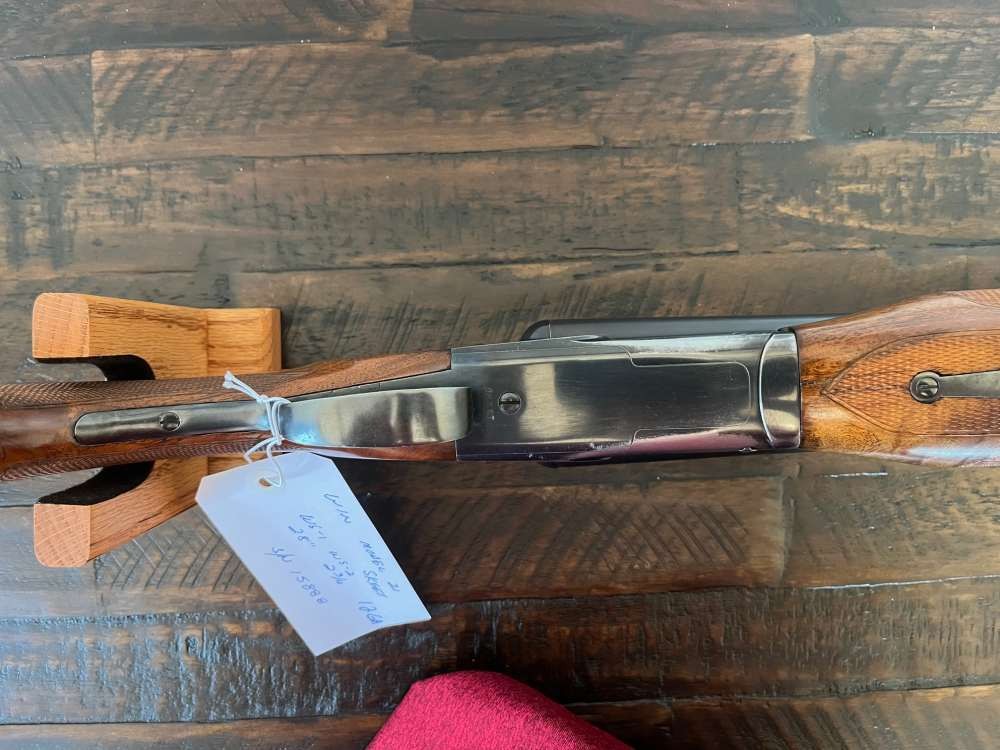
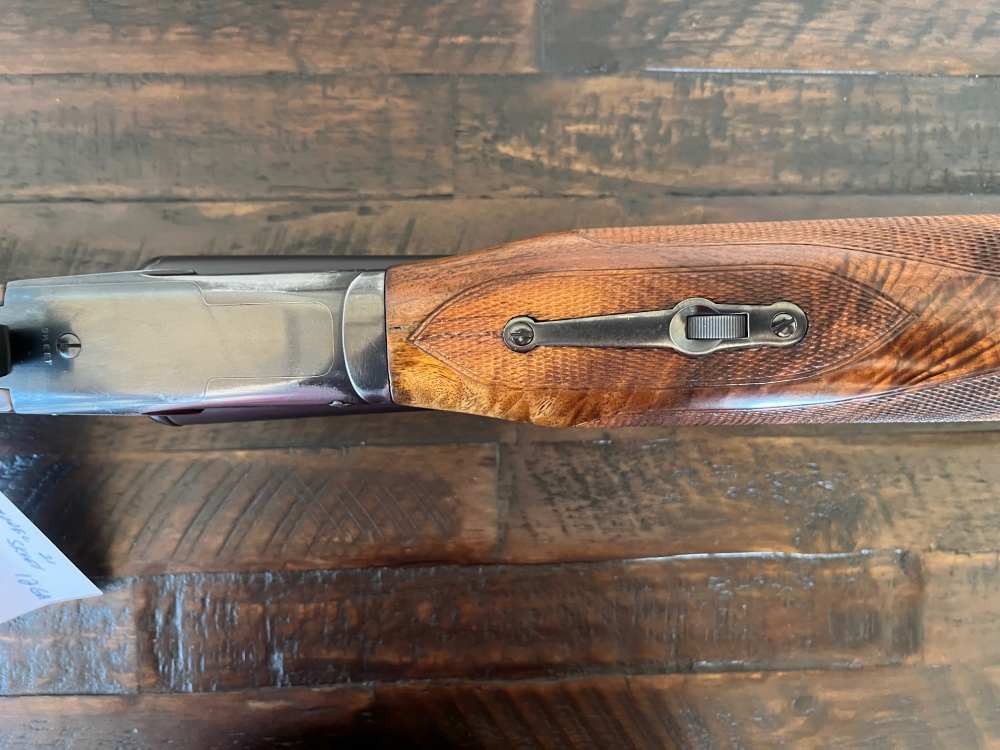
I do not expect the crack line to be invisible, either inside or outside the checkering panel. I think it can be diminished. The first three photos show the forearm as I bought the gun in September of last year. The fourth and last photos are closeups of the crack.
Chuck, when you see this, take a look at the earlier “pix” labeled photos. When enlarged, i think I can see a stress line where the crack later occurred.
- Bill
WACA # 65205; life member, NRA; member, TGCA; member, TSRA; amateur preservationist
"I have seen wicked men and fools, a great many of both, and I believe they both get paid in the end, but the fools first." -- David Balfour, narrator and protagonist of the novel, Kidnapped, by Robert Louis Stevenson.
April 30, 2023
Offline
Glad a plan was formed! Can’t wait to see the work…
November 7, 2015
Offline
Jeremy P said
Glad a plan was formed! Can’t wait to see the work…
Jeremy-
I suspect one hot day in the not-so-distant future we’ll be shooting a round of skeet with a very happy but cautious M21 owner.
Mike
January 20, 2023
Offline
TXGunNut said
Jeremy P said
Glad a plan was formed! Can’t wait to see the work…
Jeremy-
I suspect one hot day in the not-so-distant future we’ll be shooting a round of skeet with a very happy but cautious M21 owner.
Mike
Concur with all but the “not-so-distant.” The really talented gunsmiths – and Gervase is top shelf — are driven by a longing to achieve perfection. For them, to an extreme degree, “the work must say something about the man.” The expression “good enough” is not within their vocabulary and the only way they can avoid bankruptcy is to refuse work on which they could not achieve at least “excellence” without losing other customers.
To say they “take their time” glosses over the obsessiveness involved.
It is as if you told a great soloist musician not to worry about practicing for his next performance. “The audience doesn’t expect perfection” is a deadly insult.
- Bill
WACA # 65205; life member, NRA; member, TGCA; member, TSRA; amateur preservationist
"I have seen wicked men and fools, a great many of both, and I believe they both get paid in the end, but the fools first." -- David Balfour, narrator and protagonist of the novel, Kidnapped, by Robert Louis Stevenson.
November 7, 2015
Offline
I suspect you’ll be pleasantly surprised, Bill. He’s likely backed up but i suspect he’s efficient as well. I’m wondering how he’ll disguise the bedding material where it could be visible between the iron and wood. It also looks to me like oil has crept into what became a crack. I don’t think I’d notice either as the figure and contrast of the wood is quite distracting but I suspect he’ll address them in a fitting manner. Brings to mind the first custom gunsmith I patronized. He did custom guns in batches. He’d take in a number of pistols until he had 8-10, sometimes more. Then he would do one step at a time when he found the time amongst his general gunsmithing and R-word factory warranty repairs. Worked out for me, it was nice to have several months or a year to scrape together my nickels and dimes. His first job for me was a custom 1911 in the then popular IPSC style with an Armalloy finish for the princely sum of $350.
Mike
November 7, 2015
Offline
I suspect you’ll be pleasantly surprised, Bill. He’s likely backed up but i suspect he’s efficient as well. I’m wondering how he’ll disguise the bedding material where it could be visible between the iron and wood. It also looks to me like oil has crept into what became a crack. I don’t think I’d notice either as the figure and contrast of the wood is quite distracting but I suspect he’ll address them in a fitting manner. Brings to mind the first custom gunsmith I patronized. He did custom guns in batches. He’d take in a number of pistols until he had 8-10, sometimes more. Then he would do one step at a time when he found the time amongst his general gunsmithing and R-word factory warranty repairs. Worked out for me, it was nice to have several months or a year to scrape together my nickels and dimes. His first job for me was a custom 1911 in the then popular IPSC style with an Armalloy finish for the princely sum of $350.
Mike
January 27, 2018
Offline
Zeb,
In pix147959869.jpg the split is visible from the from the metal forearm catch plate to the border of the checkering. The high velocity ammo just finished the job. Winchester began inserting the forearm recoil screw and abutment to the front of forearm shoe to form a brace to eliminate forearm splitting.
Michael
March 31, 2009
Offline
What does the nose of the forend look like under the cap? Even the screw hole diameter may have contributed to the problem. My experience with stress analysis working in generating stations and refineries has taught me to respect what pressure and heat can do. The Engineers rent a program called Caesar. It will analyze all the stress points. It will put out a document that can be hundreds of pages. But that isn’t what was done years ago. I wonder what they did do?


