

 Log In


January 20, 2023
 Offline

During the final years of Model 101 production, Winchester made up (at its Olin Kodensha facility) some — nobody seems to know how many but Schwing wrote less than 5,000– Model 101 shotguns in 28 gauge on a smaller-than-twenty-gauge receiver, now known to collectors as the “baby” frame.
These were not the first or only 28 gauge versions of the Model 101 but the baby receiver was seemingly employed only on fairly late, Diamond Grade, Quail Special, Pigeon Grade Lightweight, and perhaps one or two other named, limited and relatively expensive versions of the 28 gauge 101.
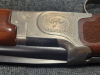
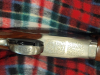
Early in the 21st Century I acquired a virtually new Pigeon Grade Lightweight 28 gauge Model 101, with 28″ Winchoke barrels, an “English” stock, and a factory cloth/leather hard case. A late model with a PK serial prefix. See the photos.
According to some sources, everything in the foregoing paragraph ticks the boxes for a “baby” frame gun — except the 28 inch barrels.
Then there’s the matter of receiver width and gun weight. I’ve read a baby 28 gauge should weigh between 6 and 6.5 pounds, although that’s for 26″ barrels. Measured just behind the fences, a baby receiver “should” be about 1.3 inches wide, whereas a standard 20 gauge receiver barreled to 28 gauge should be about 1.5 inches wide. In short, a two-tenths of an inch difference.
On my imperfect scale, my 2″ longer gun weighs a click under 7 pounds; and is 1.52 inches wide as measured by my General Instruments dial caliper.
Based on what those measurements say, I have to conclude my gun is built on the standard 20 gauge receiver.
But, before I give up on the notion and conclude i simply have a 28 gauge gun built on a 20 gauge frame — and not a “baby” with an unusually long barrel — I’d like to see what they look like side by side.
Do any of you have, that you would share with me, good, clear photographs comparing the two sizes of receiver, preferably including a dorsal [looking down on the top surfaces] view showing the relative bulk and width of the fences?
Any opinions and

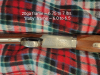
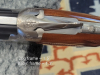 citations to references are welcome.
Thanks,
Bill
- Bill
WACA # 65205; life member, NRA; member, TGCA; member, TSRA; amateur preservationist
"I have seen wicked men and fools, a great many of both, and I believe they both get paid in the end, but the fools first." -- David Balfour, narrator and protagonist of the novel, Kidnapped, by Robert Louis Stevenson.

March 23, 2010
Offline
I have a 28 gauge Model 101 Quail Special.
January 20, 2023
Offline
Would you consider sharing a dorsal image of the receiver, with barrels installed?
I’m trying to get a baseline visualization of the proportion of the top barrel as it enters the receiver, to the lateral thickness of the fences. A 1/10th” increase in width per side seems almost undetectable.
- Bill
WACA # 65205; life member, NRA; member, TGCA; member, TSRA; amateur preservationist
"I have seen wicked men and fools, a great many of both, and I believe they both get paid in the end, but the fools first." -- David Balfour, narrator and protagonist of the novel, Kidnapped, by Robert Louis Stevenson.
July 15, 2015
Offline
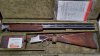
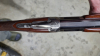
I have a 101 Pigeon Grade Lightweight with a straight/English stock. I’ve got the original paperwork including hang tag, a 28″ vent rib choked IC/Mod. It weighs 6 1/4lbs per hanging it off my trigger pull gauge, and is 1.47″ wide just below the lever pivot tapering to 1.41″ wide at the hinge pin. Despite being a “light weight” marked gun, the receiver still strongly attracts a magnet. I know the current production “light” 101s use an aluminum alloy receiver but I don’t know if any of the legacy ones did.

January 20, 2023
Offline
Good evening, Geoff. Thank you for taking your time to educate me. None of the Olin Kodensha made Model 101 or 23 Winchesters used aluminum receivers. The “Lightweight” guns were made lighter by reducing the amount of steel and Walnut where unnecessary for strength. For example, they often employed straight grips and did not employ beavertail forearms. The inter-barrel ribs were pierced instead of solid.
I’m going to study your images and compare the dimensions you furnish to those on my receiver.
Back soon.
Bill
- Bill
WACA # 65205; life member, NRA; member, TGCA; member, TSRA; amateur preservationist
"I have seen wicked men and fools, a great many of both, and I believe they both get paid in the end, but the fools first." -- David Balfour, narrator and protagonist of the novel, Kidnapped, by Robert Louis Stevenson.
January 20, 2023
Offline
Geoffrey A. Tomlinson said
I have a 101 Pigeon Grade Lightweight with a straight/English stock. I’ve got the original paperwork including hang tag, a 28″ vent rib choked IC/Mod. It weighs 6 1/4lbs per hanging it off my trigger pull gauge, and is 1.47″ wide just below the lever pivot tapering to 1.41″ wide at the hinge pin. Despite being a “light weight” marked gun, the receiver still strongly attracts a magnet. I know the current production “light” 101s use an aluminum alloy receiver but I don’t know if any of the legacy ones did.
Geoff, Here I am again and not sure what to think. Your gun is 3/4 pound lighter than mine, but receiver width measurements are almost the same. Where yours measures 1.47″ mine is 1.432″. At the hinge pin, yours is 1.41″ and mine is 1.382″. Visually, it looks like the fences are cut straight across and mine are radiused. You have a more expensive file-cut rib that is wider than my rib.
But I cannot see any difference in the scaling of the two actions. 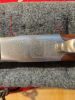
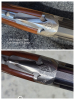
Of course, the point of the investigation is to see if my gun is built on the “baby” 28 gauge frame, which collectors have assigned a market value close to twice the amount of a 101 28 gauge built on the standard 20 gauge frame. My understanding is the Quail Special was built on the baby frame. I can’t account for the difference in weight but, vusually, the two receivers look the same. I don’t trust my judgement because it would be to my advantage to have my gun built on the baby frame.
I suppose I should try to find images of a “standard” 28 gauge 101 and see if a comparison collage reveals anything. If so, I’ll return to this post.
Geoff, Thanks again so much for helping. (Just got off the phone with your Dad. We didn’t solve all the World’s problems, yet)
Best Regards,
Bill
- Bill
WACA # 65205; life member, NRA; member, TGCA; member, TSRA; amateur preservationist
"I have seen wicked men and fools, a great many of both, and I believe they both get paid in the end, but the fools first." -- David Balfour, narrator and protagonist of the novel, Kidnapped, by Robert Louis Stevenson.
November 7, 2015
Offline
Beautiful guns! Glad I’m not too fickle to enjoy them at face value. I’ve never had a 28 but based on my little 20 I suspect there’s not a better bore for skeet. I’m too tight to buy 28ga ammo so any shotgun so chambered would arrive shortly before a progressive loader and a generous supply of components.
Mike
January 20, 2023
Offline
I’ve always said the Model 101 was underrated, particularly after Winchester began to introduce the “better than field grade” cased editions. However, all the specimens I’ve handled have shown great care in assembling and finishing. The engine turned action parts are cleanly executed and the checkering on the Pigeon Grade models is excellent.
I’ve heard derisory comments about “phony etched ‘engraving'” and I don’t know how much of the Pigeon Grade engraving was done by hand, although some of it obviously was and handsomely done, too. The scroll work looks good to me, however it was done.
Don’t take the selective single trigger and selective ejection for granted, either. It works just fine on mine. Not all Euro guns can say the same. The better Spanish guns I’ve seen are fine but I would buy them with double triggers.
The subgauge 101 was a bargain.
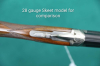
I’ve attached an image of a 101 28 gauge Skeet gun, one I’m reasonably sure was made on a 20 gauge frame. Frankly, the physical difference is too subtle for me to see in these images. I expect picking them up in comparison would reveal the differences. Ive also attached an image of a standard 101 20 gauge. 
- Bill
WACA # 65205; life member, NRA; member, TGCA; member, TSRA; amateur preservationist
"I have seen wicked men and fools, a great many of both, and I believe they both get paid in the end, but the fools first." -- David Balfour, narrator and protagonist of the novel, Kidnapped, by Robert Louis Stevenson.
August 2, 2021
Offline
Hi Bill, I have a large 101 collection. I am in Canada and have completed much research on the topic.
If you wish to call me we can discuss. The 101’s are difficult to find research on as Winchester destroyed the serial #’s and paperwork prior to selling the factory to Classic Doubles in last 1987. The Blue book of values only carries 1966-1968 due to this fact. I believe I have the last Baby Frame produced.
Rodney Buzan
my email
January 20, 2023
Offline
Rodney, thanks and I would very much like to talk to you. I am going in circles and can’t decide what I’ve got. The differences between the standard and the baby frame must be subtle because I have compared photos and have taken measurements and nothing jumps out at me.
Would you have time to take a call tomorrow evening — just name the time. I’ll have the gun out and whatever data I’ve accumulated.
I’ll email particulars.
Bill
- Bill
WACA # 65205; life member, NRA; member, TGCA; member, TSRA; amateur preservationist
"I have seen wicked men and fools, a great many of both, and I believe they both get paid in the end, but the fools first." -- David Balfour, narrator and protagonist of the novel, Kidnapped, by Robert Louis Stevenson.
January 20, 2023
Offline
Well, after consulting with Rodney, who has in inventory a number of “Baby” receiver 28 gauge 101 models and extensive knowledge about the production history of these rare little guns, I’ve learned how you can easily distinguish between the Standard 28 gauge receiver [which is actually just the 20 gauge receiver] and the “Baby” 28 gauge receiver, a frame scaled down to the smaller barrel set. Rodney has studied some surviving records obtained from a former Olin-Kodensha engineer and believes only about 300 of the Baby frame guns were ever made.
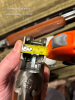
Here are two phographs Rodney made for me that I’ve annotated, illustrating a critical measurement that will establish conclusively whether a Model 101 28 gauge gun is built on the Standard or the Baby receiver. As you can see, it can be done with a good tape or a dial indicator.
With the barrels off, measure the width of the receiver at the point shown. The Standard receiver is approximately a quarter-inch wider.
The illustrated Standard receiver is 1 12/32″ [1.375″ or 3.45 cm].
The illustrated Baby receiver is 1 5/32″ [1.156″ or 2.95 cm].
To conclude, even though my gun has a PK280 serial prefix, is a “Lightweight”, and the barrels are Winchoke barrels (Rodney says all the Babys have Winchokes) — it is a Standard, not a Baby. It mikes 1.365 across (not illustrated), using my General Ultratest dial indicator.
While this difference might seem almost nominal, remember the entire receiver is proportionately smaller and, side by side, the visual difference would be apparent. The difficulty is finding a Baby for the comparison. Rodney showed me two NiC Baby 28s, so he is the man to see if you want one. [email protected] will reach him. He’s a Forum and WACA member. 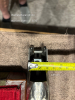
- Bill
WACA # 65205; life member, NRA; member, TGCA; member, TSRA; amateur preservationist
"I have seen wicked men and fools, a great many of both, and I believe they both get paid in the end, but the fools first." -- David Balfour, narrator and protagonist of the novel, Kidnapped, by Robert Louis Stevenson.


