

 Log In


January 31, 2026
 Offline


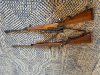

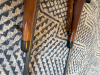
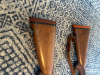
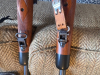
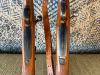 The sling swivel placement changes are interesting to me and since I have the rifles out I figured I would try and show them.
 the earlier rifle is serial# 12544 and the later is #58172

November 5, 2014
Offline
Hi winchester 71-
That change appears to have occurred in early 1938, around s/n 12,000-14,000. I believe that they encountered a problem with wood splitting between the front of the swivel base and the black fore end tip, so they moved the base back about 5/8th inch. Of course the “early” stocks appear sporadically throughout about 1939, but the “later” stocks don’t show up until early 1938 (so a fair amount of overlap).
For unknown reasons, Roger Rule did not point this change out in his book…
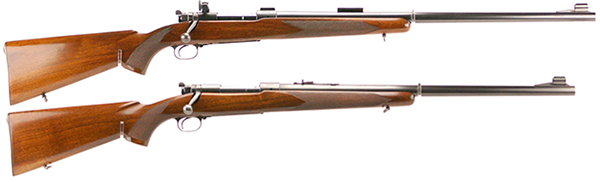
An interesting aside is that the “early” stocks can have either 18-line or 20-line checkering. Rule claims that only 20-line is correct on a pre-war Super Grade, while Whitaker says that both were used depending on the checkerer and character of the wood. In my mind, the swivel position “dates” the stock better than the serial number of the gun it’s on (due to rampant “upgrading”). Here’s a gun (of mine) that I believe is a legit early 30 GOV’T’06 Super Grade with the early swivel position. In has the coarser checkering… OTOH, two other’s I have with the early stock have 20-line checkering; S/Ns 13264 (375 MAGNUM) and 26401 (22 HORNET).
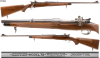
What’s your experience?
BTW… If you don’t mind saying, what are S/Ns 12544 and 58172 chambered for?
Best,
Lou
WACA 9519; Studying Pre-64 Model 70 Winchesters

January 20, 2023
Offline
Is the earlier rifle the one with the darker colored stock?
I have a 1950 Super Grade 30 Govt 06, the finish of which is quite dark. (With recoil pad).
C.f. the “hybrid” custom on the right that is a 1948 standard grade Model 70, rebarreled to 22-250 with a heavy custom SAKO barrel and fitted with a 1954 high comb Super Grade stock. All work by Nagel of San Antonio. Stock finish appears to be original but surely must have been touched up when the inletting was enlarged to bed the heavier barrel. .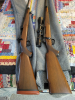
- Bill
WACA # 65205; life member, NRA; member, TGCA; member, TSRA; amateur preservationist
"I have seen wicked men and fools, a great many of both, and I believe they both get paid in the end, but the fools first." -- David Balfour, narrator and protagonist of the novel, Kidnapped, by Robert Louis Stevenson.
January 31, 2026
Offline
Hi winchester 71-
That change appears to have occurred in early 1938, around s/n 12,000-14,000. I believe that they encountered a problem with wood splitting between the front of the swivel base and the black fore end tip, so they moved the base back about 5/8th inch. Of course the “early” stocks appear sporadically throughout about 1939, but the “later” stocks don’t show up until early 1938 (so a fair amount of overlap).
For unknown reasons, Roger Rule did not point this change out in his book…
An interesting aside is that the “early” stocks can have either 18-line or 20-line checkering. Rule claims that only 20-line is correct on a pre-war Super Grade, while Whitaker says that both were used depending on the checkerer and character of the wood. In my mind, the swivel position “dates” the stock better than the serial number of the gun it’s on (due to rampant “upgrading”). Here’s a gun (of mine) that I believe is a legit early 30 GOV’T’06 Super Grade with the early swivel position. In has the coarser checkering… OTOH, two other’s I have with the early stock have 20-line checkering; S/Ns 13264 (375 MAGNUM) and 26401 (22 HORNET).What’s your experience?
BTW… If you don’t mind saying, what are S/Ns 12544 and 58172 chambered for?
Best,
Lou
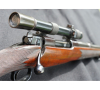
I also believe that the checkering can vary between 18 and 20 lpi. There’s another more flamboyant style of checkering on some that I have seen which tells me that perhaps Winchester gave the employee a certain amount of artistic license when it came to the checkering.
both of those model 70s are in 270
January 31, 2026
Offline
Zebulon said
Is the earlier rifle the one with the darker colored stock?
I have a 1950 Super Grade 30 Govt 06, the finish of which is quite dark. (With recoil pad).
C.f. the “hybrid” custom on the right that is a 1948 standard grade Model 70, rebarreled to 22-250 with a heavy custom SAKO barrel and fitted with a 1954 high comb Super Grade stock. All work by Nagel of San Antonio. Stock finish appears to be original but surely must have been touched up when the inletting was enlarged to bed the heavier barrel. .l
Nice rifle! Yes the darker one is 58172.

August 8, 2024
Offline
Well, I’m gonna have to agree with Roger Rule on the 20 lines per inch. Until 1941 anyways. To each there own. But, if I see a Model 70 with 18 lines per inch that was made before 1941 I would have concerns.
January 20, 2023
Offline
Bo, I can’t argue with you about a Model 70 but I can tell about my experience that convinced me factory change order dates are not always dispositive of originality.
Schwing, in his Model 21 treatise, wrote that the standard checkering pattern of the model was changed from 20 LPI in 1946 to a coarser 18 LPI.
My Skeet Gun was made in 1947 but clearly is cut at 20 LPI. Because even these Production Era guns were all de facto made in the Custom Shop — mine was made “for stock” and not to order — perhaps its employees did what they pleased, but still the gun itself contradicts Schwing.
My understanding of the standard Field, Skeet, Trap, and Duck models is they shared a common checkering pattern and were not catalogued as being made with higher grade Walnut. Although my Cody letter notes a “Skeet Finish” it doesn’t mention an upgrade in the wood itself. Nevertheless, as the photos show, the Walnut is well above straight-graiin field grade. 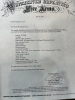
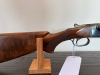
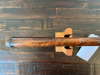
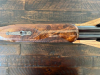
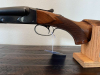
I’ve examined a number of Model 21 field grade guns made in the Eighties and early Nineties before the sale to Galazan/CSC. The wood was of good quality but nothing spectacular. These anomalies compel me to conclude there was less than complete compliance with gun department paper.
- Bill
WACA # 65205; life member, NRA; member, TGCA; member, TSRA; amateur preservationist
"I have seen wicked men and fools, a great many of both, and I believe they both get paid in the end, but the fools first." -- David Balfour, narrator and protagonist of the novel, Kidnapped, by Robert Louis Stevenson.
August 8, 2024
Offline
Zebulon, This is what I have found. All my Winchesters made before 1941 have 20 lines per inch checkering. I don’t own a lot of them. But My Model 21, 54s, 70s, and 71 all have this feature. I respect Louis’s concern with his Super Grade. He makes a valid claim. I just have not experienced a Winchester made before 1941 with the 18 lines per inch checkering.
November 5, 2014
Offline
Hi Bob and Zeb-
I understand your concerns… I have discussed this Super Grade checkering issue with a couple well known M70 dealers who have handled a bunch of them… You can easily guess whom I’ve talked to, but I don’t want to put words into their mouths…  I like to hear other’s opinions…
There’s no doubt in my mind that “all” the Pre-War and quite a few Transition STANDARD grade M70 stocks were done in 20-line checkering… As for Super Grades, with the more difficult wrap-around checkering, the question is a valid one… Rule says one thing, Whitaker another… So far the survey agrees with Whitaker… For better or worse, my gun (pictured above) is not a one-off… The way I figure it is that either some early (based on front swivel position) SG stocks had the coarser checkering OR that the early swivel position was used MUCH later in production (post-1941) than I think it was OR that early swivel position guns with coarse checkering (like my example) were sanded off and re-checkered in 18-line…
At the end of the day, I won’t buy a 1st year Super Grade with the later swivel position (regardless of checkering density) and you won’t buy a pre-war Super Grade with 18-line checkering (regardless of swivel position?)… “You pays your money and takes your choice”… It’s ALL GOOD!!!
Lou
WACA 9519; Studying Pre-64 Model 70 Winchesters
January 20, 2023
Offline
Now you guys have done it! My pre–64 guns are all postwar so I am going to have to break out my checkering scale, if I can find it.
“Well, Jane, it’s always something. If it’s not that little piece of meat that’s still between your teeth after you brush…..”
— R. Rosanadana
- Bill
WACA # 65205; life member, NRA; member, TGCA; member, TSRA; amateur preservationist
"I have seen wicked men and fools, a great many of both, and I believe they both get paid in the end, but the fools first." -- David Balfour, narrator and protagonist of the novel, Kidnapped, by Robert Louis Stevenson.
August 4, 2023
Offline
Louis Luttrell said
Hi Bob and Zeb-
I understand your concerns… I have discussed this Super Grade checkering issue with a couple well known M70 dealers who have handled a bunch of them… You can easily guess whom I’ve talked to, but I don’t want to put words into their mouths… I like to hear other’s opinions…
There’s no doubt in my mind that “all” the Pre-War and quite a few Transition STANDARD grade M70 stocks were done in 20-line checkering… As for Super Grades, with the more difficult wrap-around checkering, the question is a valid one… Rule says one thing, Whitaker another… So far the survey agrees with Whitaker… For better or worse, my gun (pictured above) is not a one-off… The way I figure it is that either some early (based on front swivel position) SG stocks had the coarser checkering OR that the early swivel position was used MUCH later in production (post-1941) than I think it was OR that early swivel position guns with coarse checkering (like my example) were sanded off and re-checkered in 18-line…
At the end of the day, I won’t buy a 1st year Super Grade with the later swivel position (regardless of checkering density) and you won’t buy a pre-war Super Grade with 18-line checkering (regardless of swivel position?)… “You pays your money and takes your choice”… It’s ALL GOOD!!!
Lou
If the stock was damaged, or developed a crack, would Winchester install a new stock for the wealthy owner that ordered a Super Grade in the 1st place? Then if they did those requests would they also make a stock for an early rifle when they were no longer making those early receivers? If they did that it would explain the 18 line checkering found on early rifles.
November 5, 2014
Offline
Hi triggerhappy-
Super Grade stocks (and floor plates) were in the contemporary Parts catalogs, so replacements could be purchased directly. Here’s a partial clip from the 1939 Parts Catalog showing that you could order a replacement Super Grade stock without returning the rifle.
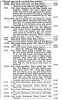
I could imagine that if a customer did send a rifle back for a new stock, that Winchester would replace it from Parts inventory, not make it up from scratch, except perhaps if the customer ordered a new/replacement stock in select walnut. From 1936 until 1947, Model 70 stocks were inlet for the Type I/II cloverleaf tang receiver. The earliest Type III oval tang receivers appeared in 1948 around s/n 88,000. I’d imagine that Winchester kept some old cloverleaf stocks in inventory for any R&R requests on pre-war guns that were received after 1948, and still wouldn’t have to make one from scratch (but, of course, they had the capacity to do so).
Unfortunately, I have not (yet) located a pre-war factory blueprint for the Super Grade stock. The big prize there would be the dated “Revision” notes at the bottom, because there would most likely have been a revision when the front swivel position was moved back, and there might be something about checkering density. Until something solid emerges, my practice is to “date” Type I Super Grade stocks (“early” versus “late”) based on the front swivel position, not the 20-line versus 18-line difference…
On Standard Grade stocks, the checkering was originally 20-line. The change to 18-line was (according to Roger Rule) authorized in 1940/41, so stocks made after that date would have probably been 18-line. But there must have been a healthy inventory of finished stocks on-hand during the lead up to WWII, because the 18-line checkered standard stocks don’t really become commonplace until you get into the Type II (Transition) guns in 1946, and even then it’s a mixture of 20-line and 18-line for quite a while.
Best,
Lou
P.S. Only Zeb could find a way to bring Gilda Radner into a discussion of Model 70 stocks!!!
WACA 9519; Studying Pre-64 Model 70 Winchesters
August 8, 2024
Offline
Yes, and Louis informed me on a .257 Roberts made in 1948. That I bought at the WACA/OGCA show last September. It has a type 1 stock (20 LPI), Type 2 Receiver (dolls head tang), and a Type 3 safety. I call it my Type 1 2 3 Model 70. Did not know about this. Until I talked to Louis. He is right. Winchester did not throw things away! This must of been a clean up after the War.
January 7, 2014
Offline
Louis Luttrell said
Hi winchester 71-
That change appears to have occurred in early 1938, around s/n 12,000-14,000. I believe that they encountered a problem with wood splitting between the front of the swivel base and the black fore end tip, so they moved the base back about 5/8th inch. Of course the “early” stocks appear sporadically throughout about 1939, but the “later” stocks don’t show up until early 1938 (so a fair amount of overlap).
For unknown reasons, Roger Rule did not point this change out in his book…
An interesting aside is that the “early” stocks can have either 18-line or 20-line checkering. Rule claims that only 20-line is correct on a pre-war Super Grade, while Whitaker says that both were used depending on the checkerer and character of the wood. In my mind, the swivel position “dates” the stock better than the serial number of the gun it’s on (due to rampant “upgrading”). Here’s a gun (of mine) that I believe is a legit early 30 GOV’T’06 Super Grade with the early swivel position. In has the coarser checkering… OTOH, two other’s I have with the early stock have 20-line checkering; S/Ns 13264 (375 MAGNUM) and 26401 (22 HORNET).What’s your experience?
BTW… If you don’t mind saying, what are S/Ns 12544 and 58172 chambered for?
Best,
Lou
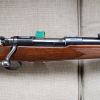
 Lou,
Lou,
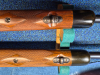
To add to your statement that the early stocks could be seen throughout 1939. The bottom stock is S/N 23275 (1939). I think the checkering is 20 LPI. I have no way of measuring it other than comparing stocks.
The top stock is S/N 121991 (1949)
RR


