

 Log In


March 23, 2007
 Offline

Saw these firearms on the Poulin auction site. Seeking forum opinions.
20” version in 38-55
https://bid.poulinauctions.com/item.aspx?i=59096736
20” in 32-40

April 15, 2005
Offline
What are the serial numbers on those 20-inch Rifles?
WACA Historian & Board of Director Member #6571L
March 23, 2007
Offline
Bert H. said
What are the serial numbers on those 20-inch Rifles?
That’s a good question. When I was initially viewing them it had a decent item description with serial numbers and condition. Now when I click on the link it just shows the lot number with a few photos. I tried to navigate back to the former without success.
April 15, 2005
Offline
At this point, I see nothing about either of them that alarms me, but when the caliber is taken into consideration, that in of itself is cause for a much closer examination. What I will say at this point, is that both of them need to be pre-1938 production rifles. Winchester discontinued the 32-40 and 38-55 as of January 1938.
Bert
WACA Historian & Board of Director Member #6571L

August 14, 2021
Offline
Cal. 38-55. S#. 1107691. Bbl. 20″ round. Hooded ramp bead front with sporting rear sight. 2/3 length mag. Blue finish. Semi beavertail forend & pistol grip walnut stock with checkered steel buttplate. S#. indicates 1927 mfg. CONDITION: over 90% original blue shows spots flaking to brown. Very good original wood finish shows scattered light marks. Bright near excellent bore. (25-1385/DS). CURIO. $2,000-3,000.
Cal. 32-40. S# 1116955. Mfg. 1936, Bbl. 20″ hooded bead front sight on a short stippled ramp. Elevator adjustable sporting rear sight. Plain trigger. “L533” on the lower tang. Smooth pistol grip walnut stock set with “C203” found in the top tang channel and a checkered steel butt plate. CONDITION: overall good with lightly thinning bbl finish that remains with 80-85% coverage that has spotty freckled oxidation moderately covering the length of the bbl. Receiver has light carry wear with 90% of its original finish. Stock has scattered handling marks and dents with light scratches. Very nice bright bore with sharp rifling. (25-1389/ZAL). CURIO. $1,000-1,500.
June 12, 2013
Offline
Steven Gabrielli said
Cal. 38-55. S#. 1107691. Bbl. 20″ round. Hooded ramp bead front with sporting rear sight. 2/3 length mag. Blue finish. Semi beavertail forend & pistol grip walnut stock with checkered steel buttplate. S#. indicates 1927 mfg. CONDITION: over 90% original blue shows spots flaking to brown. Very good original wood finish shows scattered light marks. Bright near excellent bore. (25-1385/DS). CURIO. $2,000-3,000.
Cal. 32-40. S# 1116955. Mfg. 1936, Bbl. 20″ hooded bead front sight on a short stippled ramp. Elevator adjustable sporting rear sight. Plain trigger. “L533” on the lower tang. Smooth pistol grip walnut stock set with “C203” found in the top tang channel and a checkered steel butt plate. CONDITION: overall good with lightly thinning bbl finish that remains with 80-85% coverage that has spotty freckled oxidation moderately covering the length of the bbl. Receiver has light carry wear with 90% of its original finish. Stock has scattered handling marks and dents with light scratches. Very nice bright bore with sharp rifling. (25-1389/ZAL). CURIO. $1,000-1,500.
My opinion if these rifles are original they are extremely undervalued. It appears most on auction I would be interested in are also undervalued. I suspect it is to create bidding actvity. I always wish they would provide more photos.
April 15, 2005
Offline
Steven Gabrielli said
Cal. 38-55. S#. 1107691. Bbl. 20″ round. Hooded ramp bead front with sporting rear sight. 2/3 length mag. Blue finish. Semi beavertail forend & pistol grip walnut stock with checkered steel buttplate. S#. indicates 1927 mfg. CONDITION: over 90% original blue shows spots flaking to brown. Very good original wood finish shows scattered light marks. Bright near excellent bore. (25-1385/DS). CURIO. $2,000-3,000.
Cal. 32-40. S# 1116955. Mfg. 1936, Bbl. 20″ hooded bead front sight on a short stippled ramp. Elevator adjustable sporting rear sight. Plain trigger. “L533” on the lower tang. Smooth pistol grip walnut stock set with “C203” found in the top tang channel and a checkered steel butt plate. CONDITION: overall good with lightly thinning bbl finish that remains with 80-85% coverage that has spotty freckled oxidation moderately covering the length of the bbl. Receiver has light carry wear with 90% of its original finish. Stock has scattered handling marks and dents with light scratches. Very nice bright bore with sharp rifling. (25-1389/ZAL). CURIO. $1,000-1,500.
S/N 1107691 – May 1936
S/N 1116955 – October 1936
I have both of them documented in the survey, and with no negative issues noted. Pending an “in hand” inspection, both of those “rare” Model 64 20-inch rifles appear to be legit.
And Yes, the value estimates are way too low for them.
Bert
WACA Historian & Board of Director Member #6571L
February 17, 2022
Offline
Did 64’s of that vintage have D&T holes for a receiver sight as these do?
December 21, 2006
Offline
Yes, most but not all.
W.A.C.A. life member, Marlin Collectors Assn. charter and life member, C,S.S.A. member and general gun nut.

January 20, 2023
Offline

My understanding of the Model 64’s design is Townsend Whelen had a lot to do with it and the difference in the feel of the gun from that of a Model 55 is notable. The Colonel was a target shooter and his taste ran to wider buttplates, higher and thicker combs, more substantial pistol grips, and semi-beavertail forearms.
What I can’t understand is why WRA implemented some but not all of those features on the standard grade M64. Until – I think – post WWII, the standard grade guns lacked the semi-beavertail forearm of the Deer Rifle. Maybe obsolete parts consumption was the reason in both cases.
The skinny forearm wasn’t as bothersome on the full length barrel guns but it made the 20″ version so muzzle light that holding on a target offhand, particularly without a shooting sling, was uncommonly difficult. I once owned and hunted with a 1937 20″ standard grade .30 and sold it for that reason.
Tom has a short Deer Rifle anybody would covet and I’d be curious to know his experience. I’d bet a donut it hangs better.
I’d guess the two guns at auction are rare because they were poorly conceived and few bought them..
- Bill
WACA # 65205; life member, NRA; member, TGCA; member, TSRA; amateur preservationist
"I have seen wicked men and fools, a great many of both, and I believe they both get paid in the end, but the fools first." -- David Balfour, narrator and protagonist of the novel, Kidnapped, by Robert Louis Stevenson.
April 15, 2005
Offline
oldcrankyyankee said
Did 64’s of that vintage have D&T holes for a receiver sight as these do?
As I discussed in my article found here – Winter 2023 (winchestercollector.org), the very early production Model 64 rifles were not factory drilled & tapped for a Lyman No. 56 receiver sight, but by August of 1933, sight mounting holes were drilled & tapped as standard. When the 219 Zipper cartridge was first introduced in late 1936, Winchester omitted the receiver holes on most of the early rifles in that cartridge (those with a No. 98A bolt-peep sight), but then went back to including them approximately a year or two later.
The fatter (beavertail) forend stocks were implemented well before WW II. The earlier production beavertail forends were not as pronounced (fat) as the post-WW II production rifles.
Bert
WACA Historian & Board of Director Member #6571L
January 20, 2023
Offline
Bert H. said
The fatter (beavertail) forend stocks were implemented well before WW II. The earlier production beavertail forends were not as pronounced (fat) as the post-WW II production rifles.
Bert
Bert, if I understand you correctly, there must have been three distinct forearm patterns for the Model 64, over time. A skinny one and two semi-beavertails.
Were the earlier production semi–beavertails limited to the Deer Rifle?
I once owned a 1949 Standard grade, the stock and forearm of which were identical (except for being uncheckered) to those on my present Deer Rifle of the same year. I was never sure whether the fat forearm on the former was ordinary production or special order because it also wore Super Grade swivel bases.
I’ve seen both versions of the beavertail forearm and thought the difference might have been because of a change of multiple spindle stock shaping equipment.
Bill
- Bill
WACA # 65205; life member, NRA; member, TGCA; member, TSRA; amateur preservationist
"I have seen wicked men and fools, a great many of both, and I believe they both get paid in the end, but the fools first." -- David Balfour, narrator and protagonist of the novel, Kidnapped, by Robert Louis Stevenson.
April 15, 2005
Offline
Zebulon said
Bert H. said
The fatter (beavertail) forend stocks were implemented well before WW II. The earlier production beavertail forends were not as pronounced (fat) as the post-WW II production rifles.
Bert
Bert, if I understand you correctly, there must have been three distinct forearm patterns for the Model 64, over time. A skinny one and two semi-beavertails.
Were the earlier production semi–beavertails limited to the Deer Rifle?
I once owned a 1949 Standard grade, the stock and forearm of which were identical (except for being uncheckered) to those on my present Deer Rifle of the same year. I was never sure whether the fat forearm on the former was ordinary production or special order because it also wore Super Grade swivel bases.
I’ve seen both versions of the beavertail forearm and thought the difference might have been because of a change of multiple spindle stock shaping equipment.
Bill
Yes, there were three forend stock patterns. The beavertail forend stocks found on the pre-WW II Model 64 rifles were slimmer in profile than the post-war stocks. No, the earlier beavertail forends were not limited to the Deer Rifles only.
Bert
WACA Historian & Board of Director Member #6571L
April 1, 2005
Offline
antler1 said
Steven Gabrielli said
Cal. 38-55. S#. 1107691. Bbl. 20″ round. Hooded ramp bead front with sporting rear sight. 2/3 length mag. Blue finish. Semi beavertail forend & pistol grip walnut stock with checkered steel buttplate. S#. indicates 1927 mfg. CONDITION: over 90% original blue shows spots flaking to brown. Very good original wood finish shows scattered light marks. Bright near excellent bore. (25-1385/DS). CURIO. $2,000-3,000.
Cal. 32-40. S# 1116955. Mfg. 1936, Bbl. 20″ hooded bead front sight on a short stippled ramp. Elevator adjustable sporting rear sight. Plain trigger. “L533” on the lower tang. Smooth pistol grip walnut stock set with “C203” found in the top tang channel and a checkered steel butt plate. CONDITION: overall good with lightly thinning bbl finish that remains with 80-85% coverage that has spotty freckled oxidation moderately covering the length of the bbl. Receiver has light carry wear with 90% of its original finish. Stock has scattered handling marks and dents with light scratches. Very nice bright bore with sharp rifling. (25-1389/ZAL). CURIO. $1,000-1,500.
My opinion if these rifles are original they are extremely undervalued. It appears most on auction I would be interested in are also undervalued. I suspect it is to create bidding actvity. I always wish they would provide more photos.
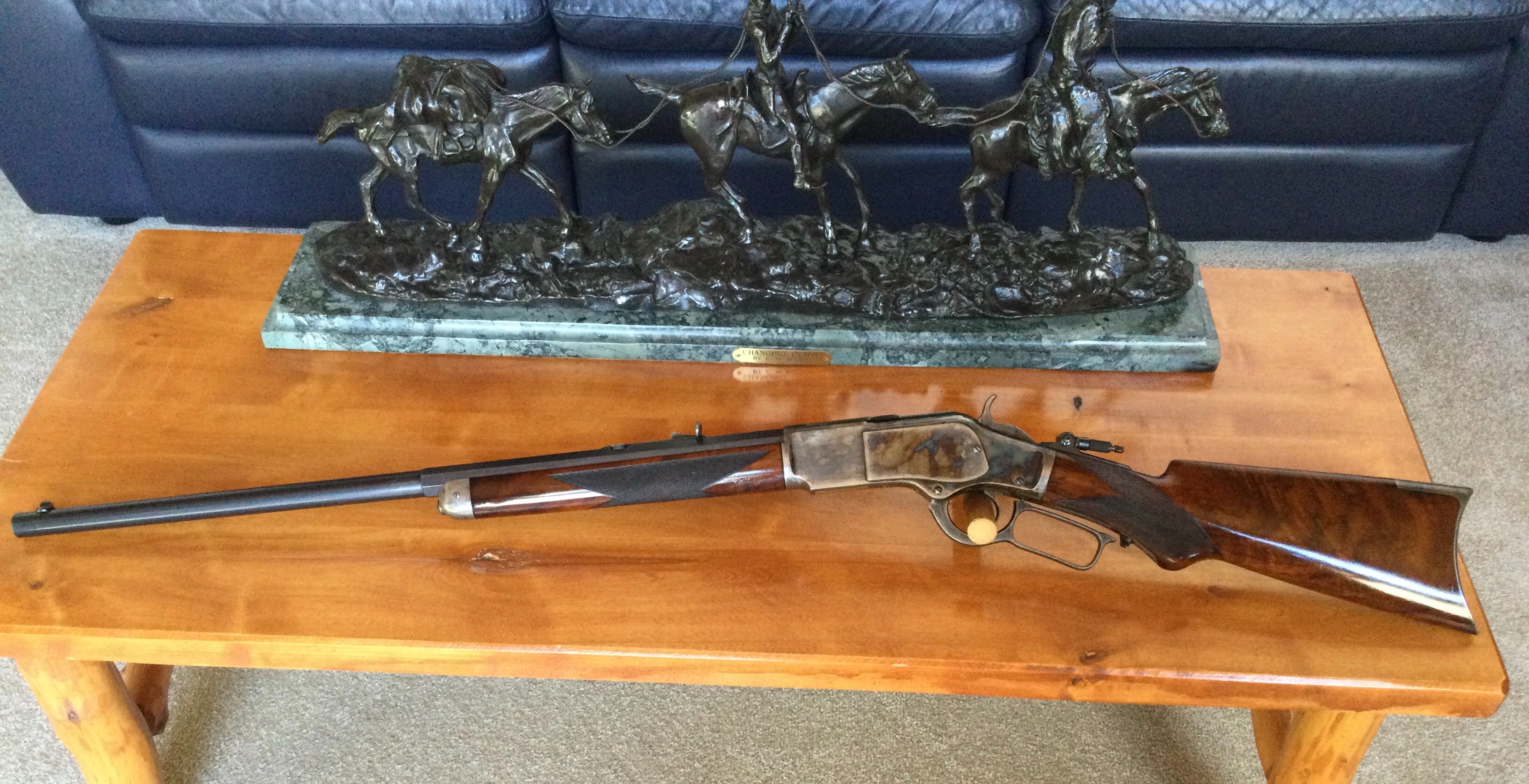
Pat – very nice pre-war Model 64 carbines – any collector of the Model 94 family would love to have them in their collection. What they lack in condition is more than made up in their rarity – they look right to me and we have not heard any negative comments yet. I have never even seen a Model 64 example in these calibers. I think they are going to sell for a lot of money. This is a nice one but in .32WCF

June 12, 2013
Offline
Burt Humphrey said
antler1 said
Steven Gabrielli said
Cal. 38-55. S#. 1107691. Bbl. 20″ round. Hooded ramp bead front with sporting rear sight. 2/3 length mag. Blue finish. Semi beavertail forend & pistol grip walnut stock with checkered steel buttplate. S#. indicates 1927 mfg. CONDITION: over 90% original blue shows spots flaking to brown. Very good original wood finish shows scattered light marks. Bright near excellent bore. (25-1385/DS). CURIO. $2,000-3,000.
Cal. 32-40. S# 1116955. Mfg. 1936, Bbl. 20″ hooded bead front sight on a short stippled ramp. Elevator adjustable sporting rear sight. Plain trigger. “L533” on the lower tang. Smooth pistol grip walnut stock set with “C203” found in the top tang channel and a checkered steel butt plate. CONDITION: overall good with lightly thinning bbl finish that remains with 80-85% coverage that has spotty freckled oxidation moderately covering the length of the bbl. Receiver has light carry wear with 90% of its original finish. Stock has scattered handling marks and dents with light scratches. Very nice bright bore with sharp rifling. (25-1389/ZAL). CURIO. $1,000-1,500.
My opinion if these rifles are original they are extremely undervalued. It appears most on auction I would be interested in are also undervalued. I suspect it is to create bidding actvity. I always wish they would provide more photos.
Pat – very nice pre-war Model 64 carbines – any collector of the Model 94 family would love to have them in their collection. What they lack in condition is more than made up in their rarity – they look right to me and we have not heard any negative comments yet. I have never even seen a Model 64 example in these calibers. I think they are going to sell for a lot of money. This is a nice one but in .32WCF
Yes they are very scarce in these rare calibers. I happen to know where a couple similar are living.


