

 Log In


November 21, 2021
 Offline

Curious as to what everyone who casts there bullets use for an alloy, lead tin mix etc, as well as if their using a gas check and what there velocity, or presumed velocity is.
November 7, 2015
Offline
I do cast for almost every centerfire Winchester I own, the alloy varies between wheelweight alloy to 20-1 lead/tin. I use gas checks for velocities over about 1400fps. I seldom measure velocity as I generally stay pretty low. Is there a specific cartridge you have in mind? I treat them all as individuals and let load performance determine the alloy and gas check usage.
Mike
April 26, 2019
Offline
I cast for the .25-20, .307 WCF, .348 WCF, .44-40 and .50 Sharps with 2-inch chamber.
For the .25-20, .44-40 and the Sharps, I use wheelweight metal and plain base bullets. My standard loads are 1,356 f.p.s. in the .25-50, 1,162 in the .44-40 and 1,177 in the Sharps. I use these loads for both hunting and practice.
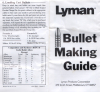
For a guide to bullet alloys, I use the Lyman brochure that came with a Lyman mould I bought years ago. I attached the guide for you to see. It cites wheelweight metal as 95.5% lead, 0.5% tin and 4% antimony.
The advantage of wheelweight metal is cost and availability. I have a tonne of the stuff. The problem is the antimony content, which makes the bullet brittle. Bullets from the 1800s had a lead-to-tin ratio of 20:1 or 16:1. Adding antimony does not make a better bullet.
The Lyman guide says wheelweights have a BHN of 9, which is hard. In my experience, bullets made from pure wheelweight won’t “bump-up” or mushroom at these velocities but because they don’t mushroom, penetration is good. The only .44-40 bullet that I recovered from a deer showed a deformed nose from hitting the spine but no expansion. The rest all passed through. I find accuracy at these velocities to be OK. In my rifles, wheelweight metal gives me five-shot, 3-inch groups at 100 yards, which for me is OK. Because they won’t “bump-up”, be sure to size your bullets one or two thousands over-size.
I hear accuracy for plain-base, wheelweight bullets drops off past 1,500 f.p.s. so I’ve never tried it. In the .307 and .348, I use a Lyman No. 2 alloy and gas check bullets. To make up a Lyman No. 2 mix, the Lyman guide suggests 9 lbs. wheelweights and 1 lb. of 50/50 bar solder. That’s what I use.
In the .307, my records show a 1½-inch group at 100 yards (velocity of 1,625 f.p.s.) and 2½ inches in the .348 (velocity, 1,717 f.p.s.). In my experience, you cannot take a Lyman No. 2, gas-checked bullet to 2,000 f.p.s. and expect any accuracy at all.
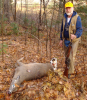
For hunting, I don’t recommend cast bullets in the .307 or .348. Lyman No. 2 alloy is even harder than wheelweights and the bullets won’t mushroom at all. I attached a pic of a doe shot with a Lyman No. 2, gas-checked bullet to show you what I mean. You’re looking at the exit wound. It left no blood trail at all.
But I don’t worry about hunting with a .44-40 bullet or a .50 Sharps that won’t mushroom. They already leave a big hole.
Mike is right. It depends on what your cartridge is and what your use is, as to what will work best for you. I would start with a good luck down your rifle’s bore. Cast bullets like a nice, shiny bore. If your bore is rough and bumpy, a jacketed bullet might be the answer.
I hope this helps,
Pete Hynard, Ontario, Canada


December 12, 2019
Offline
I cast for all my pistol calibers and several rifle-only calibers.
Years ago I bought a ton (literally) of wheel weights from a tire store. Over time, I cleaned all of that material up and retained it as one-pound ingots for casting. For 99% of my bullet casting for pistols, and anything under nominal 1200 fps, I use unchecked bullets and straight wheel weight material.
I toyed with gas checks for 357 mag and 44 mag, but decided at higher velocities, it was just easier and safer (less cleaning) to stick with jacketed bullets.
I eventually bought some straight tin and some linotype metal for blending for better results at higher velocities, and some pretty lame attempts at doing target shooting with cast rifle bullets.
Back to mostly just wheel weights in pistol calibers for plinking.
Nevada Paul
Life Member NRA
November 21, 2021
Offline
TXGunNut said
I do cast for almost every centerfire Winchester I own, the alloy varies between wheelweight alloy to 20-1 lead/tin. I use gas checks for velocities over about 1400fps. I seldom measure velocity as I generally stay pretty low. Is there a specific cartridge you have in mind? I treat them all as individuals and let load performance determine the alloy and gas check usage.
Mike
33 Win, I have a good amount of Hornady fp for it, but also have both an original Lyman and Rcbs Gas check bullet moulds for it. Now I have quite a bit of 16-1 lead tin and want to use them for practice/plinking. I figured at reduced loads and with the gas check that should be more then adequate, but im always up to hear others experience as well. A little knowledge never hurt anybody!
November 21, 2021
Offline
Pete Hynard said
I cast for the .25-20, .307 WCF, .348 WCF, .44-40 and .50 Sharps with 2-inch chamber.
For the .25-20, .44-40 and the Sharps, I use wheelweight metal and plain base bullets. My standard loads are 1,356 f.p.s. in the .25-50, 1,162 in the .44-40 and 1,177 in the Sharps. I use these loads for both hunting and practice.
For a guide to bullet alloys, I use the Lyman brochure that came with a Lyman mould I bought years ago. I attached the guide for you to see. It cites wheelweight metal as 95.5% lead, 0.5% tin and 4% antimony.
The advantage of wheelweight metal is cost and availability. I have a tonne of the stuff. The problem is the antimony content, which makes the bullet brittle. Bullets from the 1800s had a lead-to-tin ratio of 20:1 or 16:1. Adding antimony does not make a better bullet.
The Lyman guide says wheelweights have a BHN of 9, which is hard. In my experience, bullets made from pure wheelweight won’t “bump-up” or mushroom at these velocities but because they don’t mushroom, penetration is good. The only .44-40 bullet that I recovered from a deer showed a deformed nose from hitting the spine but no expansion. The rest all passed through. I find accuracy at these velocities to be OK. In my rifles, wheelweight metal gives me five-shot, 3-inch groups at 100 yards, which for me is OK. Because they won’t “bump-up”, be sure to size your bullets one or two thousands over-size.
I hear accuracy for plain-base, wheelweight bullets drops off past 1,500 f.p.s. so I’ve never tried it. In the .307 and .348, I use a Lyman No. 2 alloy and gas check bullets. To make up a Lyman No. 2 mix, the Lyman guide suggests 9 lbs. wheelweights and 1 lb. of 50/50 bar solder. That’s what I use.
In the .307, my records show a 1½-inch group at 100 yards (velocity of 1,625 f.p.s.) and 2½ inches in the .348 (velocity, 1,717 f.p.s.). In my experience, you cannot take a Lyman No. 2, gas-checked bullet to 2,000 f.p.s. and expect any accuracy at all.
For hunting, I don’t recommend cast bullets in the .307 or .348. Lyman No. 2 alloy is even harder than wheelweights and the bullets won’t mushroom at all. I attached a pic of a doe shot with a Lyman No. 2, gas-checked bullet to show you what I mean. You’re looking at the exit wound. It left no blood trail at all.
But I don’t worry about hunting with a .44-40 bullet or a .50 Sharps that won’t mushroom. They already leave a big hole.
Mike is right. It depends on what your cartridge is and what your use is, as to what will work best for you. I would start with a good luck down your rifle’s bore. Cast bullets like a nice, shiny bore. If your bore is rough and bumpy, a jacketed bullet might be the answer.
I hope this helps,
Pete Hynard, Ontario, Canada
Thank you! That little pamphlet is quite interesting, definitly has some useful information. I see your in Ontario, I suppose that makes neighbours!
November 7, 2015
Offline
33 Win, I have a good amount of Hornady fp for it, but also have both an original Lyman and Rcbs Gas check bullet moulds for it. Now I have quite a bit of 16-1 lead tin and want to use them for practice/plinking. I figured at reduced loads and with the gas check that should be more then adequate, but im always up to hear others experience as well. A little knowledge never hurt anybody!
-Morgan Arnold
I’m sorry, I have no experience with that cartridge but perhaps will someday. Meanwhile I’m listening very carefully to what Tim Tomlinson and Bert Hartman say about the round. In too many cases a little knowledge is a dangerous thing!
Mike


1 Guest(s)
