

 Log In


September 13, 2025
 Offline

I will be in the process of removing the old lacquer/varnish, whatever is on it, on a 1905 1894 SCR stock and returning it to an oil finish. I have noticed gumwood stocks that have been stripped are not the same color as when they left the factory. So I am sure some type of stain was used to get it to the Winchester color. Does anybody have a recommendation on what color stain I should use to get it “close” to the original color? And any other tip to help me through this process. And no, I am not going to sand it after removing the finish. I am leaving the character right where it is. The people who put the surface finish on it did not take any time to sand or fuss with the wood. They just grabbed a paintbrush and slapped it on, and it looks exactly as it sounds.

April 15, 2005
 Online

fzando said
I will be in the process of removing the old lacquer/varnish, whatever is on it, on a 1905 1894 SCR stock and returning it to an oil finish. I have noticed gumwood stocks that have been stripped are not the same color as when they left the factory. So I am sure some type of stain was used to get it to the Winchester color. Does anybody have a recommendation on what color stain I should use to get it “close” to the original color? And any other tip to help me through this process. And no, I am not going to sand it after removing the finish. I am leaving the character right where it is. The people who put the surface finish on it did not take any time to sand or fuss with the wood. They just grabbed a paintbrush and slapped it on, and it looks exactly as it sounds.
I am not of the opinion that there is No “one size fits all” color for the gumwood stocks. Based on my observations, the color variations found on the gumwood stock guns varied from relatively light red/brown to dark brown. In your shoes, I would look for a “walnut” stain.
Are you sure that your SRC is a 1905 production gun? The reason I ask, is that Winchester used Walnut up through 1905, and then switched to Gumwood in early 1906. What is the serial number on your SRC?
Bert
WACA Historian & Board of Director Member #6571L
June 15, 2024
Offline
I just finished redoing a gumwood stock and forearm. I used Liberon BLO250 Boiled Linseed Oil. Here’s what mine came out looking like:



The first coat was 50/50 BLO/Mineral Spirits, followed by 5 coats of 100% BLO. These pics are before hand burnishing and waxing to finish.
September 13, 2025
Offline
Burt,
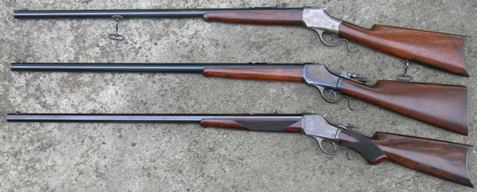
According to the date of manufacture database, 275121 was manufactured in 1905, just verified. Based on some of your comments on other posts, I know you said Gumwood was after this date. I am not really sure what this wood is, but looking at the lack of grain in the wood and the white streaks in it, it appears to be gum to me. When I strip off the surface material, I will then know for sure and post the results if you are keeping a database on the type of wood on this model. I want to go with a more reddish color than dark walnut. But if that does not cover the whiteness, I might go darker. The middle gun on your signature block is what I am aiming for.
The white streaks on the right side of your project are what I would like to cover with a stain before putting on the oil. I have used BLO for many years and understand the application process. This gumwood, if that is what it ends up being, is different from the walnut stocks I have done in the past.
Thanks for your comments
Frank

April 30, 2023
Offline
I would like to see the pics either way if you don’t mind posting…
April 15, 2005
Online
fzando said
Burt,
According to the date of manufacture database, 275121 was manufactured in 1905, just verified. Based on some of your comments on other posts, I know you said Gumwood was after this date. I am not really sure what this wood is, but looking at the lack of grain in the wood and the white streaks in it, it appears to be gum to me. When I strip off the surface material, I will then know for sure and post the results if you are keeping a database on the type of wood on this model. I want to go with a more reddish color than dark walnut. But if that does not cover the whiteness, I might go darker. The middle gun on your signature block is what I am aiming for.
Alaska94
The white streaks on the right side of your project are what I would like to cover with a stain before putting on the oil. I have used BLO for many years and understand the application process. This gumwood, if that is what it ends up being, is different from the walnut stocks I have done in the past.
Thanks for your comments
Frank
275121 identifies your Model 1894 as a mid August 1905 production receiver frame. If the receiver frame was not immediately used to assemble a complete SRC, it is very likely that it has Gumwood stocks. The probability that it was not immediately used to assemble your SRC is actually quite high.
What many collectors may not be aware of, is the fact that the production of the Model 1894 SRCs was considerably slower (less) than the Rifle variant through the year 1913. Per the survey of the Model 1894 records conducted by the CFM that encompassed serial numbers 1 – 353999 (documented in the ARMAX Vol 5), 78.2% of the Model 1894 production consisted of the Rifle variant, with just 21.2% of the production being SRCs.

My research survey of the Model 1894 beginning at serial number 354000 (picking up where the available records end) has determined that the Rifle vs. Carbine production ratio remained strongly in favor of the Rifle variant. Currently I have documented 3,961 Model 1894s that are in the 354000 – 645304 serial range (May 1907 through December 1913), and the production ratio to this point is 2,646:1,315 (66.8% rifles vs. 33.2% carbines). 1914 was the first year that saw a greater number of Carbines produced than Rifles, and the primary reason for that shift in production was the 15,100 Carbines that were manufactured to fill the French WW I contract.
While Winchester had used Gumwood beginning with the Model 1900 (bolt-action single .22 rim fire), they did not begin using it as a standard item for the more expensive Model 1892 and Model 1894 Carbines until late 1905 or early 1906. I have not (yet) been able to pin down a specific date for that change.
Bert
WACA Historian & Board of Director Member #6571L

March 31, 2009
Offline
fzando said
I will be in the process of removing the old lacquer/varnish, whatever is on it, on a 1905 1894 SCR stock and returning it to an oil finish. I have noticed gumwood stocks that have been stripped are not the same color as when they left the factory. So I am sure some type of stain was used to get it to the Winchester color. Does anybody have a recommendation on what color stain I should use to get it “close” to the original color? And any other tip to help me through this process. And no, I am not going to sand it after removing the finish. I am leaving the character right where it is. The people who put the surface finish on it did not take any time to sand or fuss with the wood. They just grabbed a paintbrush and slapped it on, and it looks exactly as it sounds.
Once the finish is removed you have to experiment with different stains. Start with the lighter walnuts or similar. A darker or black can be used sparingly just to cover the white areas. This type of wood usually gets darker than walnut when stained.
September 13, 2025
Offline
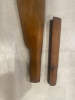
I have removed the old lacquer finish, and what I am looking at is not gumwood, as I assumed it would be, but a rather unremarkable piece of walnut. If anybody thinks otherwise, please let me know.
The question concerning the actual date of assembly due to slow-moving demand is interesting. I don’t believe this happened to this gun, as the barrel date is a “3”.
Based on these two observations, I conclude this is a walnut-stocked 1905 SRC manufactured in August 1905. Correct me if my assumption needs correcting. 
April 15, 2005
Online
fzando said
I have removed the old lacquer finish, and what I am looking at is not gumwood, as I assumed it would be, but a rather unremarkable piece of walnut. If anybody thinks otherwise, please let me know.
The question concerning the actual date of assembly due to slow-moving demand is interesting. I don’t believe this happened to this gun, as the barrel date is a “3”.
Based on these two observations, I conclude this is a walnut-stocked 1905 SRC manufactured in August 1905. Correct me if my assumption needs correcting.
The “3” is not a date stamp. It is a standard marking applied during the process of manufacturing and inspecting the barrel. Winchester did not begin date stamping their barrels until the year 1920.
The pictures you provided of the stripped stock are not clear enough (closeup) to determine which type of wood they are. A picture of the end grain on the butt stock would help.
Bert
WACA Historian & Board of Director Member #6571L
March 31, 2009
Offline
At this point I’d very lightly sand the wood with 400 grit or finer. Use a backer block while sanding so it all stays straight. Don’t sand enough to get rid of the dents. If you wish you can experiment with stains. Just do a very small spot and use the lightest stain first. Then use boiled linseed oil until the wood stops soaking it in. Let it dry between coats and use a rag to remove the excess. Keep rubbing until it does not feel gummy. You can then hand polish if you want more of a sheen.

March 20, 2010
Offline
fzando said
I have removed the old lacquer finish, and what I am looking at is not gumwood, as I assumed it would be, but a rather unremarkable piece of walnut. If anybody thinks otherwise, please let me know.
The question concerning the actual date of assembly due to slow-moving demand is interesting. I don’t believe this happened to this gun, as the barrel date is a “3”.
Based on these two observations, I conclude this is a walnut-stocked 1905 SRC manufactured in August 1905. Correct me if my assumption needs correcting.
They look like gumwood to me

1892takedown @sbcglobal.net ......NRA Endowment Life Member.....WACA Member
"God is great.....beer is good.....and people are crazy"... Billy Currington


1 Guest(s)
